Have you ever had a thought so big it felt like it was trying to burst out of your head?
In the world of Ancient Greece, this experience was personified by Athena, the goddess of Wisdom and strategy. She wasn't just a character in a story, she was a way for people to understand the power of the human mind and the importance of Civilization.
Imagine standing on a dusty, sun-drenched hill in the year 440 BCE. Below you, the city of Athens hums with the sound of merchants, poets, and stonecutters. High above, the white marble of the Parthenon gleams against a sky so blue it looks painted.
This temple was built for Athena, the city’s protector. To the Greeks, she was the breath of fresh air that brings a sudden solution to a messy problem. She wasn't a goddess of nature like the sun or the sea: she was a goddess of what humans do with their brains.
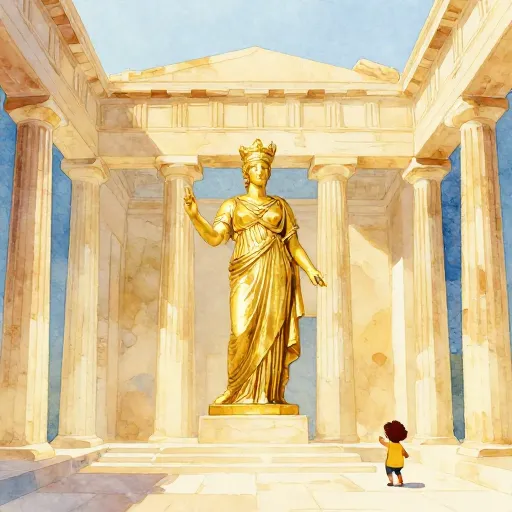
Imagine the Parthenon in its prime. It wasn't white marble back then: it was painted in bright reds, blues, and golds. Inside stood a statue of Athena forty feet tall, covered in real gold and ivory, holding a six-foot statue of Victory in her palm.
Athena’s story begins with the most famous headache in history. Her father, Zeus, the king of the gods, had a terrible pain behind his eyes. He asked the blacksmith god, Hephaestus, to hit him over the head with an axe to let the pressure out.
Suddenly, out leaped Athena, fully grown and dressed in shining armor. She didn't come from a womb, but from the seat of thought itself. This told the Greeks something very important: wisdom is a powerful force that can change the world in an instant.

Finn says:
"If Athena was born from a headache, does that mean every time I have a great idea, a tiny goddess is trying to escape my brain?"
Athena represents a special kind of intelligence the Greeks called Metis. This isn't just knowing facts or getting high marks on a test. It is practical wisdom: the ability to look at a tangled knot and see exactly which string to pull to make it come undone.
Think about the last time you were stuck on a level in a video game or trying to fix a broken toy. That moment when you stop being frustrated and start being curious is where Athena lives. It is the bridge between a problem and a solution.
It is not the strength of the body that counts, but the strength of the spirit.
Unlike her brother Ares, who was the god of messy, angry war, Athena was the goddess of Tactics. She believed that a battle is won with a plan, not just with muscles. She preferred to talk things through or outsmart her opponents rather than just charging in.
This is why she is often shown with an owl. Owls can see in the dark, which is a metaphor for being able to see the truth when everyone else is confused. While others are stumbling in the shadows of anger or fear, Athena is watching quietly.
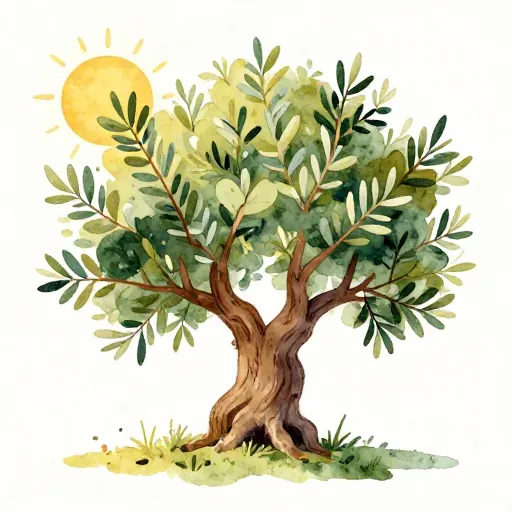
The olive tree Athena gave to Athens was considered so sacred that for hundreds of years, anyone caught cutting one down could be punished very severely. The Greeks saw these trees as a living connection to the goddess herself.
Athena wasn't just about shields and spears, though. She was also the patron of weaving and pottery. This might seem like a strange mix, but to the Greeks, weaving a beautiful cloth required the same focus and planning as winning a battle.
When you weave, you take many separate threads and pull them together to create something strong and whole. This is exactly what a good leader does with a city. They take different people with different ideas and help them work together as a Polis, or a community.

Mira says:
"I like that she’s the goddess of weaving. It’s like how the internet is a 'web' of ideas all tangled together. She’d probably be great at coding!"
There is a famous story about how Athena became the protector of Athens. She had a competition with her uncle Poseidon, the god of the sea. They both wanted to be the Patron of the most beautiful new city in Greece.
Poseidon struck the ground with his trident, and a spring of water bubbled up. The people were excited until they tasted it: it was salt water, which you can't drink. Then, Athena stepped forward and quietly planted a single seed in the earth.
Wisdom is something you are born with. It is like Athena jumping out of Zeus’s head: a natural talent for seeing the truth and making quick decisions.
Wisdom is something you build, like a piece of cloth on a loom. It takes practice, many mistakes, and a long time to learn how to weave your experiences together.
Out of the ground grew the first olive tree. It provided wood for fires, oil for lamps, and delicious food to eat. It was a gift that kept on giving for generations. The people chose Athena because she thought about what they actually needed to survive and thrive.
This story reminds us that the best ideas are often the most useful ones. Wisdom isn't just about being smart in your own head. It is about how you use your mind to help the people around you and make the world a little bit better.

She was the embodiment of practical reason, the goddess of the city, of civilized life, of handicrafts and agriculture.
In the great epic stories of the Greeks, Athena is often a mentor. She doesn't usually do the work for the heroes: instead, she gives them the courage or the idea they need to do it themselves. She helped Perseus use a mirror to defeat Medusa and guided Odysseus on his long journey home.
She often traveled in disguise, appearing as an old friend or a wise traveler. This suggests that wisdom doesn't always come with a fanfare or a lightning bolt. Sometimes, the best advice comes from a quiet voice inside you or a conversation with a friend.
Next time you have a big decision to make, try the 'Athena Method.' Instead of acting right away, pause and imagine you are an owl sitting on a high branch. What do you see from up there that you can't see from down here? Does the problem look different when you look at it from a distance?
Athena also wore a special breastplate called the Aegis. It was decorated with the face of a Gorgon and was said to be so frightening that it would make enemies freeze in their tracks. But for her friends, the Aegis was a symbol of protection and safety.
It represents the idea that knowledge can be a shield. When you understand how the world works, you aren't as afraid of it. Knowing the truth protects you from being fooled or bullied by those who want to hide the facts.
Finn says:
"I wonder if she ever got tired of being the smart one. Sometimes it's nice to just be silly and not have a master plan for everything, right?"
Even after the Greek empire faded, the idea of Athena lived on. The Romans adopted her and called her Minerva. They focused even more on her connection to schools, medicine, and the arts. She became the face of Philosophy, which literally means the love of wisdom.
Athena Through the Ages
Today, you can find Athena everywhere if you look closely. Her owl is on the back of the Greek 1-Euro coin. Libraries and universities often have statues of her near their doors. Even NASA has used her name for projects involving advanced technology and space exploration.
She reminds us that being human means more than just surviving. It means creating art, building cities, and asking big questions. Every time you use your imagination to solve a puzzle, you are following in the footsteps of the goddess with the grey eyes.

Wisdom begins in wonder.
We might not believe in gods living on a mountain anymore, but we still value the things Athena stood for. We still need people who can plan ahead, who can stay calm in a crisis, and who choose the olive branch of peace over the spear of war.
Wisdom is a journey that never really ends. It isn't a destination where you suddenly know everything. It is a way of walking through the world with your eyes wide open, ready for the next big idea to strike.
Athena’s favorite bird, the Little Owl, actually lived in the rocks of the Acropolis in Athens. Because they were everywhere, people started to associate them with the city and its goddess, eventually putting them on their money!
Something to Think About
If you could invent a new 'Olive Tree' for the world today - something simple that helps everyone live better - what would it be?
Athena's gift was about solving a real human problem with a simple idea. There are no right or wrong answers here, just think about what the world needs most right now.
Questions About Religion
Why is Athena always wearing a helmet?
Did Athena have any children?
Is Athena stronger than Ares?
The Owl is Still Watching
The world of the Greek gods might feel like a distant memory, but the ideas Athena stood for are still at work. Whenever you choose to think before you act, or whenever you create something beautiful from scratch, you are using the 'Metis' that the ancients valued so highly. Wisdom isn't a superpower reserved for gods: it's a tool that belongs to anyone who is willing to look a little closer and wonder a little more.