If you had to travel through a land of monsters and magic to reach paradise, what would you bring with you?
For thousands of years, people in Ancient Egypt answered this question by creating a Papyrus scroll filled with secret passwords and protective charms. They called it the Book of Coming Forth by Day, a collection of magical instructions designed to help the soul navigate the afterlife.
Imagine you are standing on the banks of the Nile River three thousand years ago. The air is warm and smells like damp earth and papyrus reeds. To the people living here, the world was divided into two parts: the land of the living and the mysterious realm of the dead.
They didn't see death as a dark or scary wall, but rather as a difficult journey. Just like you might use a map and a guidebook to explore a deep, tangled forest, the Egyptians believed the soul needed a manual to find its way.
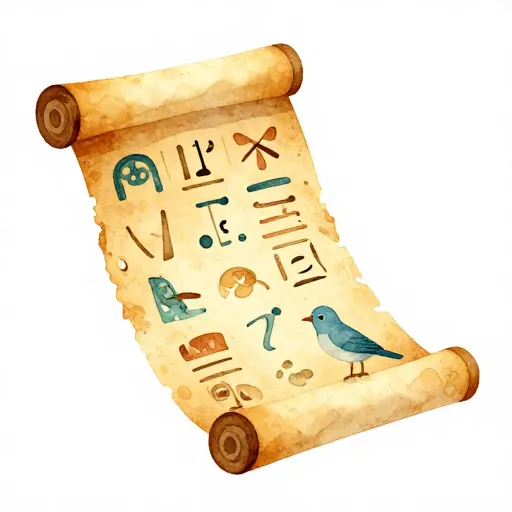
The 'Book of the Dead' isn't actually a book! It's a collection of separate spells that were written on papyrus scrolls or even painted on coffin lids. Archaeologists gave it that name in the 1800s, but the Egyptians called it the 'Spells for Coming Forth by Day.'
The Workshop of the Scribes
A Scribe was a person who spent years learning the art of writing. In a quiet, sun-drenched room called a House of Life, these artists would sit on the floor with their legs crossed. They used thin reed brushes and ink made from soot and minerals to draw beautiful pictures and Hieroglyphs.
Not every Book of the Dead was the same because they were personalized for the person who bought them. A wealthy person might have a scroll over seventy feet long, filled with colorful paintings of gods and goddesses. Someone with less money might only be able to afford a short scroll with a few essential spells.

Mira says:
"It’s like the Egyptians were creating the world’s first 'How-To' guide for the soul. They didn't want to leave anything to chance!"
These scrolls were expensive, so people often saved their money for years to buy one. They believed that having these words written down gave them power over the obstacles they would face. It was their insurance policy for the soul, ensuring they would never be lost in the dark.
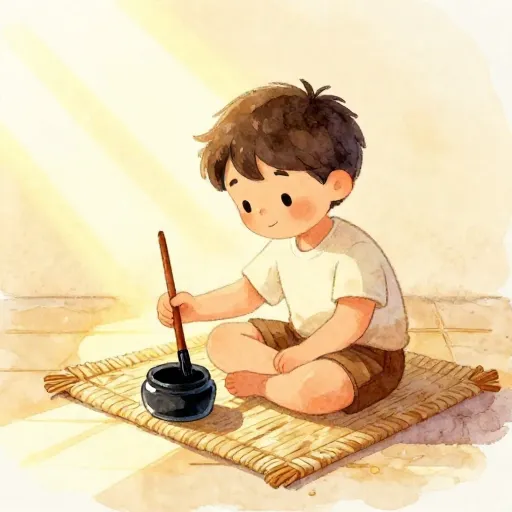
Imagine you are a scribe in a dusty workshop. You are carefully painting a scene of a woman standing before a giant green-skinned god. You have to be very careful: if you miss a single word of a spell, it might not work, and the soul you are trying to help might get stuck at the first gate!
The Anatomy of a Soul
To understand why the book was so important, we have to look at how the Egyptians thought about the human person. They didn't think you were just one thing. Instead, they believed a human was made of several different parts that had to stay connected even after the body stopped working.
One part was the Ka, which was like your life force or your "twin." It needed food and water to stay strong. Another part was the Ba, which was your personality: the things that make you "you." The Ba was often drawn as a bird with a human head so it could fly between the world of the living and the world of the spirits.
O you who bring spirits, you who count the stars... let the soul of the deceased come forth before you.
If the soul didn't have the right spells, these parts might get separated or forgotten. The Book of the Dead acted like a glue that kept the Ka and the Ba together. It helped the person transform into an Akh, a shining spirit that could live forever among the stars.
The Dangerous Path of the Duat
Once a person passed away, their journey began in a place called the Duat. This was a landscape of deep valleys, rivers of fire, and heavy gates guarded by strange creatures. Imagine a world where the sun travels at night, fighting off a giant chaos-serpent named Apep.
The Egyptians used 'protection spells' for everyday things. Try writing your own 'Spell for a Good Day.' What three things would you want to happen? Maybe a spell for 'Finding a Great Book' or 'The Power of the Perfect Snack.' Write it down and keep it in your pocket!
The Book of the Dead provided the secret names of the monsters and the passwords for the gates. If a spirit came to a gate guarded by a creature with the head of a crocodile and the body of a lion, they wouldn't panic. They would simply unroll their scroll, find the right chapter, and speak the magic words.
Many of these spells were about transformation. One spell allowed the soul to turn into a golden hawk, while another helped them turn into a lotus flower. These weren't just for fun: they were tools to help the soul escape traps or fly over obstacles that a human shape couldn't handle.

Finn says:
"If I could turn into any animal to get past a monster, I think I'd choose a falcon. Being able to fly away from a lake of fire seems like a pretty good plan."
The Hall of Two Truths
The most important part of the journey happened in a grand courtroom called the Hall of Two Truths. Here, the person had to stand before forty-two different judges and the king of the afterlife, Osiris. This wasn't a test of how much money you had, but a test of how you had lived your life.
Some Egyptians believed that only by being a truly perfect person could you pass the test of the scales. They focused on the 42 'Negative Confessions' where you had to promise you never stole or lied.
Others believed that the magic spells were a way to get help. They used 'heart scarabs' to keep their hearts quiet, hoping the magic would protect them even if they weren't always perfect.
In the center of the room stood a giant scale. The god Anubis, who had the head of a jackal, would take the person’s heart and place it on one side of the scale. On the other side, he placed the Feather of Truth, which belonged to the goddess Ma'at.
The Book of the Dead was intended to give the deceased the power to go wherever he pleased and to perform every act which he had been accustomed to perform upon earth.
If the heart was heavy with bad deeds and lies, it would weigh more than the feather. But if the person had lived a kind, honest life, the heart and the feather would be perfectly balanced. This moment was the ultimate "Big Idea" of Ancient Egypt: the belief that goodness is the only thing you can truly take with you.
Ammut: The Devourer
Waiting by the scales was a creature that looked like a terrifying patchwork quilt of animals. Her name was Ammut, and she had the head of a crocodile, the front of a lion, and the back of a hippopotamus. She wasn't a god to be worshipped, but a consequence to be avoided.
If a person’s heart failed the test, Ammut would eat it, and the soul would cease to exist forever. This was the greatest fear of any Egyptian. However, the Book of the Dead even had a spell for this: Spell 30B was carved onto a stone heart scarab and placed over the person's chest to stop their heart from "testifying" against them.
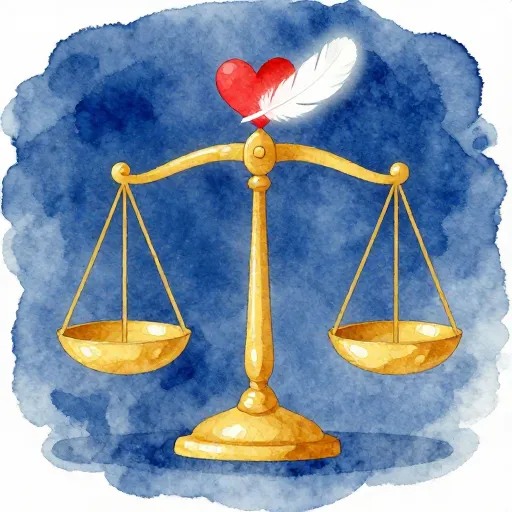
Look closely at the scales of Ma'at. On one side is a human heart, and on the other is a single, fluffy ostrich feather. It’s a quiet, heavy moment. The whole universe is waiting to see if they balance. There is no shouting or arguing: just the simple truth of the scale.
This shows us a fascinating tension in their culture. They valued being good, but they also understood that being human is complicated. Sometimes we make mistakes, and they hoped that a little bit of magic might help balance the scales when they needed it most.
Mira says:
"The 'Negative Confession' is so interesting. Instead of saying 'I am good,' they had to prove they hadn't done specific bad things, like stealing someone's water or being grumpy for no reason."
The Field of Reeds
For those whose hearts were light as a feather, the reward was a place called the Field of Reeds. To us, it might sound a bit strange because it looked exactly like Egypt! It was a land of endless sunshine, flowing rivers, and tall green crops that never failed.
In the Field of Reeds, you would meet your parents and grandparents again. You would sit under trees and play board games like Senet. The Egyptians didn't want a paradise that was totally different from their world; they wanted a version of their home where nothing ever went wrong and no one was ever hungry.
Through the Ages
Through the Ages
The way people thought about these spells changed as the centuries passed. At first, only Kings were allowed to have magic words carved into their tomb walls. Later, nobles began painting them on their coffins. Finally, the Book of the Dead made these secrets available to anyone who could afford a scroll.
This "democratization" of the afterlife meant that everyone, from farmers to bakers to scribes, felt they had a chance at eternity. It turned the afterlife from an exclusive club into a journey that every human being was invited to take.

The Egyptians were a people who loved life so much that they wanted it to last forever.
Today, we find these scrolls in museums all over the world. When we look at the careful drawings and the rhythmic spells, we aren't just looking at ancient history. We are looking at a very human desire: the hope that even when we face the unknown, we can find a way to be brave, to be good, and to find our way home.
Something to Think About
If you had to choose one memory to be as light as a feather, which one would it be?
There are no right or wrong answers here. Think about a moment when you felt truly kind, brave, or happy. Why does that memory feel 'light' to you?
Questions About Religion
Was the Book of the Dead actually scary?
Did every Egyptian have one?
Can we still read the spells today?
The Journey Continues
The Book of the Dead reminds us that human beings have always wondered about what happens next. Whether we see it as a map, a collection of poems, or a guide to being a better person, it shows how much we value the stories we tell ourselves about the mystery of life. Next time you see a feather or a drawing of a jackal, remember the scribes who sat in the sun, writing down the secrets of the stars.