Have you ever wondered why even the people who have everything they want still feel like something is missing?
Over 2,500 years ago, a prince named Siddhartha Gautama set out to answer that exact question. His journey led him to a state of deep understanding called enlightenment, changing how millions of people think about the mind and the heart.
Imagine a world where everything you could ever want is given to you before you even ask. In the foothills of the Himalayas, in a place called Lumbini, a young prince lived exactly this way. His father, the King, wanted to protect him from every possible sadness, so he built high walls around the palace to keep the outside world away.
Inside those walls, it was always summer. There were musicians, gardens filled with peacocks, and soft silks to wear. The Prince grew up never knowing that people got sick, grew old, or died. He lived in a beautiful, gilded bubble.

Finn says:
"If the Prince had everything he wanted, why was he still unhappy? Does getting every toy you want actually make the 'wanting' feeling go away?"
The Four Sights
Even in a perfect palace, curiosity is hard to keep in a cage. One day, Siddhartha asked his chariot driver to take him outside the gates to see how the rest of the world lived. What he saw changed him forever: he saw an old man, a sick man, and a funeral procession.
For the first time, he realized that suffering was a part of life for everyone, no matter how rich they were. He also saw a peaceful monk who seemed to have no belongings but looked completely at rest. Siddhartha realized that his palace was a distraction from the truth of the world.
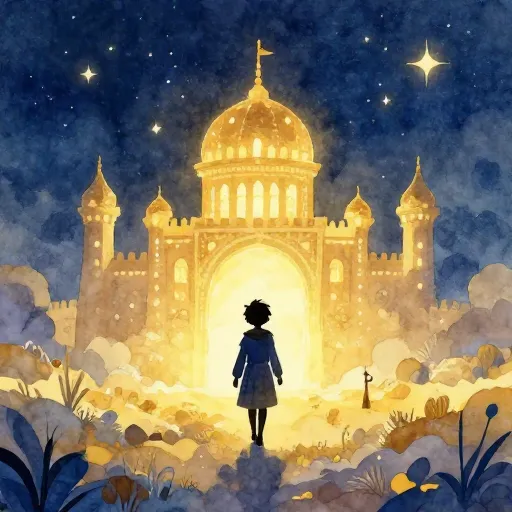
Imagine leaving a palace where the floors are made of polished marble and the air smells like jasmine. You step out onto a dusty road where the sun is hot and you have no idea where your next meal is coming from. That is the choice Siddhartha made: trading a perfect dream for a difficult reality.
He began to wonder if there was a way to find a peace that didn't depend on living in a palace. He started to feel that his luxuries were like golden chains: they were pretty, but they still kept him from being free. He decided he had to leave his family and his wealth behind to find the secret to ending sadness.

Peace comes from within. Do not seek it without.
Searching in the Shadows
Siddhartha spent the next six years wandering through the forests of India. He met famous teachers and learned how to meditate, but he still didn't feel he had the answer. He tried being incredibly strict with himself, eating almost nothing and sitting in the sun for days.
He thought that by hurting his body, he would make his mind stronger. Eventually, he became so thin and weak that he couldn't even stand up. A young village girl saw him and offered him a bowl of rice milk, which he accepted. This simple act of kindness saved his life.
Living with every luxury imaginable, having servants, and never seeing anything sad or difficult.
Living with absolutely nothing, sleeping on the ground, and trying to ignore your body's need for food.
At that moment, Siddhartha realized that neither extreme worked. Being too rich and spoiled had not made him happy, but being too strict and starving himself hadn't worked either. He needed a path that was right in the middle.
He called this the Middle Way. It is the idea that we find balance by not being too greedy for things, but also not being too harsh on ourselves. It is like tuning a guitar string: if it is too tight, it snaps; if it is too loose, it won't play a note.

Mira says:
"It is like when I'm trying to balance on a beam. If I lean too far left or too far right, I fall. The Middle Way sounds like finding the perfect center where you can finally stand still."
The Great Awakening
Siddhartha traveled to a place called Bodh Gaya and sat down under a massive fig tree, now known as the Bodhi tree. He vowed that he would not get up until he understood why people suffer and how they can be free. He sat in deep meditation, watching his thoughts pass by like clouds in the sky.
As he sat, he faced many distractions: fears, desires, and doubts. Instead of fighting them, he simply noticed them and let them go. Finally, as the morning star rose in the sky, he felt a profound shift. He understood that everything in the world is connected and that nothing stays the same forever.
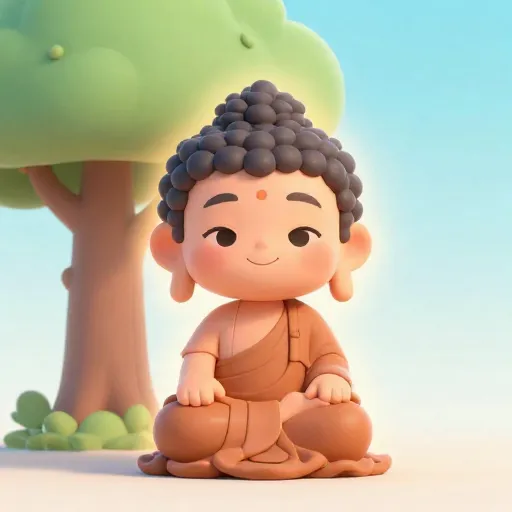
A jug fills drop by drop.
He had reached a state called Nirvana, a word that means "to blow out" like a candle flame. He hadn't disappeared, but the fires of his anger, greed, and confusion had been blown out. From that moment on, he was known as the Buddha, which means "The Awakened One."
He realized that most of our unhappiness comes from wanting things to be different than they are. We want the sun to stay up when it’s time for bed, or we want our favorite toy to never break. By accepting that things change, which is called impermanence, we can stay peaceful even when life gets messy.

The word 'Buddha' isn't a name, it is a title! It comes from the Sanskrit word 'budh,' which means to wake up. It is like saying someone is 'The Wide-Awake One' while everyone else is still dreaming.
Sharing the Light
The Buddha spent the next 45 years walking from village to village. He didn't want people to worship him like a god; he wanted them to be their own teachers. He taught that everyone has a "Buddha nature" inside them, which is a seed of wisdom and compassion.
He taught his followers to live by the Dharma, a word for the natural laws of how the world works. He also formed a community called the sangha, where people could practice being kind and mindful together. He spoke to kings and beggars, treating them both with the same quiet respect.

Believe nothing, no matter where you read it, or who said it... unless it agrees with your own reason and your own common sense.
One of the most important things he taught was that we should never just believe something because a famous person said it. He encouraged people to test his ideas in their own lives, like a goldsmith tests gold by rubbing it on a stone. This made his ideas feel very different from many other religions of the time.
Through the Ages
The Idea that Traveled
After the Buddha died at the age of 80, his ideas didn't stay in one place. They traveled over high mountains and across deep oceans. In different countries, the way people practiced his teachings changed: in Japan, it became Zen; in Tibet, it involved colorful art and chanting.
Today, many people who aren't even religious use the Buddha's techniques. Scientists study how his methods of sitting quietly can actually change the way our brains work. They find that it helps people feel less stressed and more focused on the present moment.
Finn says:
"So being a 'Buddha' isn't a special job, it's more like a way of being really, really present? I wonder if I was a little bit 'awake' this morning when I just watched the birds instead of rushing to breakfast."
Learning to be "awake" is a bit like learning to see the world for the first time. It means noticing the taste of your food, the feeling of the wind on your face, and the way your heart feels when you are kind to someone. It is a journey that starts with a single, quiet breath.
Sit quietly for one minute. Try to count ten breaths without thinking about anything else. If a thought about lunch or a game pops in, just notice it, say 'hello' to it, and go back to counting. It is harder than it sounds, isn't it?
Even though the Buddha lived a very long time ago, his questions are still our questions. We all want to know how to be happy when things go wrong. Perhaps the answer isn't in a palace or in a book, but in the quiet space we find when we simply stop and look around.
Something to Think About
If you were a prince or princess in a perfect palace, would you stay there, or would you want to see the real world, even if it was sad sometimes?
There isn't a right answer to this: some people believe we can do more good by having power, while others believe we can only understand the truth by being among people.
Questions About Religion
Is the Buddha a god?
Why are there so many different looking statues of Buddha?
Do you have to be Buddhist to meditate?
A Journey of a Thousand Miles
The story of the Buddha isn't just a history lesson; it is an invitation to look at your own life with fresh eyes. Whether you are in a quiet room or a busy playground, the 'Middle Way' is always there, waiting for you to find your balance. Keep asking questions, keep being curious about your own mind, and remember: even a jug fills drop by drop.
