Have you ever wondered what happens if you just... stop?
Around 2,500 years ago, a prince named Siddhartha Gautama decided to find out. His discovery led to the creation of mindfulness, a way of training the mind that has traveled from the snowy peaks of the Himalayas to modern classrooms all over the world.
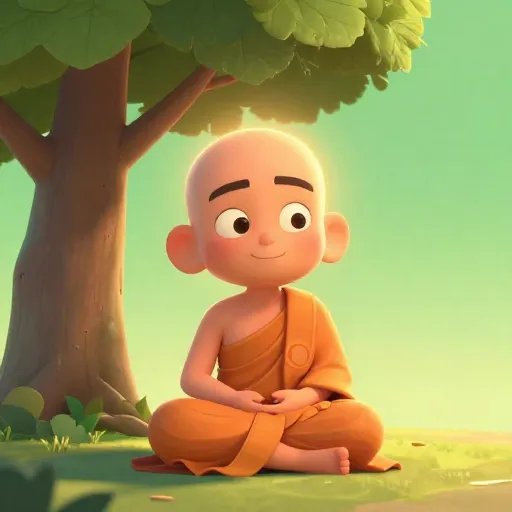
The air was thick with the scent of wild jasmine and damp earth. Under a massive fig tree with heart-shaped leaves, a man sat perfectly still. He was not sleeping, and he was not waiting for someone: he was simply watching his own mind.
This moment, occurring in ancient India, is where the story of Buddhist meditation begins. It was a radical experiment in silence that would eventually influence millions of people across every continent on Earth.
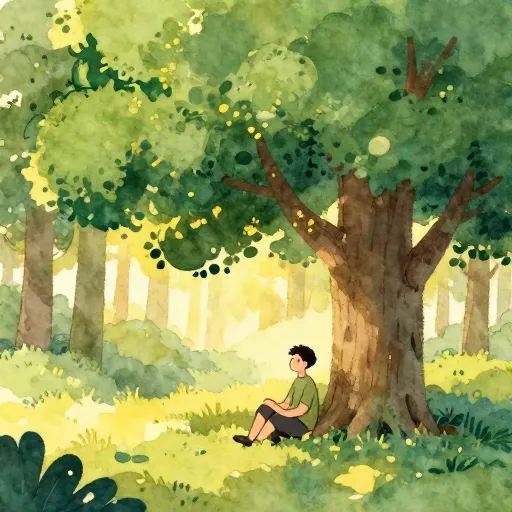
Imagine a forest in India 2,500 years ago. It is hot and buzzing with insects. You see a man sitting under a giant tree. He hasn't moved for hours. Monkeys are swinging above him, and people are walking past on the dusty road, but he looks like he is in another world entirely. This is Siddhartha, searching for the 'Middle Way' between having too much and having too little.
At the time, most people thought that to be spiritual, you had to do difficult things like fasting for weeks or climbing mountains. Siddhartha realized something different: that the biggest mystery in the world was right inside his own head.
He wanted to understand why people felt sad or stressed, and he found that by being very still, he could see his thoughts clearly. This state of deep understanding became known as enlightenment, a word that means waking up to how things really are.

Finn says:
"So, if the Buddha was just sitting there, how did he know he was 'enlightened'? Is there like a lightbulb that actually goes off, or does your brain just feel different?"
As the followers of the Buddha grew in number, they developed different ways to practice this stillness. These are what we call meditation traditions. Think of them like different styles of music: they all use sound, but they feel very different to listen to.
In the south of Asia, in places like Sri Lanka and Thailand, a tradition called Theravada became popular. They focused on a practice called Vipassana, which means insight or seeing clearly.
Peace is every step. The shining red sun is my heart. Each flower smiles with me.
Vipassana is like being a scientist of your own body. Instead of trying to change how you feel, you simply notice it. If your leg itches, you notice the itch. If you feel bored, you notice the boredom.
Close your eyes for just 30 seconds. Try to count how many breaths you take. If you start thinking about something else, just say 'thinking' in your head and go back to number one. How high can you get before a thought pops up?
The most important tool in this tradition is something you carry with you everywhere: your breath. By focusing on the air moving in and out of your nose, you give your mind a place to rest.
When your mind wanders off to think about lunch or a video game, you just gently bring it back to the breath. It is like training a puppy: you have to be kind but firm, over and over again.

Mira says:
"I like the idea that the breath is an anchor. It’s like when I’m swimming: no matter how big the waves are, the anchor stays stuck in the sand so the boat doesn't float away."
As the ideas of Buddhism traveled north and east, they changed and mixed with local cultures. In China and eventually Japan, a very famous tradition called Zen emerged.
Zen is famous for being direct and sometimes a bit mysterious. The main practice is Zazen, which literally means just sitting. In Zen, you do not try to reach a special state: you just sit and let the world be exactly as it is.
In some traditions, you try to keep your mind on one single thing, like a candle flame or a sound, to make your brain very strong and steady.
In other traditions, you open your mind up wide and just watch thoughts float by like boats on a river, without trying to catch any of them.
Zen teachers also used strange puzzles called a koan to help students stop thinking so hard. A koan is a question that the logical brain cannot answer, like: What is the sound of one hand clapping?
By wrestling with these puzzles, students eventually realize that their thoughts are not the whole story. They learn to trust their intuition and the quiet space between their thoughts.
Finn says:
"Wait, the sound of one hand clapping? That’s impossible! But maybe that's the point? Like, your brain gets so tired of trying to figure it out that it just gives up and becomes quiet?"
High up in the clouds of the Himalayan mountains, another tradition grew in Tibet. Because the landscape was so dramatic and colorful, the meditation there became very visual.
In Tibetan traditions, people often use a mantra, which is a sacred sound or phrase repeated over and over. They also use a mandala, a complex and beautiful circular map made of colored sand, to help them focus their imagination.

You are the sky. Everything else: it is just the weather.
Imagine sitting in a quiet room and visualizing a bright light in your chest that slowly grows until it fills the whole world. This type of meditation uses your imagination to cultivate feelings of courage and kindness.
It is like building an internal landscape that is full of color and light, even if the world outside is cold and grey. This tradition reminds us that our minds are incredibly powerful tools for creating how we feel.
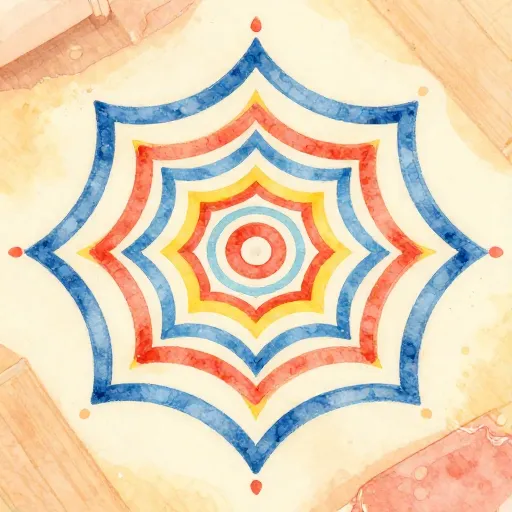
In Tibet, monks sometimes spend weeks making huge, beautiful patterns out of colored sand called Mandalas. Once they are finished, they immediately sweep all the sand away! This is a type of meditation to show that nothing in the world stays the same forever.
Across all these different styles, there is one practice that almost everyone shares: Metta, or loving-kindness meditation. This is not about being still or clearing the mind. It is about practicing a specific feeling.
You start by wishing yourself well, then a friend, then someone you find difficult, and finally every living thing in the universe. It is based on the idea that kindness is a skill that gets stronger the more you use it.
Think of someone who makes you laugh. In your mind, say to them: 'May you be happy. May you be safe. May you be kind.' Notice how your chest feels when you say those words. That is the start of Metta!
This movement of ideas did not happen overnight. It took hundreds of years for these practices to move across deserts and oceans. Along the way, different cultures added their own flavors, like the tea ceremonies of Japan or the chanting of the Tibetan monks.
The Long Journey of a Quiet Idea
In the modern world, meditation has moved out of temples and into hospitals, sports teams, and schools. We often call it mindfulness today. Scientists have even looked at the brains of people who meditate and found that the parts of the brain responsible for calm and focus actually get thicker.
Your work is to discover your world and then with all your heart give yourself to it.
But even with all the science, meditation remains a bit of a mystery. It is one of the few things in life where you do not have to achieve anything. You do not have to be the best at it, and you cannot really fail at it.
It is simply a way of checking in with yourself. It is a reminder that no matter how busy or loud the world gets, there is always a quiet place inside you that is as vast as the sky and as still as a mountain.
Something to Think About
If you were a tradition, what would your meditation look like?
Would it involve movement, like dancing? Or would it be about looking at the stars? There is no right or wrong way to find a moment of quiet in a busy world.
Questions About Religion
Is meditation a religion?
What if my mind won't stop talking?
How long do I have to sit still?
The Secret Garden
Meditation is a bit like having a secret garden inside your own mind. It takes a little bit of work to pull the weeds of distraction, but once you do, it becomes a place where you can always go to feel safe, curious, and awake to the world around you. Whether you prefer the puzzles of Zen or the breathing of Vipassana, the garden is always there, waiting for you to sit down.
