
Have you ever looked at a sunset so beautiful that you forgot your own name for a second?
That feeling of being part of something massive and mysterious is at the heart of Mysticism. For thousands of years, certain people in the Christian tradition have searched for a direct, personal connection with God through Contemplation and silence.
Imagine you are standing on the edge of a vast, quiet ocean at night. You cannot see the bottom, and you cannot see where the water ends and the sky begins.
You might feel a little bit small, but you also feel like you are part of the whole world. This feeling of being connected to a deep mystery is exactly what Christian mystics have spent their lives exploring.
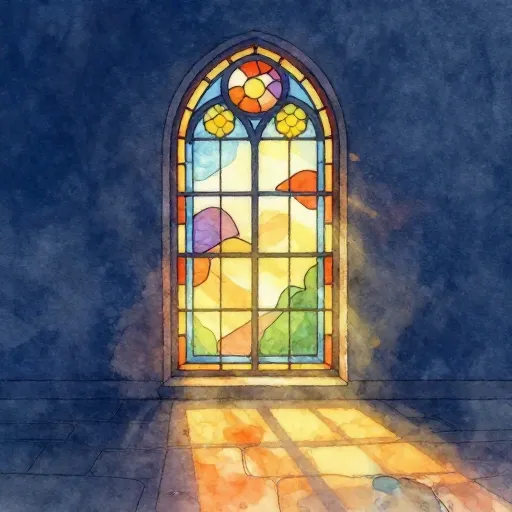
Imagine you are walking through a massive cathedral. The air is cool and smells like beeswax candles. Sunlight hits the stained glass, splashing red and blue light across the floor. In the distance, you hear a single voice singing a melody that seems to float up to the ceiling. This is the 'feeling' of mysticism: wonder, beauty, and a bit of a shiver.
The Whispering Desert
Long ago, around the year 300, the first Christian mystics didn't live in big churches or busy cities. They moved out into the dry, sandy deserts of Egypt and Syria.
These men and women were called the Desert Fathers and Mothers. They practiced Asceticism, which meant living very simply with almost no toys, fancy clothes, or even much food.

Go, sit in your cell, and your cell will teach you everything.
Why did they leave everything behind? They believed that the world was too noisy to hear the voice of God.
They thought that if they stayed in the quiet long enough, they would stop thinking about their own worries. In that empty space, they hoped to find a kind of Transcendence, or a way to go beyond everyday life.

Finn says:
"If the desert was so quiet, did they ever get bored? Or is boredom just what happens when we haven't found the mystery yet?"
The Music of the Spheres
As the centuries passed, mysticism moved from the lonely desert into the stone walls of the Monastery. These were places where monks and nuns lived, worked, and prayed together.
In the 12th century, a woman named Hildegard of Bingen became one of the most famous mystics in history. She wasn't just a nun: she was also a scientist, a musician, and a writer.

Hildegard of Bingen was so respected that Kings and Popes wrote to her for advice. She even invented her own secret language called 'Lingua Ignota' and wrote 77 songs!
Hildegard had incredible dreams and visions that she called "The Shade of the Living Light." She didn't just see God as a person on a throne; she saw the divine in the green plants and the spinning stars.
She used a special word, Viriditas, which means "greenness" or "freshness." To her, being a mystic meant feeling the energy of life pulsing through every leaf and every person.

Mira says:
"I love the idea of 'Viriditas.' It makes me think that every time I see a new sprout in the garden, I'm seeing a little bit of a miracle."
A Hazelnut in the Palm of Your Hand
In the middle of the 1300s, another woman named Julian of Norwich was living in a tiny room attached to a church in England. She spent most of her time alone, looking out a small window at the world.
Julian had a famous vision where she saw something the size of a hazelnut lying in her hand. When she asked what it was, she felt an answer in her heart: it was the whole world.

All shall be well, and all shall be well, and all manner of thing shall be well.
Julian’s ideas were very brave for her time. She believed that God was like a loving parent who would never be angry with their children.
She taught that even when things feel scary or broken, there is a deeper peace holding everything together. She called this Interiority, or the quiet world we carry inside ourselves.

Try the 'Hazelnut Challenge.' Find a small object: a pebble, a seed, or a button. Hold it in your hand and look at it for three minutes. Think about how much energy it took to make that object, and how it is connected to the rest of the universe. Does it feel different after three minutes?
Light and Dark: Two Ways to See
How do you talk about something that is too big for words? Mystics have two main ways of thinking about this mystery.
One way is called Kataphatic mysticism. This is when you use beautiful things like music, stained glass windows, and stories to understand the divine.
We can know God through things we see and touch, like art, nature, and the words in holy books.
God is so much bigger than our brains that we have to let go of all words and images to find the truth in the darkness.
The other way is called Apophatic mysticism. This is much more mysterious because it says that God is so big, we can only describe what He is not.
It is like trying to describe the color blue to someone who has never seen it. You might say it isn't red, it isn't hot, and it isn't loud. This path leads into a famous idea called The Cloud of Unknowing.
Finn says:
"The 'Cloud of Unknowing' sounds like a great place to hide. Maybe not knowing everything is actually a kind of superpower."
The Interior Castle
In the 1500s, a Spanish nun named Teresa of Avila wrote about the human soul as if it were a beautiful crystal castle. She said that inside every person, there are seven rooms, and the goal of life is to travel to the very center.
She didn't think you needed to travel across the ocean to find adventure. To Teresa, the biggest adventure was happening right inside your own mind and heart through Contemplation.
Mystics Through the Ages
The Modern Hush
You might think mysticism is something only for people in old-fashioned robes, but it is still happening today. Modern mystics teach that we can find the "hush" even in a busy city.
They suggest that when we are fully present, like when we are painting a picture or listening closely to a friend, we are touching that same mystery. It's about being awake to the wonder of being alive.

Contemplation is the highest expression of man's intellectual and spiritual life.

Many mystics were considered troublemakers by the leaders of their time. This is because mystics believed they could talk to God directly, which meant they didn't always wait for a priest or a king to tell them what to do.
Mysticism doesn't provide easy answers or a list of rules to follow. Instead, it invites us to be comfortable with not knowing everything.
It tells us that the universe is much deeper and more beautiful than it looks on the surface. And the best part? You don't need a map to get there: you just need to be still and listen.
Something to Think About
If you had to find a 'quiet place' inside your own mind, what would it look like?
There are no right or wrong answers here. Some people imagine a secret garden, others imagine a deep ocean or a library where the books have no titles. Your inner world belongs only to you.
Questions About Religion
Is mysticism the same as magic?
Do I have to be religious to be a mystic?
Why did mystics talk about 'darkness' so much?
The Door is Always Open
Christian mysticism reminds us that the world is a much more magical place than we often realize. Whether you find that wonder in a desert, a hazelnut, or just a moment of quiet before you go to sleep, the mystery is always there, waiting for you to notice it. Keep asking questions, keep being still, and keep looking for the greenness in everything.
