What if the most powerful force in the universe wasn't a king's army or a mountain's height, but a quiet kind of love?
Around 2,000 years ago, in a dusty corner of the Roman Empire, a teacher began sharing ideas that would eventually transform the world. This tradition, known as Christianity, grew from a small group of friends into a global community of billions. It is a story of faith, a search for grace, and a belief that every single person has immense value.
Imagine you are standing on a sun-baked road in ancient Palestine. The year is roughly 30 CE, and the air smells of baked bread and dry earth. This region was part of the massive Roman Empire, where soldiers in iron armor kept a strict and often heavy-handed order.
In this busy, crowded world, a Jewish man named Jesus began to travel from village to village. He didn't have a palace or a crown, but he had something that made people stop and listen. He spoke about a different kind of kingdom, one that lived inside people's hearts rather than on a map.
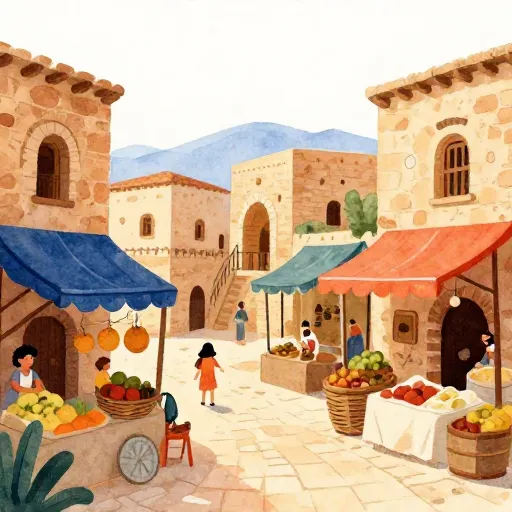
Imagine a bustling marketplace in Jerusalem. You hear the clatter of donkey hooves, the shouting of merchants selling figs and grain, and the rhythmic clink of a blacksmith's hammer. In the middle of this noise, a crowd gathers around a man who isn't shouting, but speaking with a quiet authority that makes the whole market feel still.
Jesus taught that the most important thing a person could do was to love God and love their neighbor. This sounds simple today, but back then, it was a radical idea. He suggested that your "neighbor" wasn't just the person who lived next door or someone who looked like you.
To Jesus, a neighbor was anyone in need, even someone your society told you to dislike. He spent his time with people who felt left out: the poor, the sick, and the lonely. He invited everyone to a metaphorical table, suggesting that in God's eyes, there were no favorites.
Love your enemies and pray for those who persecute you.
This message of radical inclusion made some people very excited and others very nervous. The religious leaders and the Roman governors wondered if this teacher might start a revolution. In a way, he did, though it wasn't the kind of revolution they expected with swords and shields.

Finn says:
"Wait, so if a Roman soldier was mean to them, Jesus told them to be kind back? That sounds really hard to do when you're angry!"
After Jesus died, his followers claimed something truly extraordinary: that he had returned to life. They called this the Resurrection. This belief became the heartbeat of Christianity, giving his followers the courage to spread his message across the Mediterranean sea and beyond.
They didn't call themselves Christians at first: they were simply people of "The Way." They met in secret homes, shared their food, and looked after the widows and orphans in their cities. It was a community built on the idea that everyone was part of one giant, spiritual family.

In the early days, when it was dangerous to be a Christian, people used a secret code to find each other. They would draw a simple fish shape (called an Ichthys) in the sand. If the other person recognized it, they knew they were among friends.
As the movement grew, they needed to keep track of the stories and letters being shared. These writings were eventually gathered into a collection called the New Testament. When combined with the Hebrew Scriptures (which Christians call the Old Testament), it formed the Bible.
Think of the Bible not as a single book, but as a vast library. It contains poetry, history, ancient laws, and mysterious visions. It is a record of people trying to understand their relationship with the divine over thousands of years.

Mira says:
"I like the idea of the Bible being a library. It's like a long conversation between different people across time, all trying to solve the same mystery."
One of the most important ideas in this library is grace. Grace is a word that describes a gift that you didn't earn and don't have to pay back. In Christianity, it means that God’s love is given freely to everyone, regardless of their mistakes.
This led to a big focus on forgiveness. The idea is that because you have been forgiven, you should forgive others. It is a cycle of kindness that is supposed to keep going, even when it feels difficult or unfair.
Lord, make me an instrument of your peace.
Over the centuries, Christianity became the official religion of the Roman Empire, and it began to look very different. Instead of meeting in small houses, people built massive cathedrals with stained-glass windows that touched the clouds. The religion split into different branches, like Catholic, Orthodox, and later, Protestant.
Traditions and rituals, like lighting candles or using incense, are important ways to connect with God through our physical senses.
Faith is mostly about a person's direct relationship with God and reading the Bible, so churches should often be simple and plain.
Each branch has its own way of practicing, but they mostly agree on a concept called the Trinity. This is a big, beautiful mystery. It’s the idea that God exists in three ways at once: as a Father (the Creator), as a Son (Jesus), and as a Holy Spirit (the breath of life in the world).
It is like water, which can be ice, liquid, or steam. It is all the same stuff, just appearing in different forms. Christians use this idea to explain how the divine can be far away in the stars and yet as close as your own heartbeat.

To understand the idea of the Trinity, find a prism or a glass of water on a sunny day. When the single beam of white light hits the glass, it splits into many colors. It is still just 'light,' but you are seeing the different parts that make it up. Think about how one thing can have many different expressions.
Christianity Through the Ages
As the centuries passed, Christianity influenced almost everything in the Western world, from the way we count years to the way we think about human rights. Many of the first hospitals and universities were started by people who wanted to put their faith into action.
Of course, like any human story, the history of Christianity has dark chapters where people used the religion to justify war or unfairness. But through it all, there has always been a thread of people returning to that original, quiet message of love and justice.

The secret of happiness is to live moment by moment and to thank God for all that He is sending us in His goodness.
Today, you can find Christians in every country on Earth. Some express their faith through silent prayer in a monastery, while others do it by dancing in a colorful parade or working to protect the environment. They are all looking for ways to see the "light" in a world that can sometimes feel quite dark.
Finn says:
"I wonder if the 'Kingdom of God' is actually just what happens when everyone decides to be helpful at the same time."
Ultimately, Christianity is an invitation to wonder. It asks us to consider if there is a meaning behind the stars and if we have a responsibility to care for one another. It doesn't offer a simple map for life, but it offers a compass pointed toward compassion.
The word 'Gospel' actually comes from an old English word meaning 'Good News.' For the early Christians, the good news was that they didn't have to be perfect to be loved by God.
Something to Think About
If love is the 'Good News' at the heart of this story, how does that change how you look at people you find difficult to get along with?
Questions About Religion
Do all Christians believe the same thing?
Why is the cross the symbol of Christianity?
Is Christianity the oldest religion?
A Living Tradition
Whether you are looking at a giant cathedral or a small group of people helping at a food bank, the story of Christianity is still being written. It is a tradition that invites us to look for the light in the world and to remember that every person we meet is someone worthy of love. As you go through your day, notice where you see people trying to bring peace or kindness to others - those are the same 'big ideas' that started on that dusty road long ago.
