Can a person be a leader without an army, a country, or a palace?
The Dalai Lama is one of the most famous people in the world, known for his infectious laugh and his teachings on compassion. For centuries, he has been the spiritual leader of Buddhism in the high, snowy mountains of Tibet.
Imagine standing on a high, windy plateau where the air is thin and the mountains touch the clouds. In a small village called Taktser, a two year old boy sat on the floor of a farmhouse in 1937. He didn't know yet that a group of men in disguises was traveling across the country to find him. They weren't looking for a king: they were looking for a teacher who had been lost and found many times before.
This boy's name was Lhamo Thondup. To his family, he was just a curious toddler who loved to play. But to the search party of monks, he was potentially the 14th reincarnation of the Dalai Lama. They believed that when a Dalai Lama dies, his spirit is born again in a new body to continue helping the world.

Finn says:
"What if he wasn't the right boy? It's like a giant game of Hide and Seek where the person hiding doesn't even know they are being looked for!"
The search party didn't just walk into the house and announce who they were. They dressed as servants so they could watch the boy's behavior without being noticed. They were looking for signs: a certain way of looking at people, or a recognition of things from a "past life."

The search party used a sacred lake called Lhamo La-tso to find the boy. High ranking monks looked into the water and saw visions of letters and a house with a blue tile roof. They used those clues to find the Dalai Lama's village!
The Test of the Toys
When the monks finally revealed themselves, they brought a collection of items with them. Some of these things had belonged to the 13th Dalai Lama, who had passed away a few years earlier. Other items were clever fakes: beautiful, shiny objects designed to catch a child's eye.
The little boy was asked to choose which items belonged to him. Without hesitation, he picked up the old, worn out walking stick and the simple prayer beads that the previous leader had used. He reportedly said, "It's mine, it's mine!"
Be kind whenever possible. It is always possible.
This was the moment everything changed. At just four years old, the boy was taken to Lhasa, the capital city of Tibet. He was renamed Tenzin Gyatso and began a life of intense study. He lived in the Potala Palace, a massive building with over 1,000 rooms, perched high on a hill.
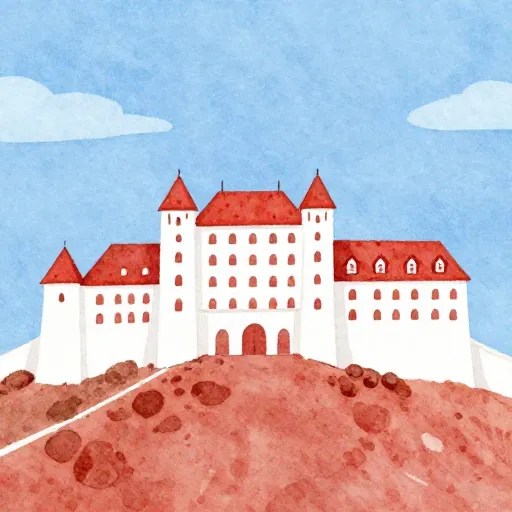
Imagine a palace so big it has its own schools, temples, and government offices inside its walls. The Potala Palace in Lhasa is built into a mountainside and has white and red walls that glow in the sunlight. In the winter, it was so cold inside that the young Dalai Lama could see his breath while he studied.
What Does the Name Mean?
The title "Dalai Lama" is actually a mix of two languages. "Dalai" comes from a Mongolian word meaning ocean, and "Lama" is a Tibetan word for teacher. Together, it means "Ocean of Wisdom."
Think about how big and deep the ocean is. It never runs out of water, and it holds secrets far beneath the surface. The Tibetans believe the Dalai Lama has a mind like that ocean: vast, deep, and always moving toward kindness.

Mira says:
"I like the 'Ocean' idea. It means wisdom isn't just one thing you learn: it's a huge, deep place you can keep exploring forever."
For the young Dalai Lama, being an "ocean of wisdom" meant a lot of homework. He studied philosophy, history, and the way the mind works. He had to learn how to debate: a style of arguing where you try to find the truth by asking difficult questions.
But he wasn't just a student. He was also a high ranking monk. This meant he lived a very simple life, even in a palace. He wore maroon and yellow robes and spent hours each day in meditation, training his brain to stay calm and focused.
The Idea of the Bodhisattva
To understand the Dalai Lama, you have to understand a word called bodhisattva. In the Buddhist tradition, a bodhisattva is someone who could reach a state of perfect peace and leave all suffering behind. Instead of leaving, however, they choose to stay on Earth to help everyone else.
Imagine you are at the finish line of a race. You have won, and you could go home and rest. Instead, you turn around and walk back to the starting line to help the people who are struggling or lost. That is the job of a Dalai Lama.

Try a 'Compassion Minute.' Close your eyes and think of someone who is having a hard time. Imagine a warm, golden light traveling from your heart to theirs, making them feel safe and brave. The Dalai Lama does this every single day!
This choice is rooted in altruism, which is the practice of acting for the benefit of others. The Dalai Lama teaches that humans are like a single body. If your toe is hurt, your whole body feels it. If one person in the world is suffering, it affects everyone else, too.
My religion is very simple. My religion is kindness.
A Leader in Exile
Life for the Dalai Lama wasn't always peaceful. In 1950, when he was only fifteen, the country of China invaded Tibet. Suddenly, the teenager had to lead his people through a very scary time. He tried to make peace, but the situation became too dangerous.
In 1959, he had to make a heartbreaking choice. To stay safe and keep his culture alive, he had to leave Tibet. He dressed as a common soldier and escaped over the freezing Himalayan mountains on foot and by horse. He eventually reached India, where he has lived in exile ever after.

When he was a boy, the Dalai Lama loved mechanical things. He used to fix old watches and even had a telescope to look at the stars from the roof of the Potala. He once even fixed an old car that had been sitting in the palace for years!
Even though he lost his palace and his home, he didn't stop being the Dalai Lama. He set up a community in a town called Dharamsala. From there, he began traveling the world, telling people that you don't need a country to have a voice. You just need a message of peace.
The Science of a Smile
One of the most surprising things about the current Dalai Lama is how much he loves science. Even as a child in Lhasa, he used to take apart old clocks and film projectors to see how they worked. He was fascinated by the way things fit together.
As an adult, he started meeting with brain scientists. He wanted to know if meditation actually changed the physical structure of the brain. He even let scientists put sensors on his head to measure his brain waves while he meditated on compassion.
Finn says:
"So he’s a spiritual leader AND a gadget geek? I wonder if he’d be good at fixing my tablet or if he’d just tell me to meditate on it."
The results were amazing. The scientists found that people who practice being kind actually have different brain activity. Their brains are "wired" for happiness. The Dalai Lama often says that if science proves a religious belief is wrong, then the religion must change. This is a very big, bold idea.
Some people believe that religion should stay exactly as it was hundreds of years ago to preserve ancient truth.
He believes that religion and science should work together. If science finds a new fact about the world, our beliefs should adapt to fit the truth.
The Nobel Peace Prize
In 1989, the Dalai Lama was awarded the Nobel Peace Prize. This is one of the highest honors a human can receive. He won it because he refused to use violence to solve the problems in Tibet. He believed that hate only creates more hate, and only love can stop it.
When he accepted the prize, he didn't take the credit for himself. He said it was a tribute to all people who work for peace. He continues to travel today, meeting with world leaders and regular children, always reminding them that the secret to a happy life is actually quite simple.
If you want others to be happy, practice compassion. If you want to be happy, practice compassion.
Through the Ages
Why He Matters Today
You might wonder why a man who lives in the mountains and wears robes is so famous on the internet and on TV. It is because he represents an idea that we often forget: that being gentle is a form of strength. He shows us that you can be serious about the world without losing your sense of humor. \mathrm{He} often says that he is just a "simple Buddhist monk." He doesn't want to be treated like a god or a king. He wants us to see him as a brother or a friend who is also trying his best to be kind every day.
Something to Think About
If you were searching for a friend you had known in a past life, what three objects would you use to test them?
There are no right or wrong answers. Think about the things that are so 'you' that only a true friend would recognize them.
Questions About Religion
Is the Dalai Lama a god?
Does he ever get angry?
Will there be a 15th Dalai Lama?
The Power of a Laugh
The Dalai Lama is famous for his laugh: a deep, belly-shaking sound that makes everyone around him smile. He shows us that even when life is very difficult, we can find a reason to be joyful. He reminds us that being wise doesn't mean being grumpy: it means having a heart as big as the ocean.
