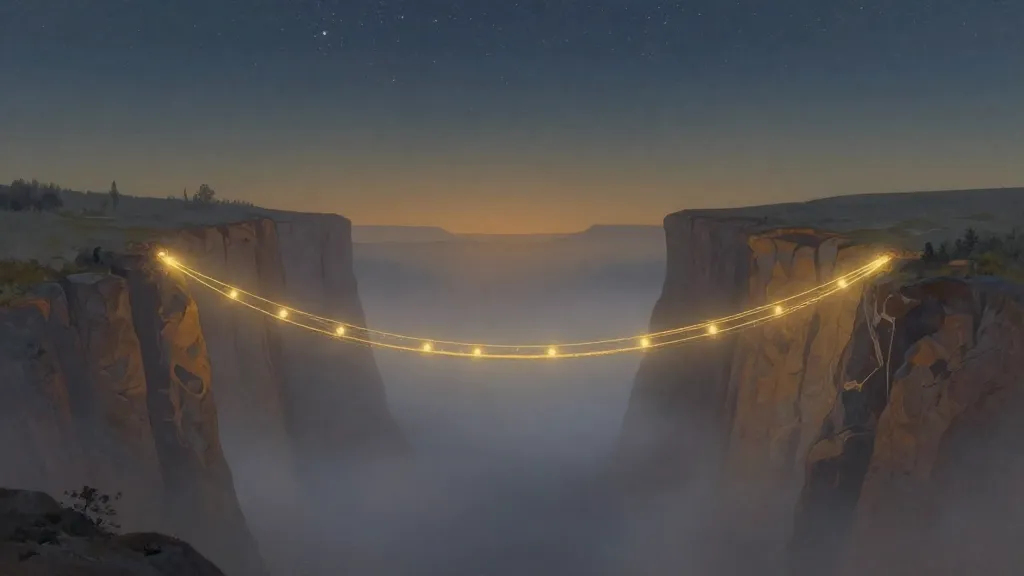
Have you ever closed your eyes and fallen backward, certain that a friend would catch you before you hit the ground?
That flutter in your stomach is more than just a game: it is a small version of faith. While we often talk about faith in terms of religion, the idea actually started as a way to describe trust and the invisible promises that hold our world together.
Imagine you are standing on a street corner in Ancient Rome, about two thousand years ago. The air smells of roasted grain and dusty stone. You see two merchants shaking hands over a crate of olives.
They aren't signing a long legal contract with dozens of pages. Instead, they are calling upon Fides, the Roman goddess of trust and reliability. To the Romans, faith wasn't just a private feeling in your heart.
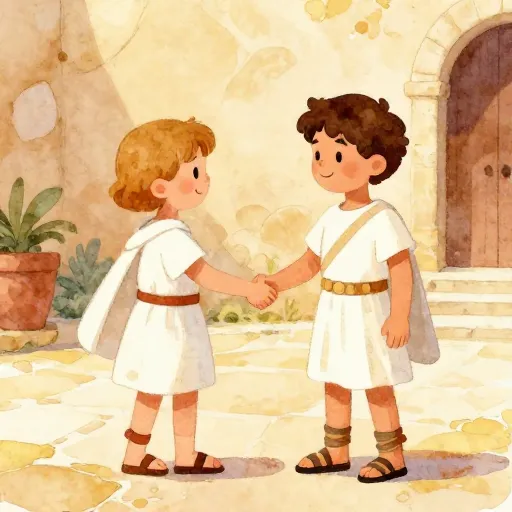
Imagine a Roman temple with a statue of a woman holding a white cloth. This is Fides. Romans believed that when you shook someone's right hand, you were physically 'locking' your faith with theirs. Breaking that trust wasn't just mean: it was considered a crime against the gods.
It was a public bond. If you had 'fides,' it meant people could rely on you to do what you said you would do. It was the social glue that kept the empire from falling apart.
The Birth of a Big Idea
In these ancient times, faith was closely tied to loyalty. When you had faith in a leader or a friend, you were pledging your allegiance to them. You were saying: 'I am choosing to stand by you, even when things get difficult.'
As time went on, the meaning of the word began to shift. It moved from being something you did (like keeping a promise) to something you had (like a belief). This change happened as different religions began to spread across the world.

Mira says:
"I like to think of faith as a colorful thread. You can't always see where the whole string goes, but you can hold onto your end of it really tightly."
People started to think about faith as a way of knowing things that they couldn't see with their eyes. If science is about what we can prove in a lab, faith became about the things that science couldn't quite reach.
Knowing vs. Believing
There is a big difference between knowing that a chair is made of wood and having faith that the chair will hold you up. You can measure the wood and weigh the chair, but the 'trust' part happens inside your mind.
Belief should be based on things we can see, touch, and prove with experiments. If there is no evidence, we shouldn't believe it.
Some truths are felt rather than seen. Things like love, hope, and purpose can't be put under a microscope, but they are still real.
Many philosophers argue that faith is actually a special kind of conviction. It is a deep-seated certainty that doesn't require a mountain of physical evidence. It’s like the way you know your parents love you: you can’t 'prove' it like a math equation, but you feel the truth of it every day.
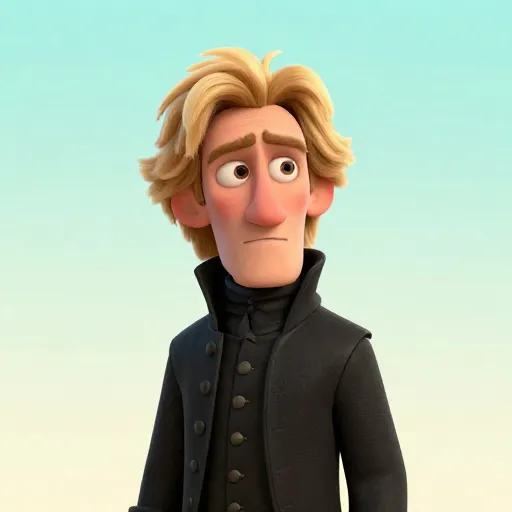
If I am capable of grasping God objectively, I do not believe, but precisely because I cannot do this I must believe.
Kierkegaard lived in Denmark a long time ago. He thought that if you could prove everything, you wouldn't need faith at all. To him, the uncertainty was the most important part of the whole experience.
The Leap of Faith
Have you ever had to make a big decision without knowing how it would turn out? Maybe you tried out for a play or moved to a new school. This is what philosophers call a leap.
You gather all the information you can, you look at the map, but eventually, you have to jump. You have to trust that there is something on the other side waiting to catch you.
The next time you are worried about trying something new, draw a 'Staircase of Faith.' On the bottom step, write what you are doing today. On the top step, write your goal. Leave the middle steps blank or draw them as clouds. It reminds you that you don't need to see the middle to keep climbing.
This 'leap' is central to many religious traditions. It’s the moment where a person decides to believe in something bigger than themselves, even if they have lingering questions. They choose to live as if their belief is true.
Why Do People Have Faith?
For many people, faith provides a sense of meaning. It helps answer the 'Why?' questions that pop up late at night. Why are we here? Why is there beauty in the world? Why do bad things happen?
Finn says:
"So if faith is about things we can't see, does that mean gravity is a kind of faith? I can't see it, but I definitely believe it's going to keep me on the ground!"
Religion often provides a framework for this faith. It gives people stories, songs, and rituals to help them express what they believe. It connects them to a community of other people who are asking the same big questions.
Faith Beyond Religion
You don't have to be religious to experience faith. We use 'secular' faith every single day without realizing it. We have faith that the pilot knows how to fly the plane, and we have faith that our friends will keep our secrets.
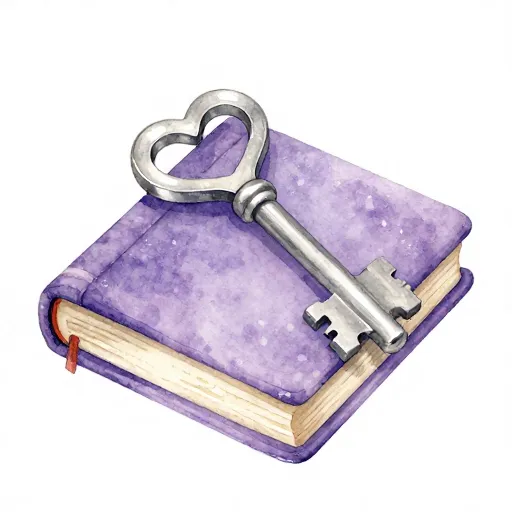
The word 'fiancé' (someone you are engaged to marry) comes from the same old root word as faith! It literally means someone you have 'confided' in or someone you trust with your future.
Think about the future. No one knows for sure what will happen tomorrow. Yet, we make plans, we plant seeds in gardens, and we study for tests. This is a form of faith: a belief that the future is worth working for.
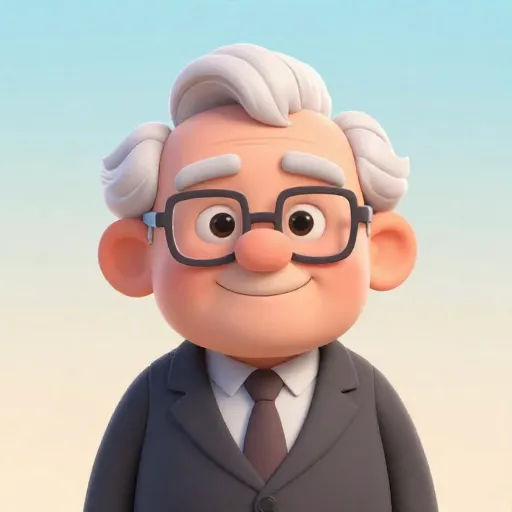
Faith is the state of being ultimately concerned.
Tillich was a thinker who believed that everyone has something they care about more than anything else. He called this our 'ultimate concern.' Whatever that thing is, that is where your faith truly lives.
The Shadow of Faith: Doubt
Some people think that doubt is the enemy of faith. They think that if you have questions or feel unsure, your faith must be weak. But many of the world's greatest thinkers believe the exact opposite.
They argue that doubt is actually a necessary part of faith. If you were 100% sure of something, you wouldn't need faith; you would just have 'knowledge.' Faith only exists because there is a possibility that we might be wrong.
Mira says:
"Maybe having questions is like having a map. The questions show you where you've been and help you figure out which way you want to go next."
Asking 'Is this really true?' or 'Why does this matter?' isn't a sign of failure. It’s a sign that you are taking your beliefs seriously. It means you are exploring the edges of what you know.
Through the Ages: The Story of Faith
Faith as a Force for Change
Throughout history, faith has moved people to do incredible things. It has inspired artists to paint beautiful cathedrals and musicians to write songs that make people cry. But it has also inspired people to fight for justice.
When things in the world seem broken or unfair, it takes a lot of faith to believe they can be fixed. You have to believe in a version of the world that doesn't exist yet. You have to trust that 'right' will eventually win over 'might.'
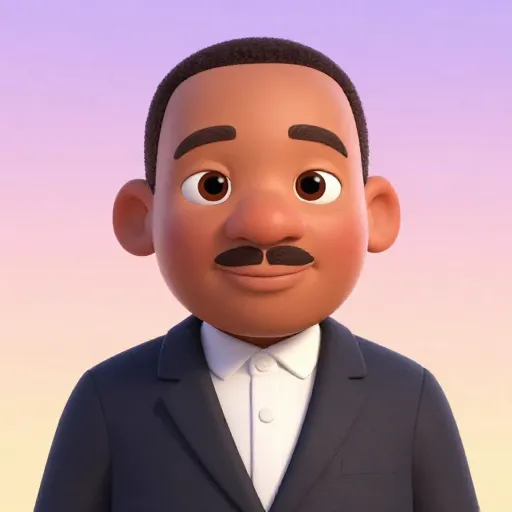
Faith is taking the first step even when you don't see the whole staircase.
King was a leader who used his faith to change the laws of the United States. He believed that even if you can't see the end of the journey, you still have to start walking. His faith gave him the courage to face very scary situations.
Living with the Unknown
In the end, faith is a way of being comfortable with the unknown. It is a way of saying, 'I don't have all the answers, and that's okay.' It allows us to keep exploring, keep dreaming, and keep trusting each other.
In many languages, the word for 'faith' and the word for 'belief' are exactly the same. But in English, we use 'faith' more often to describe a relationship of trust, and 'belief' to describe an idea we think is true.
Whether it is faith in a creator, faith in humanity, or faith in yourself, it is a tool for navigation. It helps us steer our ship through the foggy parts of life when the stars are hidden behind the clouds.
Something to Think About
If you could only have faith in one thing that you couldn't prove, what would you choose?
There is no right or wrong answer here. Think about what makes you feel the most 'at home' in the world.
Questions About Religion
Is faith the same thing as religion?
Can you have faith and still have questions?
How do I know if my faith is 'real'?
Keeping the Door Open
Faith isn't a destination where you arrive and stop thinking. It's more like a telescope: a tool that helps you look further into the distance than your eyes can see on their own. Whether you are religious, curious, or somewhere in between, remember that it's okay to hold space for the things we don't yet understand.
