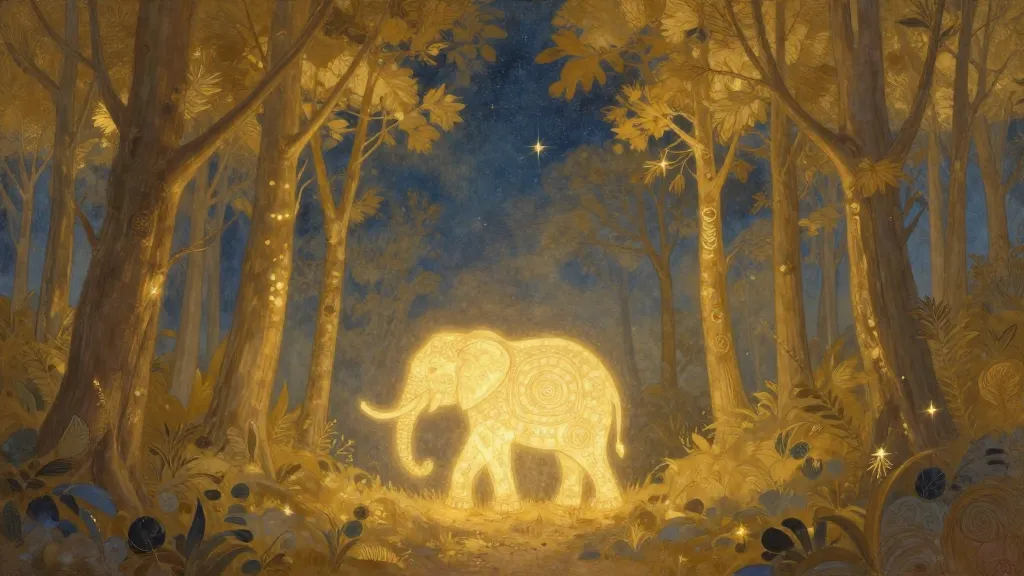
Have you ever stood at the very start of something big, like the first day of school or the first page of a blank notebook, and felt a mix of excitement and a little bit of worry?
For millions of people around the world, this feeling is where Ganesha comes in. He is one of the most recognizable figures in Hinduism, often shown with the head of an elephant and a round belly, known as the 'Remover of Obstacles' who helps people find their way through new beginnings.
Imagine you are in ancient India, perhaps fifteen hundred years ago. The air is warm and smells of sandalwood and rain. In the corner of a bustling city, a sculptor is carving a figure out of stone.
This figure has a human body but the large, fan-like ears and long trunk of an elephant. People stop to bow, not because they think the stone is a living animal, but because it represents a Big Idea.
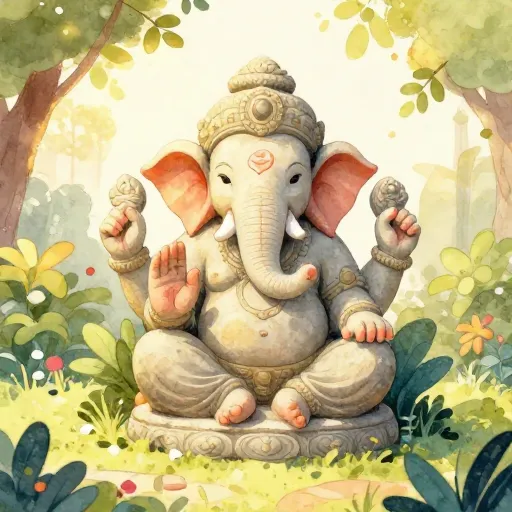
Imagine a sculpture made of dark, smooth stone. It feels cool to the touch. The figure has four arms, each holding something different: a rope to pull you toward your goals, a small axe to cut ties with things that hold you back, and a sweet snack to reward your hard work.
Ganesha is the son of the goddess Parvati and the god Shiva. His story begins with a deep sense of protection and loyalty. According to the ancient stories, or Puranas, Parvati created Ganesha from the earth to guard her door while she bathed.
He was so dedicated to his job that he even stood up to the mighty Shiva. This led to a famous battle and a transformation that gave Ganesha his unique elephant head.

Mira says:
"It is interesting that he was made from clay. It makes me think about how we are all shaped by our families and our homes before we ever step out into the world."
The Anatomy of Wisdom
When we look at Ganesha, we are actually looking at a map of how to think. Every part of his body is a symbol for a tool we can use in our own lives.
His large ears are there to remind us to listen more than we speak. In a world full of noise, the ability to truly hear what others are saying is considered a superpower.
- The Large Head: Represents thinking big and having a broad vision.
- The Small Eyes: Represent the importance of focus and looking closely at details.
- The Trunk: Shows flexibility, as it can pull down a tree or pick up a tiny needle.
Mythology is not a set of lies; it is a set of truths that cannot be expressed in any other way.
One of the most curious parts of Ganesha’s appearance is his broken tusk. There are many stories about how it happened, but the most famous one says he broke it off himself.
He did this so he could use it as a pen to write down the Mahabharata, one of the longest and most important poems in history. This tells us that sometimes we have to make a sacrifice or give something up to finish a great work.
Ganesha is known as a patron of writers and students. In ancient India, before starting to write a book, an author would always write 'Om Shri Ganeshaya Namah,' which means 'I bow to the great Ganesha.' It was like a ritual to make sure the ink didn't blot and the ideas kept flowing.
The Mouse and the Elephant
At the feet of the giant Ganesha, you will almost always find a tiny mouse. This mouse is his Vahana, or his vehicle. It seems like a strange choice: how could a small mouse carry a heavy elephant?
This is a lesson in balance. The elephant represents strength and wisdom, while the mouse represents our wandering desires and the little things that distract us.
By riding the mouse, Ganesha shows that he has mastered his distractions. He isn't running away from the small things: he is leading them.
Finn says:
"What if the mouse isn't just a helper? What if the mouse is the part of us that feels small, and Ganesha is the part of us that is brave enough to lead?"
Some people see the mouse as a symbol of our own minds. Our thoughts can scurry around like a mouse in a kitchen, looking for snacks and getting into trouble. Ganesha invites us to sit quietly and guide those thoughts toward a bigger purpose.
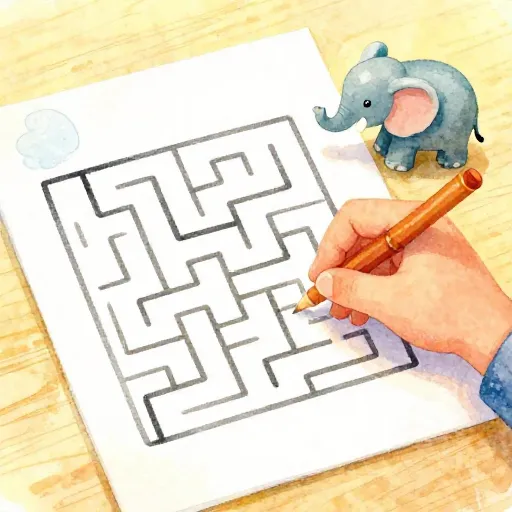
Think of a goal you have right now. It could be learning a new song or finishing a book. Now, imagine an obstacle in your way. Instead of getting frustrated, try to 'be like the trunk.' How can you be flexible and find a way around it or over it? Draw your goal and then draw three different paths to get there.
The Art of Starting Over
In Hindu tradition, Ganesha is the first person invited to any ceremony. If a family moves into a new house, they place a small statue, or Murti, of Ganesha near the entrance.
If a student starts a new school year, they might say a prayer to Ganesha. This is because he is the 'Lord of Thresholds,' the space between where you were and where you are going.
The elephant is the animal that does not know how to run, but it knows how to move through the thickest forest.
This isn't just about magic: it is about psychology. When we acknowledge that a path might have obstacles, we stop being afraid of them. We start looking for ways around them, just as Ganesha does.
Ganesha Through the Ages
A Global Celebration
Every year, usually in August or September, millions of people celebrate Ganesh Chaturthi. This is a ten-day festival that turns entire cities into giant art galleries.
In Mumbai, India, massive statues of Ganesha are carried through the streets with music and dancing. At the end of the festival, the statues are carried to the ocean or a river and submerged in the water.
Ganesha is a divine figure who uses animal traits to teach humans about the universe. The elephant head isn't about being an animal; it is a symbol for infinite wisdom and the vastness of the mind.
In many cultures, animals are seen as closer to the natural world. By having an elephant head, Ganesha shows that humans and nature are not separate, and that we should respect the intelligence of all living things.
This ritual represents the idea that everything comes from the earth and eventually returns to it. It is a reminder that even our biggest ideas and our most solid forms are part of a cycle that keeps moving.
It can feel a bit sad to see the beautiful statues disappear into the waves. However, the festival teaches that the spirit of wisdom stays with us, even when the physical shape is gone.
Dealing with Obstacles
We often think of an 'obstacle' as something bad, like a wall in our way. But in the philosophy of Ganesha, obstacles are often just signals.
They tell us to slow down, to think differently, or to find a new tool. Sometimes, the obstacle itself is the very thing that helps us grow stronger.
Mira says:
"I wonder if we should say 'thank you' to the obstacles. If everything was easy all the time, we might never find out what we are really capable of."
Ganesha is sometimes called 'Vighneshvara,' which means 'Lord of Obstacles.' Interestingly, this means he is both the one who removes obstacles and the one who places them there in the first place.

Ganesha loves a sweet called a 'modak.' It is a dumpling filled with coconut and jaggery. In statues, he is often holding one. The modak is shaped like a drop of water, representing the 'sweetness' of finding inner peace and spiritual knowledge.
Why would someone who loves you put an obstacle in your way? Think about a teacher who gives you a difficult math problem. They aren't trying to stop you: they are trying to help you discover how much you can actually do.
You are the observer of the world; you are the creator, the sustainer, and the destroyer of all difficulties.
As we look at history, we see that Ganesha has changed over time. He started as a simple folk figure and became a symbol of national unity during India’s struggle for independence.
Today, you can find Ganesha in yoga studios in New York, in temples in London, and on computer screens in Tokyo. He has become a global symbol for the courage it takes to start something new.
Something to Think About
If you could remove one obstacle for someone else today, what would it be?
There are no right or wrong answers here. Sometimes the best way to understand the 'Remover of Obstacles' is to think about how we can help clear the path for the people around us.
Questions About Religion
Why does Ganesha have an elephant head?
What does Ganesha hold in his hands?
Is Ganesha a god of luck?
The Path Stretches Out
Ganesha reminds us that every journey begins with a single step, and that no obstacle is too big if we have the right mindset. Whether he is a figure of faith, a character in a story, or a symbol of inner strength, he invites us to look at our challenges with a calm heart and a bit of wonder. Next time you face a difficult task, remember the elephant and the mouse: size doesn't matter as much as the wisdom you bring to the path.