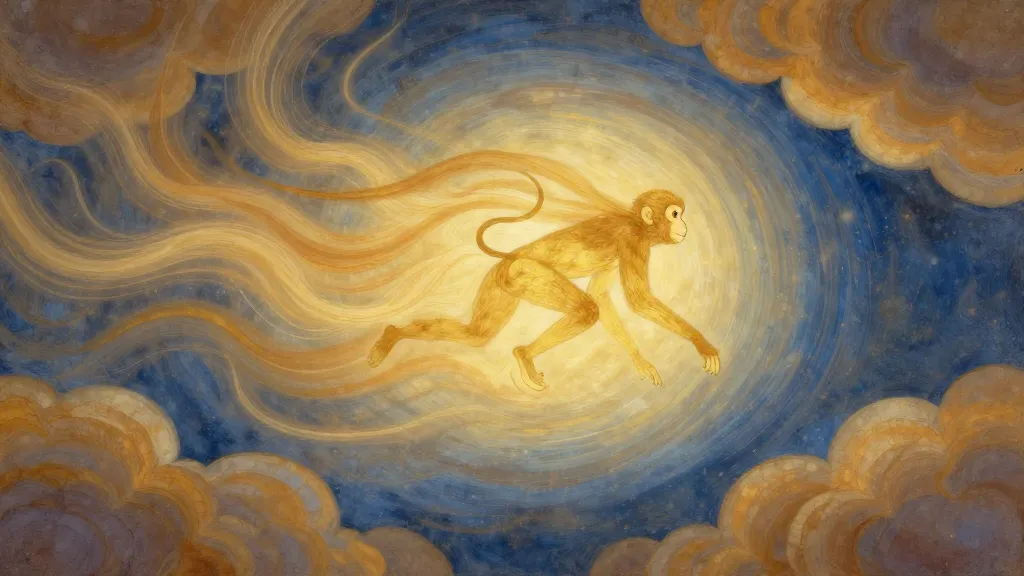
Have you ever felt like you had a giant secret inside you, a source of strength that you just hadn't learned how to use yet?
In the ancient traditions of Hinduism, few figures are as beloved or as full of surprises as Hanuman, the monkey god who reminds us that even the smallest help can move mountains. His story is told in the Ramayana, an epic poem from ancient India that has traveled across the world for thousands of years.
Imagine a world where the trees speak, the mountains are medicine, and a single monkey can leap across the ocean in a single bound. This is the world of the Ramayana, one of the most important stories ever told. At the center of this story is a figure who is part animal, part divine, and entirely devoted to being helpful.
Hanuman is not just a character in a book: he is a symbol of what humans can achieve when they focus their minds. Thousands of years ago, in the ancient cities and forests of the Indian subcontinent, storytellers began sharing the adventures of this extraordinary monkey. They didn't just see him as a pet or a helper, but as a teacher of wisdom and power.
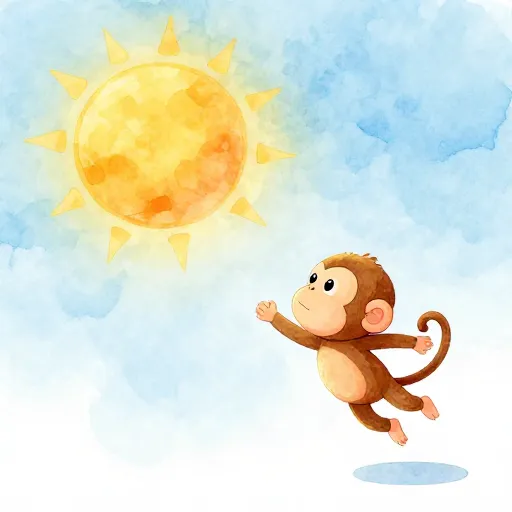
Imagine a tiny monkey baby looking up at the morning sky. The sun is a giant, glowing orange hanging just out of reach. With a giggle, he kicks off the ground and flies higher and higher, the wind whistling past his ears, as he opens his mouth wide to take a bite of the biggest fruit in the universe.
Hanuman's journey begins with a moment of pure, childish wonder. As a baby, he looked up at the sky and saw the glowing, golden sun. Because he was the son of Vayu, the god of the wind, he had the ability to fly through the air. He didn't see a giant ball of fire: he saw a delicious, ripe mango and decided he had to have a bite.
This early adventure ended with a bit of a crash, leading to a mark on his jaw that gave him his name. The word Hanuman actually comes from the Sanskrit words for 'broken jaw.' It is a reminder that even heroes have moments where they overreach or make mistakes in their excitement.

Finn says:
"Wait, if Hanuman actually bit the sun, wouldn't it be way too hot? I wonder if the 'sun' was just a metaphor for a really big goal that seemed impossible to reach."
Because of his mischief, the gods decided that Hanuman should forget how powerful he was for a while. They didn't take his strength away, but they hid it behind a veil of forgetfulness. He would only remember his true potential when someone else reminded him of it, or when he needed it to help others.
This idea of 'forgotten power' is a big part of why people love Hanuman. It suggests that we all have hidden talents that might be sleeping inside us. Sometimes we need a friend to tell us 'you can do this' before we realize what we are truly capable of achieving.
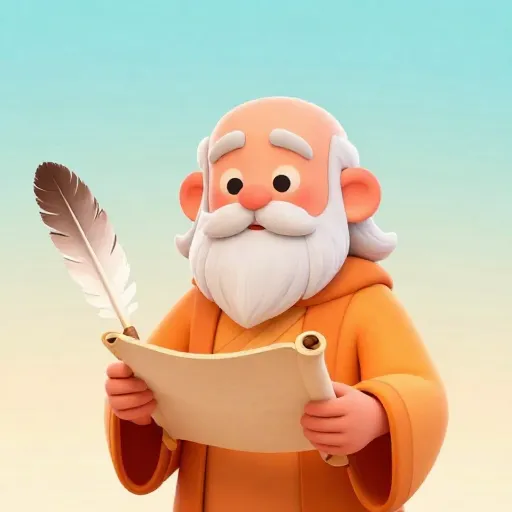
He who is the son of the Wind God is equal to the Wind in speed and to the Sun in luster.
When Hanuman grew up, he met a prince named Rama, who was searching for his lost wife, Sita. Rama was kind and wise, but he was facing a problem that seemed impossible to solve. Sita had been taken across the sea to a faraway island, and Rama had no way to reach her.
Hanuman didn't ask for a reward or look for fame. He simply recognized the goodness in Rama and decided to offer his help. This is where the concept of Bhakti comes in, which is a Sanskrit word meaning deep, loving devotion or service to something greater than yourself.
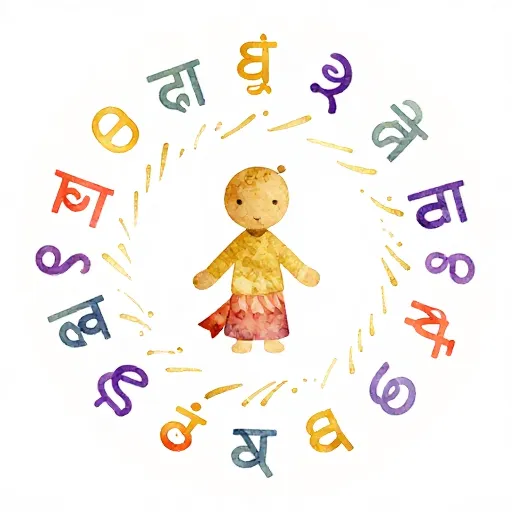
Hanuman has 108 different names in Sanskrit! Some of them include 'Anjaneya' (son of Anjana), 'Maruti' (son of the wind god Marut), and 'Sankat Mochan' (the one who removes troubles). Each name describes a different part of his personality or a different adventure he had.
To reach Sita, Hanuman had to cross a vast ocean. Standing on the shore, he felt small and uncertain, until his friends reminded him that he was the son of the wind. As they spoke, Hanuman began to grow. He grew taller than the trees, taller than the cliffs, until he was like a living mountain himself.
With a mighty roar, he jumped. The air rushed past him, and the ocean below looked like a tiny puddle. This famous leap represents the moment we overcome our fears by believing in ourselves. For Hanuman, the leap wasn't about showing off: it was about the determination to help a friend.

Mira says:
"I like the idea that we 'forget' our powers. It's like when you're nervous about a piano recital and you forget you know the song, until you start playing and your hands remember for you."
In many stories, heroes are strong because they want to win. Hanuman is different because his strength comes from his humility. He is often depicted kneeling at the feet of Rama, not because he is weak, but because he chooses to use his power for someone else.
This creates a fascinating paradox. In philosophy, a paradox is when two things that seem opposite are both true at the same time. Hanuman is both the most powerful warrior and the most humble servant. He shows that being 'big' doesn't mean looking down on others.
Hanuman is a fierce fighter who can defeat giant demons and burn down enemy cities with his flaming tail. He represents pure strength and courage.
Hanuman is also a scholar who mastered the Vedas (ancient books of wisdom). He chooses to be a humble student of Rama, showing that wisdom is more important than force.
One of the most famous stories about Hanuman involves a mountain of healing herbs. During a great battle, Rama's brother was badly hurt, and only a specific plant from the Himalayas could save him. Hanuman flew all the way to the mountains, but when he arrived, he realized he didn't know which plant was the right one.
Rather than giving up or wasting time, he decided to bring the entire mountain back with him. He reached under the earth, lifted the massive peak onto his hand, and flew across the sky. This image of Hanuman carrying a mountain is one of the most famous symbols in all of history, representing the idea that no problem is too big if you are willing to think outside the box.
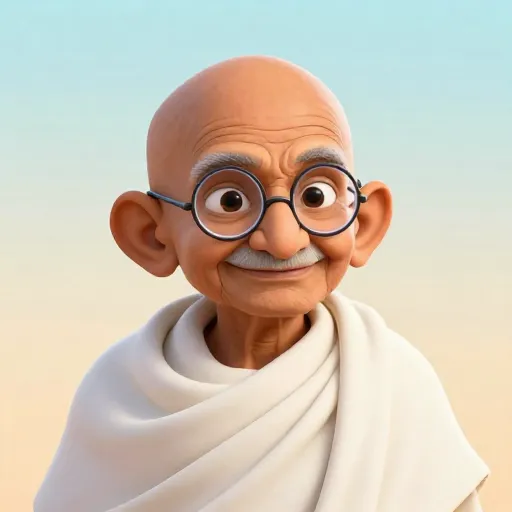
Hanuman is the perfect server... his devotion to Rama was so great that he forgot his own existence.
Hanuman is also known for having a 'monkey mind.' If you have ever tried to sit still and noticed your thoughts jumping from your homework to a snack to a game to a funny memory, you have experienced a monkey mind. It is a mind that is always moving, always curious, and sometimes hard to control.
By practicing focus and devotion, Hanuman learned to master his monkey mind. He didn't stop being a monkey: he just learned how to point all that energy in one direction. This is why many people who practice Yoga or meditation look to Hanuman as a guide for how to calm their own racing thoughts.
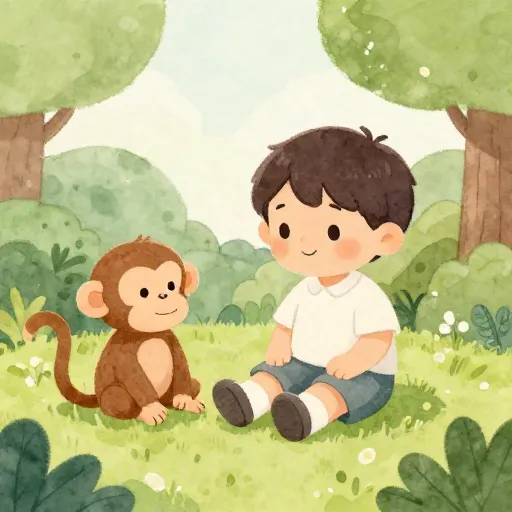
Try the 'Hanuman Focus' challenge. Sit comfortably and close your eyes. Imagine your thoughts are little monkeys jumping from tree to tree. Don't try to stop them, just watch them. After a minute, pick one 'tree' (like the sound of your breath) and see if you can stay there for ten seconds. That's you training your monkey mind!
Through the Ages
As the story of the Ramayana traveled, Hanuman changed too. In Thailand, he is known as a clever and mischievous white monkey who is a bit of a trickster. In China, he likely inspired the famous character of Sun Wukong, the Monkey King, who also flies on clouds and fights with a magical staff.
This shows us how ideas travel like seeds on the wind. A story that started in India thousands of years ago grew different branches in different cultures. Even though the details changed, the core idea remained: a hero who is brave, strong, and deeply connected to his friends.
Finn says:
"It's cool how he's a hero in so many different countries. He's like a superhero who has different versions in different comic books, but he's always the same guy at heart."
Today, you can find statues of Hanuman all over the world. Some are small enough to fit in a pocket, and others are as tall as skyscrapers. People sing a special prayer called the Hanuman Chalisa, which lists forty verses about his amazing deeds. They believe that saying these words can help them find courage when they are afraid.
But you don't have to be religious to appreciate Hanuman. He represents a part of the human experience that we all share. He is the bridge between our animal instincts: our playfulness and energy: and our highest potential for wisdom and kindness.

Hanuman is the evolution of the mind, from the restless monkey to the steady devotee.
Hanuman reminds us that we are often much more than we appear to be. He is a monkey who became a god, not by changing his face, but by changing his heart. He shows us that the greatest power isn't found in a weapon or a crown, but in the simple act of showing up for the people we care about.
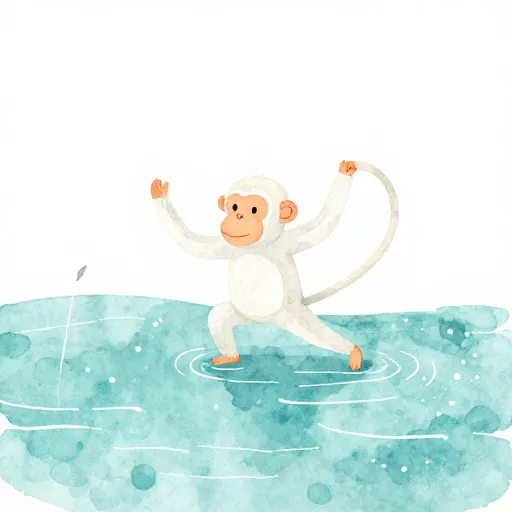
In the Thai version of the story, called the Ramakien, Hanuman is often shown as a white monkey. He is a clever general who uses his wits as much as his muscles. He even once used his tail to create a bridge for an entire army to cross a river!
As you think about Hanuman, remember that he spent much of his life not knowing he was a hero. He was just a monkey who wanted to be useful. Perhaps there is a 'mountain' in your life that feels too big to move, or a 'leap' you are afraid to take. If so, you might find a bit of Hanuman's wind at your back.
Something to Think About
If you could forget your limitations for one day, what would you try to achieve?
There isn't a right or wrong answer here. Think about whether your 'limitations' are things you actually can't do, or just things you've told yourself you can't do.
Questions About Religion
Is Hanuman a monkey or a person?
Why does Hanuman have a red face in some pictures?
Can I learn from Hanuman if I'm not Hindu?
The Strength Within
Whether he is leaping across oceans or carrying mountains, Hanuman reminds us that our greatest adventures often start when we decide to help someone else. He shows us that being a hero isn't about being perfect: it's about being brave enough to try, even when we feel small. Next time you feel a bit uncertain, imagine the son of the wind standing behind you, reminding you of the strength you might have forgotten.