If you look up at the night sky and see the white smudge of the Milky Way, you are looking at a story about Hera.
In the ancient world, Hera was not just a character in a book: she was the Queen of Olympus and the guardian of the home. While many stories focus on her anger, the people of Ancient Greece saw her as the essential force of Sovereignty, the power that makes a leader a leader and a family a family.
Imagine you are standing on a dusty hill in Greece nearly three thousand years ago. The air smells of wild thyme and salty wind from the Mediterranean Sea. Below you, a massive stone temple rises: the Heraion. It is one of the oldest and largest temples ever built in this land.
For the people living then, the world was a chaotic and often scary place. Storms could destroy crops, and wars could break out between cities. They believed that to keep life stable, someone had to be in charge of the rules. That someone was Hera.
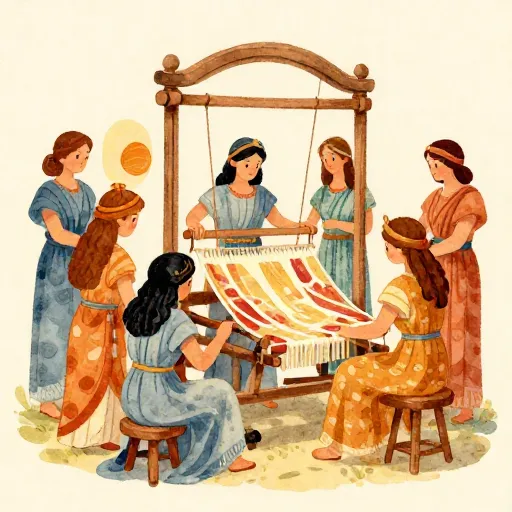
Imagine the Temple of Hera at Olympia. It was built hundreds of years before the famous Parthenon. In the center sat a massive statue of Hera on her throne. Every four years, a group of sixteen women would weave a beautiful new robe (a peplos) just for her. They didn't do this for Zeus: they did it for the Queen.
More Than a Wife
Many modern stories introduce Hera simply as the wife of Zeus. They focus on her jealousy when Zeus was unfaithful. But if we only see her that way, we miss the most interesting part of her identity. Long before Zeus became the king of the gods, Hera was likely a powerful Great Goddess of the earth and the seasons.
She was the daughter of the Titans Cronus and Rhea. This meant she was a goddess of the highest rank by birth. When she married Zeus, it wasn't just a wedding: it was a Sacred Marriage that joined the sky and the earth together. This union was supposed to ensure that nature stayed in balance.

Mira says:
"It is interesting that Hera is often called the 'Queen of the Gods' but people focus so much on her husband. I wonder if it’s harder to be the person who has to keep everyone else in line than it is to be the one who makes the lightning."
In the Greek mind, Hera was the only one who could truly stand up to Zeus. While other gods trembled when Zeus reached for a lightning bolt, Hera looked him in the eye. She was his equal in every way, holding a golden scepter that matched his own.

Hera is the goddess of the stable relationship, the guarantor of the order of the world.
The Vigilance of the Peacock
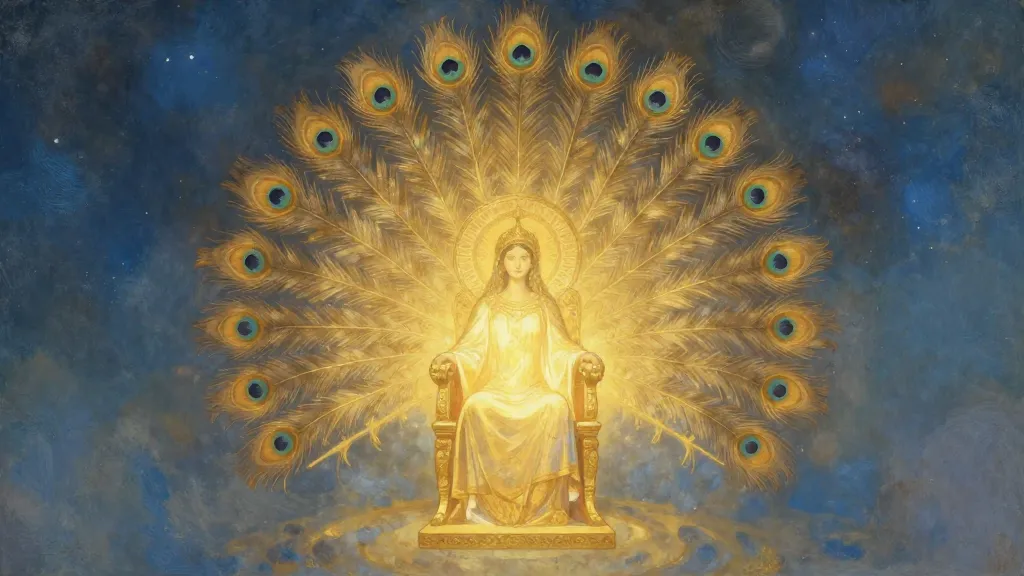
If you see a peacock today, you might think of its beautiful feathers. For Hera, the peacock was a symbol of Vigilance, or the act of keeping a very careful watch. Legend says that she took the hundred eyes of her giant servant, Argus, and placed them on the peacock’s tail.

The Milky Way gets its name from Hera! According to legend, when Hera was nursing the baby Hercules, some of her milk splashed across the sky. The Greeks called it 'Galaxias Kyklos,' which means 'Milky Circle.' We still use that word 'galaxy' today.
Why did she need so many eyes? Hera’s job was to protect the Sanctity of the family. In Ancient Greece, the family was the most important unit of society. If families fell apart, the whole city would fall apart too. Hera was the watcher who made sure people kept their promises to one another.
This is why she was the patron of marriage. To the Greeks, marriage wasn't just about romance: it was a contract that created a stable world for children to grow up in. Hera was the personification of that stability. She was the one who said, "I am watching, and I expect you to be loyal."

Finn says:
"If Hera has a hundred eyes on her peacock, does that mean she sees the stuff we try to hide? Like when I say I did my homework but I actually just played games? That’s a lot of pressure!"
The Problem of Hercules
We cannot talk about Hera without talking about her most famous enemy: Hercules. In most movies, Hera is the villain who tries to destroy the hero. She sent serpents into his cradle and made his life incredibly difficult. From a modern perspective, this seems cruel and unfair.
Hera was a bully who punished children like Hercules for things that weren't their fault. She let her anger get in the way of justice.
Hera was a protector of the law. By challenging Hercules, she made sure he earned his place. Her anger was a signal that rules were being broken.
However, if we look closer, we see a deeper idea at work. In Greek, the name Herakles (Hercules) actually means "The Glory of Hera." This is a strange contradiction. How can someone she hated be named after her glory? Some thinkers believe that Hera represented the Adversity that makes a person great.
Think about a diamond. A diamond only becomes hard and brilliant because of intense pressure and heat. By testing Hercules, Hera forced him to prove he was worthy of becoming a god. She was the obstacle that created the hero. Without her challenges, he would have just been a strong man with nothing to do.
Golden-throned Hera, whom Rhea bore, immortal queen, outstanding in beauty, sister and wife of loud-thundering Zeus.
Hera and the Golden Fleece
While Hera was a nightmare for Hercules, she was the greatest friend a hero could have if they showed her respect. Take the story of Jason and the Argonauts. When Jason was trying to cross a flooded river, he saw an old woman waiting on the bank. Even though he was in a hurry, he stopped to carry her across.
That old woman was Hera in disguise. Because Jason showed kindness and Piety (respect for the gods and the elderly), Hera became his secret weapon. She didn't just give him strength: she gave him ideas. She whispered advice and helped him assemble the greatest crew of heroes the world had ever seen.
Hera was the goddess of 'Vigilance.' Today, try to be like her peacock. Sit quietly for five minutes and notice things you usually ignore. What sounds do you hear? What tiny details do you see in the room? Being a good 'watcher' helps you understand the world better.
This shows us a different side of Hera’s character. She wasn't just looking for someone to punish. She was looking for people who understood that small acts of kindness and respect are the foundation of a good society. She rewarded those who protected the vulnerable and kept their word.
The Queen of the Cities
Hera’s influence wasn't just in the home: it was in the city walls. She was a Patron of many powerful Greek cities, especially Argos and Samos. The people there didn't worship her because they were afraid of her temper. They worshipped her because they wanted her protection over their laws.
Mira says:
"I like that she had her own festivals for girl athletes. It makes her feel like a protector of girls who want to do big things, not just people who want to stay at home."
In these cities, Hera was celebrated with festivals called the Heraia. These included athletic competitions for women, showing that Hera was also a goddess who empowered girls to be strong and competitive. She wasn't just sitting on a throne: she was active in the world, ensuring that women had a place in the public life of the city.
Through the Ages
The Idea of the "Angry Queen"
Over time, Hera’s reputation changed. When the Romans took over, they called her Juno. She remained powerful, but the stories began to focus more and more on her anger at Zeus’s mistakes. Later, during the Middle Ages and the Renaissance, writers often used Hera as a warning about "jealousy."

In Rome, Hera was called Juno. The month of June is named after her! Because she was the goddess of marriage and family, June became the most popular month for weddings: a tradition that many people still follow today.
But is jealousy always a bad thing? Or is it sometimes a reaction to something valuable being threatened? If someone breaks a promise to you, it is natural to feel a protective kind of anger. Hera was the voice of that feeling. She believed that relationships are sacred and that breaking them has consequences.

Hera's stories are often about how she fights to protect what is hers. In a world that didn't always value women, she was a goddess who refused to be ignored.
Today, we might see Hera as a symbol of the struggle for Equity in a relationship. She was a queen who demanded to be treated with the same respect as a king. She reminds us that even when the world feels unfair, there is power in standing up for what is right and holding people accountable for their actions.
Something to Think About
Is it possible to be both a protector and a punisher at the same time?
Hera punished those who broke family rules, but she also protected those who were kind. Think about how we treat people who break the rules today. Is there a way to hold people accountable while still being a 'protector' of the community? There are no easy answers, but thinking about it is how we grow.
Questions About Religion
Why was Hera always so angry in the stories?
What are Hera's main powers?
Did Hera ever have any children of her own?
The Eyes in the Garden
The next time you see a peacock, or look at the Milky Way, or even just see a family looking out for one another, remember Hera. She reminds us that power isn't just about strength or lightning bolts. Sometimes, the greatest power is the steady, watchful eye that ensures everyone keeps their promises and that the world stays in balance.