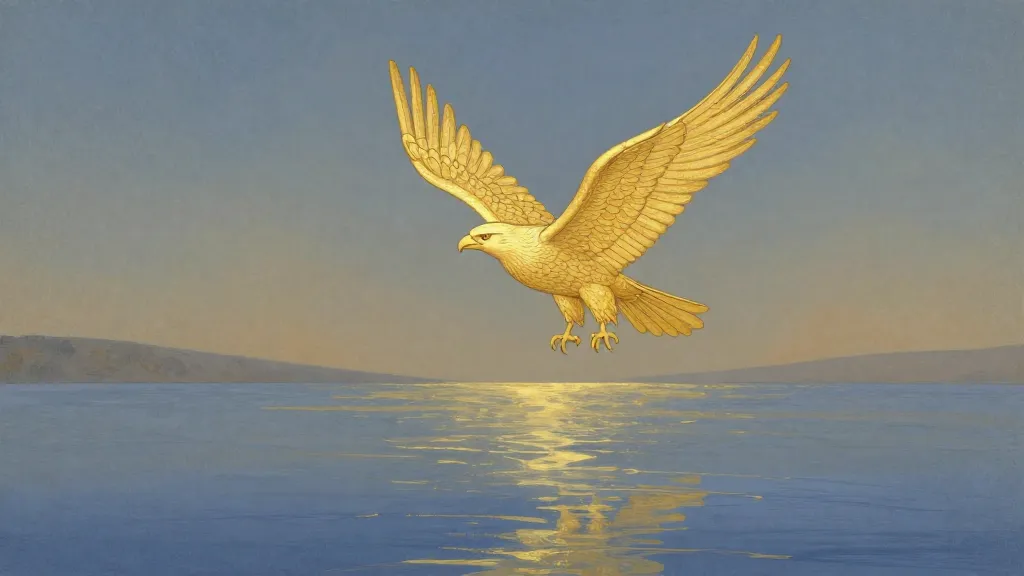
Have you ever looked at a hawk circling high above and wondered what the world looks like from its point of view?
In Ancient Egypt, people looked at the falcon and saw more than just a bird: they saw Horus, the god of the sky. He was a central figure in Egyptian Mythology, representing the power of the Pharaoh and the eternal struggle to keep the world in balance.
Imagine standing on the banks of the Nile River four thousand years ago. The heat is heavy: but a cool breeze ripples the water. You look up and see a falcon, motionless against the blue, its sharp eyes scanning the desert sands.
To the people living there, that bird was not just a hunter. It was a living shadow of a god who had been there since the beginning of time. They called him Horus: the "Distant One."
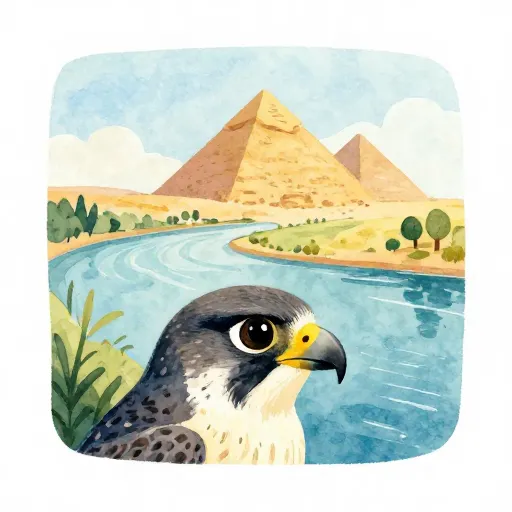
Imagine you are a falcon. You are soaring 2,000 feet above the Nile. Below you, the river looks like a long green ribbon cutting through a vast sea of orange sand. You can see the tiny white sails of boats and the glittering gold tops of the pyramids. Everything looks connected from up here.
Horus is one of the oldest and most complex figures in history. He was often shown as a man with the head of a falcon, wearing a double crown. This crown was important because it showed he ruled over both Upper and Lower Egypt: the two halves of the kingdom.
He was more than a king: he was the sky itself. The ancient stories tell us that his right eye was the sun and his left eye was the moon. When he blinked, or when he flew across the heavens, the day turned to night.
Finn says:
"If his eyes were the sun and the moon, did he have to be careful not to blink during the day, or would it suddenly get dark for a second?"
To understand Horus, we have to look at his family. He was the son of Isis, a powerful magician, and Osiris, the first king of Egypt. His birth was a secret, hidden away in the papyrus swamps of the Nile Delta to keep him safe from his uncle, Set.
Set was the god of storms, desert heat, and chaos. He had killed Osiris to take the throne for himself. This created a world that was broken and out of alignment: a world where the rightful king was gone and a usurper ruled.
The Egyptians are religious to excess, beyond any other nation in the world.
As Horus grew up, he learned that he had a heavy responsibility. He was the heir to the throne, the one who had to restore Ma'at, which is the Egyptian word for truth, balance, and order. He could not just be a child: he had to be a protector.
This led to a series of legendary battles known as the Contendings of Horus and Set. These were not just physical fights with swords or spears. They were trials of strength, wit, and endurance that lasted for eighty years.
Set represented the desert and the storms. He was the force that broke things apart and caused change, which was scary but necessary for new things to happen.
Horus represented the green fields and the steady sun. He was the force that kept things the same and made sure life continued safely every day.
Sometimes they raced in boats made of stone. Other times they transformed themselves into hippopotamuses to see who could stay underwater the longest. These stories show us how the Egyptians thought about the world: as a constant tug-of-war between stability and change.
In one of these fierce battles, Set managed to tear out Horus's left eye. This was a moment of deep darkness and loss. But it also led to one of the most famous symbols in human history: the Wedjat, or the Eye of Horus.
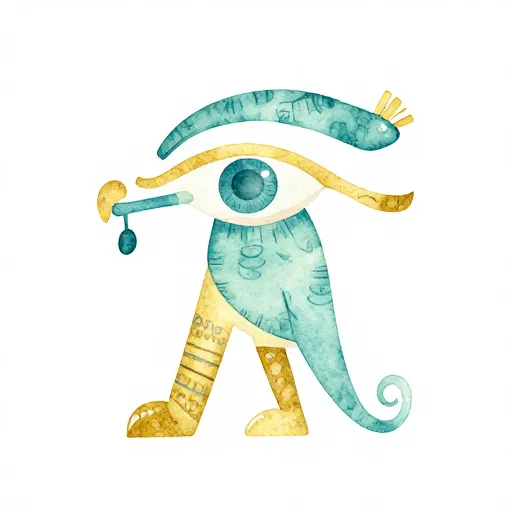
The Eye of Horus was used as a measurement system! Each part of the eye drawing stood for a different fraction: 1/2, 1/4, 1/8, 1/16, 1/32, and 1/64. If you added them all up, they almost made a whole (63/64). The missing 1/64 was said to be the magic Thoth used to heal the eye.
According to the myths, the god Thoth, who looked after wisdom and writing, found the pieces of the broken eye. He used his magic to heal it and put it back together. The eye became a symbol of sacrifice, healing, and protection.
When the eye was restored, it was even more powerful than before. Horus did not keep it for himself: he offered it to his dead father, Osiris, to help him find his way in the afterlife. This act of giving is why the eye was worn as an Amulet by people for thousands of years.

Mira says:
"The eye was broken into six pieces, and the Egyptians used those pieces to represent fractions in math. It’s like their mythology and their homework were the same thing!"
The story of the eye reminds us that even when something is broken, it can be mended into something new. It also explains why the moon is not always full. As the moon wanes, the Egyptians believed the eye was being damaged again: as it waxes, it is being healed.
Eventually, the other gods decided that Horus was the rightful winner. He became the first king of a united Egypt. From that point on, every human Pharaoh was seen as the "Living Horus" on earth.
The Eye of Horus is the symbol of the offering which the living made to the dead.
When a Pharaoh sat on the throne, he wasn't just a man. He was wearing the mantle of the falcon god. This meant he had to be the one who kept the peace and ensured the sun rose every morning. People believed the safety of the world depended on the King acting like Horus.
You can see this connection in Egyptian art. Often, a statue of a Pharaoh will have a small falcon perched behind his head, wrapping its wings around his neck. This was a way of saying: the god is protecting the king, and the king is the god's voice.
Draw your own Eye of Horus! Start with a regular eye shape, then add the 'teardrop' mark and the long, curling 'falcon' tail below it. This symbol was meant to be a lucky charm. If you were a god or a king, what special symbol would you want people to wear to feel safe?
But what happened when a Pharaoh died? The Egyptians had an answer for that too. They believed the dead king became Osiris, the ruler of the underworld, while his son became the new Horus. It was a cycle that never ended, like the flooding of the Nile.
This idea of a son honoring his father and taking up his work is a very human one. It makes the grand, golden myths of Egypt feel a little closer to home. It is about growing up and finding your place in a story that started long before you were born.
Finn says:
"What if the Pharaoh was a bad leader? Did people think Horus had left him, or was Horus just having a bad day?"
As time passed, the image of Horus traveled far beyond the borders of Egypt. When the Greeks and Romans arrived, they were fascinated by him. They mixed his stories with their own, calling him Harpocrates: the god of silence and secrets.
Through the Ages
Even today, we see the influence of the falcon god. Pilots sometimes wear the Eye of Horus for luck. You might see it on jewelry or in movies. It has become a universal sign for someone who is watching over us, making sure things stay right.
In the person of the king, the human and the divine were joined.
In the end, Horus represents the part of us that wants to fix what is broken. He represents the courage to face chaos, even when it feels much bigger than we are. He reminds us that having a "falcon's eye" view means seeing the big picture.
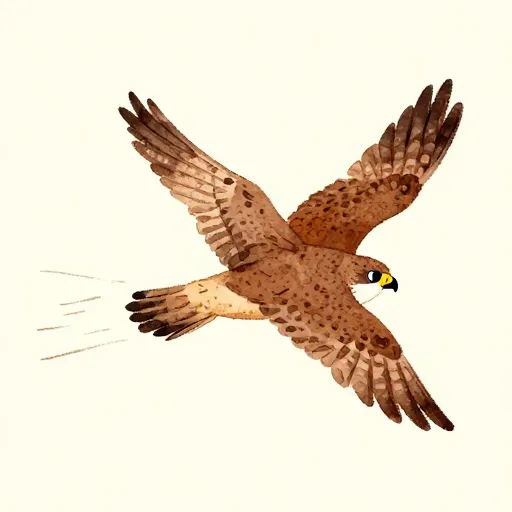
The Peregrine Falcon, which is the bird Horus was based on, is the fastest animal on the planet. When it dives, it can reach speeds of over 200 miles per hour. It’s no wonder the Egyptians thought this bird was divine!
We may no longer believe that a giant falcon flies across the sky to bring the day. But we still value the things Horus stood for: justice, healing, and the protection of the people we love. The Distant One is perhaps not so distant after all.
Something to Think About
If you could see the world through the eyes of a falcon, what is one thing you would want to look at more closely?
There isn't a right or wrong answer here. Some people want to see the beauty of the trees, while others want to see how everyone is connected. What would your falcon's eye find?
Questions About Religion
Was Horus a real person?
Why does Horus have a bird head?
Are Horus and Ra the same god?
The Sky is Still Watching
Next time you see a hawk or a falcon high above, remember the Distant One. The stories of Horus remind us that looking up can help us understand what is happening down here on the ground. Whether it is through math, magic, or mythology, we are all just trying to make sense of the vast, beautiful sky.
