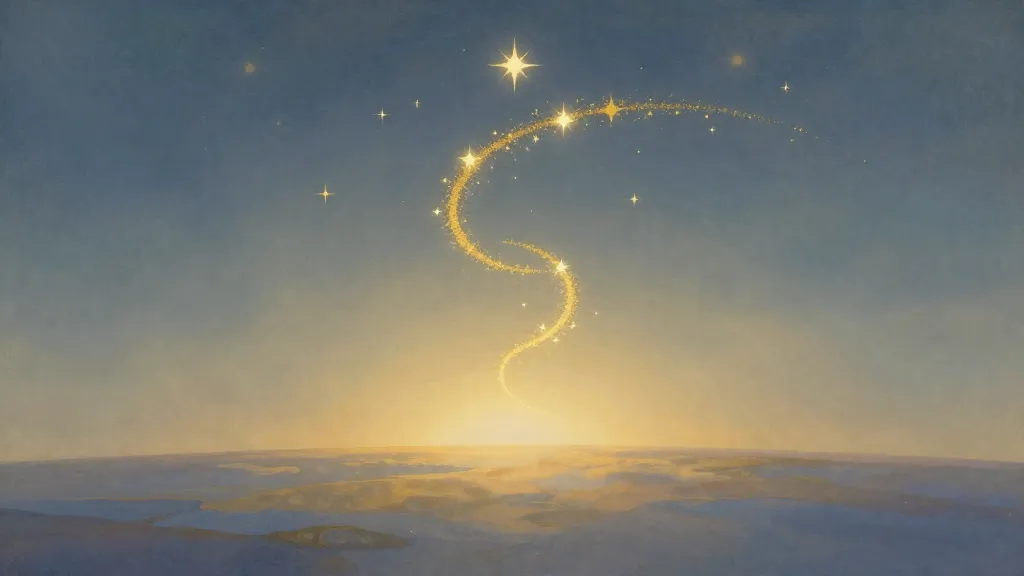
If you look up at the night sky, do you feel small, or do you feel like you belong to something huge?
For as long as humans have been around, we have used the word God to describe the biggest, most mysterious questions of life. Whether through Faith, history, or philosophy, people have tried to understand if there is a power or a presence that connects everything in the universe.
The Oldest Question in the World
Imagine you are standing in a dark cave thirty thousand years ago. There are no city lights, no internet, and no books. You look out at a thunderstorm or a field of blooming flowers, and you wonder: How did this get here?
Since the very beginning, humans have been experts at noticing patterns. We see that the sun rises every morning and the seasons change like clockwork. This led our ancestors to believe that there must be a 'Who' or a 'What' behind the 'How.'

Archaeologists have found evidence that humans were burying their dead with flowers and jewelry over 100,000 years ago. This suggests that even back then, people believed there was something more to life than just what we can see.
In those early days, people didn't have just one idea of God. They saw the divine in everything: the wind, the mountains, and the animals. This belief is called Animism, the idea that everything in nature has a spirit or a soul.

Finn says:
"If the ancient people saw God in the wind, does that mean the wind was their version of a superhero? Or was it more like a feeling they had when the air moved?"
One, Many, or None?
As civilizations grew, so did our ideas about the divine. In places like Ancient Egypt and Greece, people believed in Polytheism, which is the belief in many different gods. Each god had a specific job, like making the grain grow or ruling the sea.
Later, a different idea became popular: Monotheism. This is the belief that there is only one God who created everything. This idea changed the way people thought about the world, making it feel like there was one big story with one author.
- Monotheism: The belief in one single God (like in Judaism, Christianity, and Islam).
- Polytheism: The belief in many gods (like in Ancient Rome or some forms of Hinduism).
- Pantheism: The belief that God and the Universe are actually the same thing.
God is a personal being who listens to prayers, has a plan for the world, and cares about how we behave.
God is an impersonal force or energy, like the 'Soul of the World,' that doesn't have a human-like personality.
But not everyone thinks of God as a person or a spirit. Some people are Atheists, meaning they don't believe in any gods at all. Others are Agnostics, who believe that we simply cannot know for sure if a god exists or not.
The Philosophers’ Detective Work
Thinkers have spent thousands of years trying to prove or disprove God using logic. It is a bit like being a detective looking for footprints of someone you have never met.
One famous philosopher named Xenophanes noticed something funny about how people talked about the divine. He realized that people usually imagined God looking exactly like them.
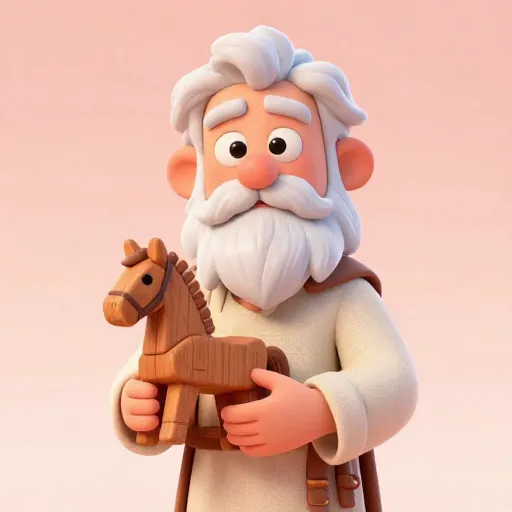
If cattle and horses and lions had hands and could create with their hands... horses would draw the shapes of gods like horses, and cattle like cattle.
He was pointing out that our human brains are limited. We have a hard time imagining something that isn't like us. If we have faces, we think God must have a face. If we have rules, we think God must have rules.

Mira says:
"I like what Xenophanes said. It makes me wonder: if we found aliens on another planet, would their version of God look like a giant octopus or a glowing cloud?"
A Feeling in the Heart
While some people use their brains to think about God, others use their feelings. They might feel a sense of Awe when they see a beautiful sunset or feel a deep sense of peace when they are being kind to someone else.
This is often called a spiritual experience. It is the feeling that you are part of something much bigger than your own life. You might feel it in a quiet church, a busy mosque, or just sitting under an old oak tree.
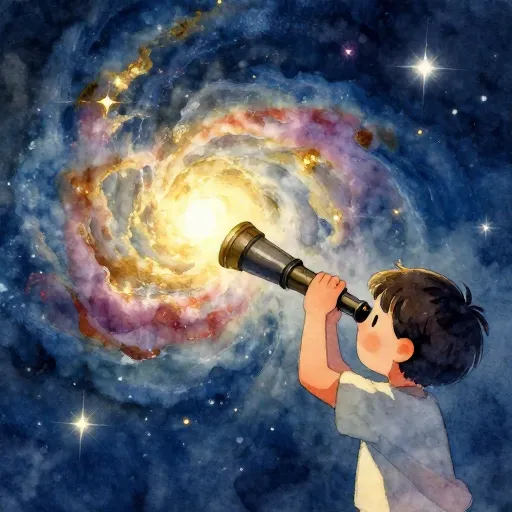
Imagine you are looking through a telescope at a galaxy millions of light-years away. You see billions of stars swirling in a perfect spiral. Some people look at that and see a random accident: others look at it and see the 'signature' of a creator. How does it make you feel?
Blaise Pascal, a brilliant mathematician and philosopher, thought a lot about this. He knew that math could solve many problems, but it couldn't explain the feeling of love or the sense of the divine.

The heart has its reasons which reason knows nothing of.
Pascal believed that some things are too big for our logic to catch. Just because you can't see the wind doesn't mean it isn't moving the trees. To many people, God is like that: invisible but powerful enough to move the heart.
The Universe as a Machine
During a time called the Enlightenment, people started looking at the world through the lens of science. They saw the universe as a giant, perfect clock. If there is a clock, they reasoned, there must be a Creator who built it.
A Journey Through the Divine
This idea suggested that God might be like a grand architect. This architect designed the laws of physics and the way gravity works, and then let the world run on its own. It made God feel less like a person and more like a Great Mind.
Finn says:
"I don't think I need a final answer right now. Whether it's a giant architect or just a huge accident, the fact that we're here to talk about it is pretty cool."
Science and the Mystery
Sometimes people think that science and religion are at war. They think you have to choose between believing in evolution and believing in God. But many scientists throughout history didn't see it that way.
They felt that the more they learned about the complexity of a cell or the vastness of space, the more they felt a sense of the Transcendent. This word describes something that is 'beyond' our normal world, something we can't quite grasp.
- Science asks: How does the world work?
- Religion and Philosophy ask: Why does the world exist?
- Both start with a sense of wonder and a desire to find the truth.
Try to think of something that exists but can't be seen, touched, or measured with a ruler. Examples might be 'Justice,' 'Love,' or 'The number zero.' Many people think of God in this way: as a real idea that shapes our lives even if we can't put it in a box.
Albert Einstein, one of the smartest people to ever live, often spoke about this. He didn't believe in a God who watched over every person like a king, but he felt a deep respect for the order of the universe.
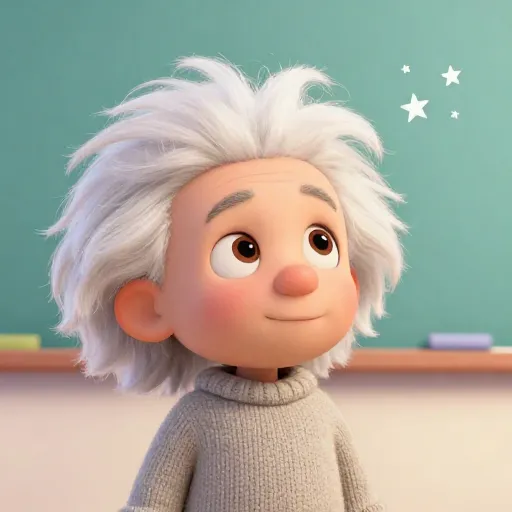
I believe in Spinoza's God, who reveals himself in the orderly harmony of what exists.
Living with the Unknown
Talking about God is different from talking about gravity or math. With math, 2+2 is always 4. With God, people have different answers, and those answers change depending on where they live and how they were raised.
There are over 4,000 different religions in the world today. Each one has its own stories, names, and traditions for understanding the divine. While they disagree on the details, they all share a common goal: trying to find meaning in the world.
It is okay to have questions that don't have easy answers. In fact, some of the most important things in life: like 'What is love?' or 'What is fair?': don't have simple answers either.
Being comfortable with the 'I don't know' is part of being a great thinker. We can listen to what people believed in the past, look at what people believe today, and still keep our own eyes open to the mystery of being alive.
Something to Think About
If you were going to explain the 'mystery of the world' to a friend, what words would you use?
There are no right or wrong answers here. Some people use the word 'God,' some use the word 'Nature,' and some use no word at all. What feels right to you today?
Questions About Religion
Is God a person?
Where does God live?
Can science prove God exists?
The Conversation Continues
Whether you see God in a holy book, a scientific equation, or a quiet moment in nature, you are participating in a conversation that is thousands of years old. The 'Big Idea' of God isn't about having a final answer: it is about the wonder we feel when we ask the questions.
