Have you ever looked up at the night sky and felt both very small and very connected to everything else at the same time?
This feeling of connection is at the heart of Islam, a religion followed by nearly two billion people around the world today. It began over 1,400 years ago in a landscape of shifting sands and brilliant stars, teaching that there is a deep, invisible unity behind all of creation.
Imagine you are standing in the city of Mecca around the year 610. The air is dry and smells of incense and dust. This was a busy place where traders from all over the world met to sell spices, silk, and stories.
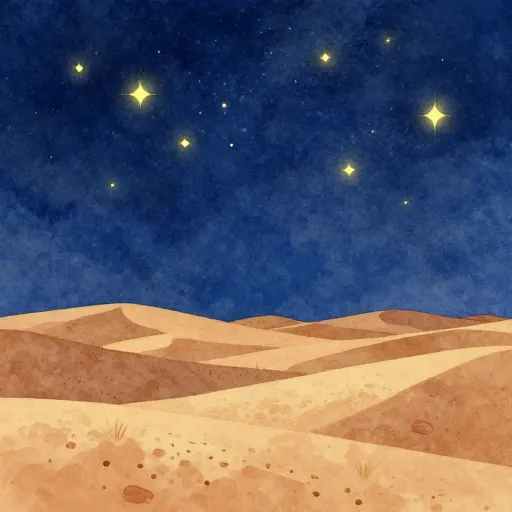
Imagine a night in the desert. The sand is cool now, and the sky is so dark that the stars look like spilled diamonds. Without city lights, you can see the Milky Way stretching across the sky. This is the environment where people first started thinking about the vastness of the universe and the one power that created it.
In this busy world, a man named Muhammad often went to a quiet cave in the mountains to think and pray. He was looking for answers to the big questions: Why are we here? How should we treat one another? It was in this quiet place that he received the first verses of the Quran.

Finn says:
"If the Prophet was alone in a cave, how did he know the words were important? I wonder if the silence made the message feel even louder."
Muhammad became the Prophet, a messenger who shared these ideas with his family and neighbors. He taught that there is only one God, called Allah in Arabic, and that all people should be treated with fairness and kindness, no matter how much money they have.
The best among you are those who have the best manners and character.
At first, these ideas were very surprising to the people in Mecca. Most people there worshipped many different gods and lived in tribes that often fought with each other. The idea that everyone belonged to one big family, or Ummah, was a radical change.
Belief is a private thing between a person and God. It happens in the heart and doesn't need to be shown to others.
Belief must be shown through actions, like helping the poor or praying together, because our faith connects us to the community.
As the message spread, it grew into a way of life that balances what you believe in your heart with what you do with your hands. This balance is often explained through the Five Pillars, which are five core actions that help a person stay connected to their faith.
These pillars aren't just rules to follow. They are more like rhythms, like the beating of a heart or the changing of the seasons. They include praying five times a day, giving to the poor, and fasting during the month of Ramadan.
The Language of the Heart
The Quran is the holy book of Islam, but for many, it is more than just a book. It is a collection of verses that were originally spoken aloud, meant to be heard and recited with a specific rhythm and beauty.

Mira says:
"The calligraphy reminds me of how a song feels in your ears, but for your eyes. It makes the words look like they are dancing."
Because the words were considered so sacred, artists began to find ways to make the written words look as beautiful as they sounded. This led to the creation of Calligraphy, a style of artistic writing where letters curve and flow like vines or waves.
Find a piece of graph paper or a pattern in your house. Try to follow one line with your finger and see how it connects to every other line. In Islamic art, these patterns are meant to help your mind wander into the idea of 'infinity', something that never ends.
In Islamic tradition, you won't see pictures of people or animals in a mosque. Instead, you see incredible patterns called Arabesque. These are geometric shapes that repeat over and over, suggesting that the world is organized and that everything is connected to a single center.

The ink of the scholar is more holy than the blood of the martyr.
A World of Ideas
About 1,200 years ago, the Islamic world entered a time called the Golden Age. While much of Europe was in a quiet period, cities like Baghdad and Cairo were buzzing with scientists, doctors, and philosophers who wanted to understand how the world worked.
The world's oldest degree-granting university was founded by a Muslim woman named Fatima al-Fihri in the year 859! It is called the University of al-Qarawiyyin and it is still open today in Morocco.
They didn't see a conflict between their faith and their science. In fact, they believed that by studying the stars or the way plants grow, they were learning more about the wisdom of the creator. They translated ancient Greek books and invented things we still use today, like algebra.
Through the Ages
Think about the numbers you use in math class. We call them 'Arabic numerals' because it was Muslim scholars who helped spread this system of counting, including the very important concept of zero, from India to the rest of the world.
The Inner Journey
Within Islam, there is a path called Sufism that focuses deeply on the inner experience of love and wonder. Sufis are often called the 'mystics' of Islam. They use poetry, music, and sometimes even a special kind of spinning dance to feel closer to the divine.
Mira says:
"I like the idea that we are all searching for a home we once knew. It makes everyone's journey feel a bit more similar, doesn't it?"
One of the most famous Sufis was a poet named Rumi. He wrote about how the human soul is like a flute made of reed: it sings because it is longing to return to the reed-bed where it began. His poems are still read by millions of people today, even those who aren't Muslim.
Your task is not to seek for love, but merely to seek and find all the barriers within yourself that you have built against it.
Today, Islam is practiced in almost every country on Earth. You can find Muslims in the snowy mountains of Bosnia, the tropical islands of Indonesia, and the busy streets of New York City. Every person brings their own culture and language to the tradition.
During the month of Ramadan, many Muslims fast from food and drink while the sun is up. It isn't just about being hungry: it's a way to practice patience and to remember what it feels like for people who don't have enough to eat every day.
Being a Muslim today can mean many things. For some, it is about the quiet peace of prayer. For others, it is about the excitement of the Eid festivals. For everyone, it involves the challenge of living a good life in a complicated world.
Something to Think About
If you had to choose one action to do every single day to remind yourself of what you value most, what would it be?
There isn't a right or wrong answer here. Some people choose a quiet moment of silence, others choose a specific kind of work, and some choose a way of helping others. What feels most like 'you'?
Questions About Religion
What is the difference between Islam and Muslim?
Why do Muslims pray toward Mecca?
What is the Quran?
The Pattern Continues
Islam is a tradition that looks back to the ancient past while constantly moving into the future. Whether it is through the complex math of a computer program or the simple act of sharing a meal with a neighbor, the ideas of unity and connection continue to shape our world in ways we are still discovering.
