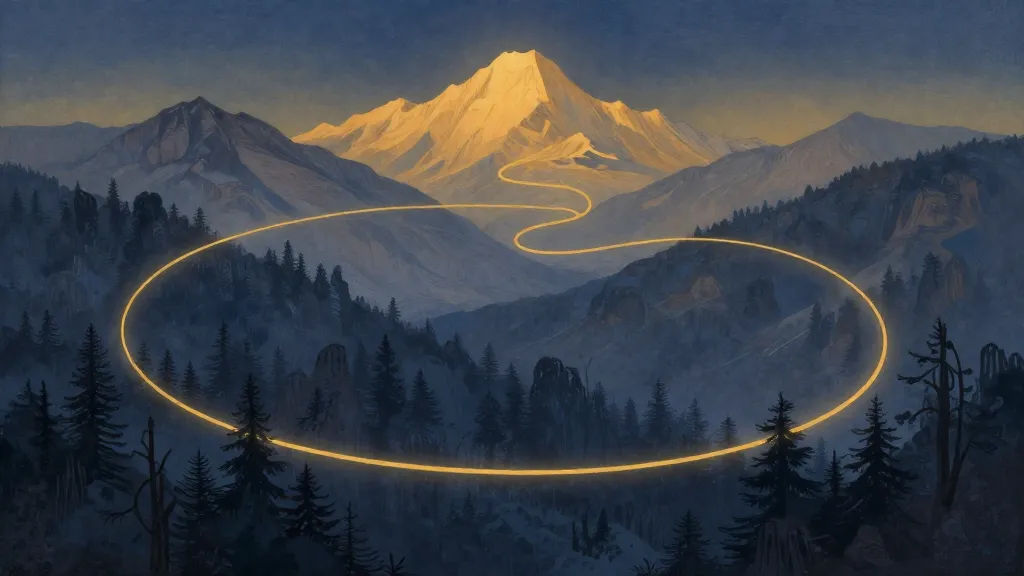
Have you ever noticed that your favorite movies, books, and even your own dreams seem to follow the same secret pattern?
Whether it is a knight in a dusty legend or a pilot in a galaxy far, far away, most adventures share a hidden structure called the Hero’s Journey. This idea was popularized by a man named Joseph Campbell, who realized that humans have been telling the exact same story since the beginning of time.
Imagine a young boy sitting in a giant, quiet library in New York City around the year 1914. His name is Joseph, and while other kids are playing stickball in the streets, he is surrounded by books about Native American tribes. He is fascinated by their stories of Buffalo Queens and trickster coyotes.
As he grows up, he starts reading stories from Ancient Greece, India, and Scandinavia. He notices something strange. Even though these people lived thousands of miles apart and never met, their stories are almost identical. It is as if all humans are born with the same map inside their heads.
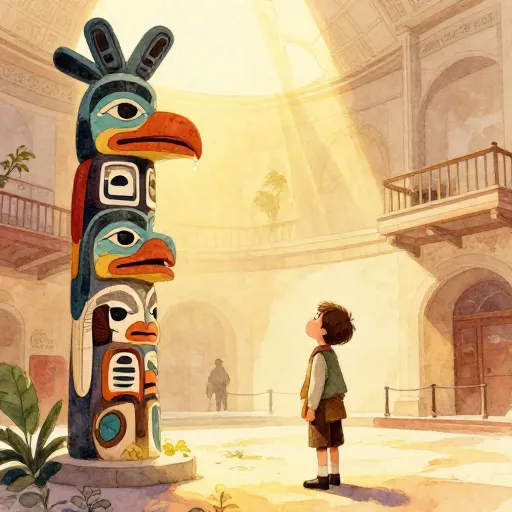
Imagine a young Joseph Campbell standing in front of a massive totem pole at the American Museum of Natural History in New York. He is looking up at the carved eagles and bears, feeling a tingle in his spine. He realizes that the stories this totem pole tells are just as important as the stories he learns in school about George Washington or Ancient Rome.
Joseph Campbell spent his whole life trying to figure out why this map exists. He called this universal pattern the monomyth, which basically means one story. He believed that all myths are like different masks wearing the same face.
Finn says:
"If everyone is telling the same story, does that mean we’ve already run out of new ideas? Or is it like a language that we all just happen to speak?"
The Call to Adventure
Every journey starts in the Ordinary World. This is the place where the hero feels safe, but maybe a little bored or out of place. Think of a hobbit in a quiet hole or a student waiting for the school bell to ring.
Then, something happens: the Call to Adventure. This is a message, an event, or a person that invites the hero to leave their comfort zone. It is the moment the mystery begins, and the hero realizes the world is much bigger than they thought.
Think about your morning today. What was your 'Ordinary World'? Was there a 'Call to Adventure' (like a difficult math problem or a friend asking for help)? If you wrote your morning as a movie script, what would the title be?
Sometimes, the hero does not want to go. Campbell called this the Refusal of the Call. It is that feeling in your stomach when you are offered a lead role in a play or a spot on a new team and you think: I can’t do that.
Follow your bliss and the universe will open doors where there were only walls.
Crossing the Threshold
Once the hero decides to go, they must cross the threshold. This is the line between the world they know and the world of magic, danger, and mystery. It is like stepping through a wardrobe into a snowy forest or diving into a deep pool of water.
In the ancient stories Campbell studied, this threshold was often guarded by a monster or a giant. To get past, the hero has to prove they are ready. They cannot go back to being the person they were before they stepped across that line.
Some people believe a true hero is someone who is forced into a journey they don't want. Their bravery comes from doing the right thing even when they are terrified.
Other people think a hero is someone who actively seeks out adventure and change. Their bravery comes from their curiosity and their desire to make the world better.
On the other side of the threshold, the hero meets a mentor. This is usually an older, wiser person who provides a tool, a map, or just some really good advice. Think of a wizard, a grandmother, or a coach who has seen it all before.

Mira says:
"I noticed that mentors usually give the hero something they already had, like courage. They just help the hero find it. It's like my teacher who says she doesn't give us answers, she just helps us ask better questions."
The Belly of the Whale
Campbell described a very dark part of the journey called the Belly of the Whale. This is a moment where the hero is completely swallowed by their problem. It feels like they have disappeared from the world, and everything is dark and confusing.
But this isn't the end. In mythology, being in the dark is where the hero starts to change. They have to let go of their old fears to become something new. It is a place of transformation, where the hero realizes they are stronger than they realized.
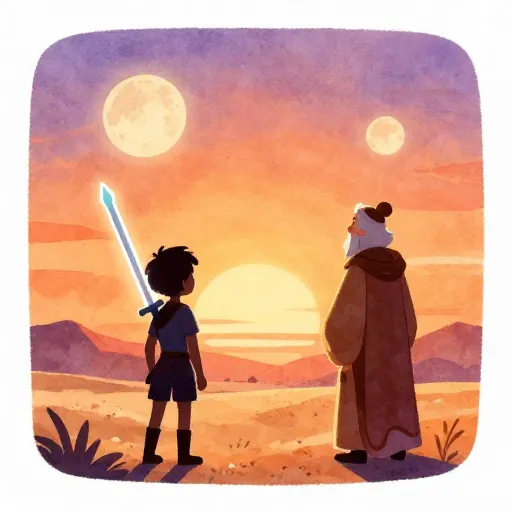
In the 1970s, a filmmaker named George Lucas was struggling to write a movie about space. He read Campbell’s book, 'The Hero with a Thousand Faces,' and realized he was missing the 'skeleton.' He used Campbell's ideas to create Star Wars! Luke Skywalker, Obi-Wan Kenobi, and Darth Vader are all based on Campbell’s archetypes.
During this time, the hero encounters archetypes. These are "character types" that appear in every culture: the Trickster who makes jokes, the Shadow who represents the hero's fears, and the Herald who brings news. Campbell believed these characters aren't just in stories: they are parts of our own minds.
The cave you fear to enter holds the treasure you seek.
The Supreme Ordeal and the Boon
At the very center of the map is the Supreme Ordeal. This is the biggest challenge, the final boss, or the hardest test. It is the moment where the hero faces their greatest fear. If they survive, they win the boon.
A boon might be a physical treasure, like a golden apple or a magic sword. But Campbell said the most important boons are ideas. The hero discovers a truth about themselves or the world that can help people back home.
Finn says:
"Wait, so the hero goes through all that danger just to come back to the same place they started? That seems like a lot of walking for nothing. But I guess they aren't the same person when they get back."
The Road Back and the Return
Winning the treasure is not the end of the story. The hero has to get back to the Ordinary World. This is often harder than the journey out! They have to figure out how to be a hero in a place where people still care about boring, everyday things.
The Journey Through Time
When they finally return, they are the Master of Two Worlds. They can live in the normal world, but they carry the magic of the adventure inside them. They use their treasure to help their community grow or heal.
The word 'Hero' actually comes from an ancient Greek word that means 'protector.' It didn't mean someone who was perfect or famous: it meant someone who was willing to stand in front of others to keep them safe.
Why We Tell These Stories
Joseph Campbell believed that we don't just read myths to be entertained. We read them because they are instructions for how to live. He thought our lives are miniature versions of the Hero's Journey.
When you start a new grade, make a new friend, or face a fear, you are the hero of your own story. You are crossing thresholds and finding mentors every single day. The monsters you face might not have three heads, but they feel just as real.
A hero is someone who has given his or her life to something bigger than oneself.
Something to Think About
If you were the author of your own life story, what 'threshold' are you standing in front of right now?
There are no right or wrong answers. Sometimes we are in the middle of a big adventure, and sometimes we are just resting in our Ordinary World, waiting for the next call.
Questions About Religion
Does every single story follow the Hero's Journey?
Can a hero's journey happen without any magic?
Is a hero always a boy?
Your Own Myth
Joseph Campbell didn't just want us to admire heroes in books. He wanted us to realize that we are heroes, too. Every time you try something new, every time you help someone, and every time you face a fear, you are following that golden circular path. The world is full of thresholds waiting for you to step across them. Where will your journey take you next?
