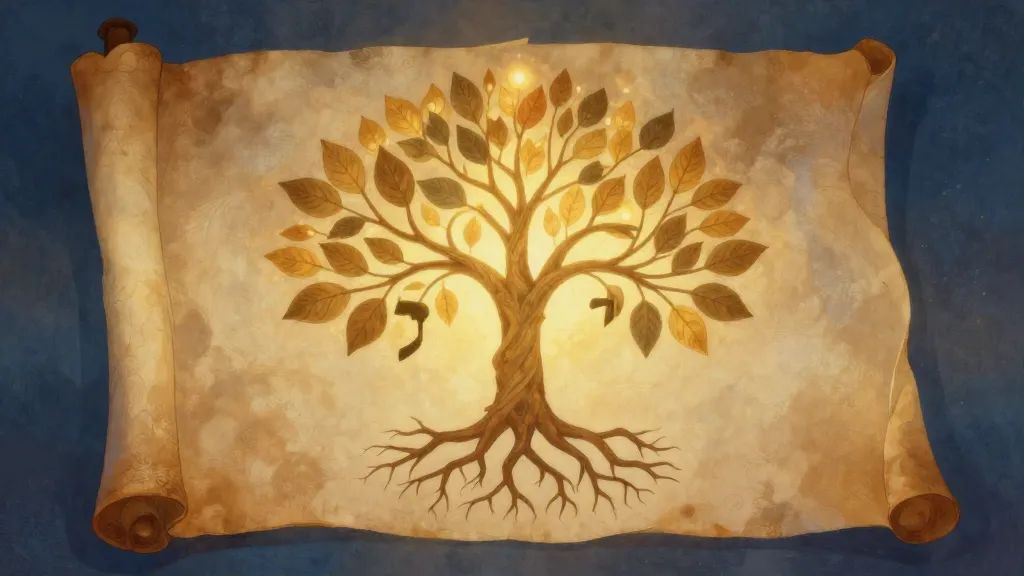
Imagine you had to leave your home and could only take what you could carry in your mind.
For thousands of years, the Jewish people have carried their home with them through stories, laws, and a deep commitment to Monotheism. This tradition, built on a Covenant or a special promise, teaches that the world is a place of wonder that needs humans to help complete it.
The People of the Question
Around 3,800 years ago, in a world where most people believed in many different gods for the sun, the rain, and the harvest, a man named Abraham had a radical thought. He began to believe that there was only one God, a single force that connected everything in the universe.
This was the birth of a big idea that changed history. It wasn't just a new way to pray: it was a new way to live. Abraham entered into what the Bible calls a Covenant, which is like a two-way promise between a people and God.
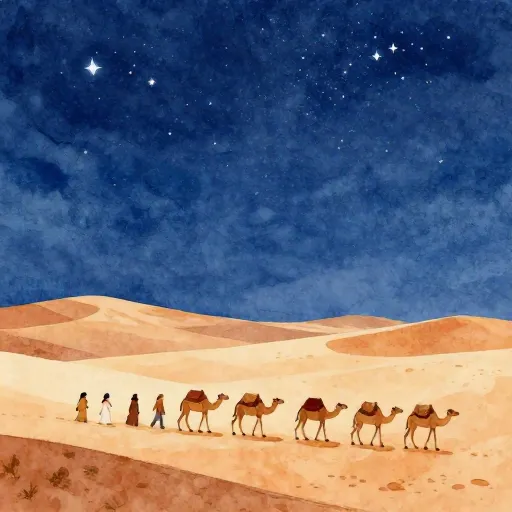
Imagine standing in a vast, quiet desert under a sky filled with more stars than you could ever count. There are no city lights and no phones. This is where the story of Judaism began: with a small group of people wandering through the wilderness, carrying their laws and their God with them in a wooden chest called the Ark.
This promise was simple but difficult. It said that if the people lived with justice and kindness, they would become a light for the rest of the world. This journey started in the Middle East, in a land called Canaan, but the ideas didn't stay in one place for long.
Unlike many ancient civilizations that focused on building massive stone pyramids or temples that stayed in one spot, the early Jewish people focused on their words. They realized that you can destroy a building, but it is much harder to destroy an idea.

Finn says:
"If an idea is 'portable,' does that mean it can never be lost? What if someone forgets the story?"
The Sacred Library
The heart of Judaism is a collection of writings called the Tanakh. The most famous part of this is the Torah, which is often written on long, beautiful parchment scrolls. These scrolls contain the five books of Moses, telling the story of how the Jewish people escaped slavery in Egypt and received the Ten Commandments.
But here is the interesting part: for Jewish thinkers, the story didn't end when the scroll was finished. In fact, the Torah was just the beginning of a massive, 3,000-year-long conversation.
If I am not for myself, who will be for me? But if I am only for myself, who am I? And if not now, when?
Jewish scholars created another set of books called the Talmud. If you look at a page of the Talmud, it looks like a beautiful mess. The main text is in the middle, and all around the edges are comments, questions, and arguments from teachers who lived hundreds of years apart.
It is as if they are all in the same room, debating the same question. In Judaism, asking a good question is often considered more important than having the right answer. This is because a question shows that you are still thinking and growing.

In many Jewish schools, students study in pairs called a Chavruta. Instead of sitting quietly and listening to a teacher, the two students read out loud and argue with each other about what the text means. They believe that 'sharpening' your mind against someone else's is the best way to learn.
Survival Through Stories
History was often very hard for the Jewish people. They were often forced to leave their homes and move to different countries, a process called the Diaspora. Because they were spread out all over the world, from Spain to China to Poland, they had to figure out how to stay connected.
They did this through their traditions. No matter where they were, they celebrated the same holidays and studied the same books. They turned their homes and their Synagogue (a place of meeting) into the centers of their world.

Mira says:
"It's like they built a house out of words and memories instead of bricks. You can take that house anywhere."
One of the most powerful traditions is Shabbat, the day of rest. It starts every Friday evening at sunset and lasts until Saturday night. For 24 hours, the world slows down. No work is done, no chores are finished, and today, many people even put away their phones.
Shabbat is based on the idea that humans aren't just 'doing' machines. We are 'being' humans. By stopping for one day, people remember that they are free and that the world is something to be enjoyed, not just conquered.
The idea of Shabbat is to create a 'palace in time.' Try this: Pick one hour this weekend to have a 'Mini-Shabbat.' Turn off all screens, put away your homework, and do something that just makes you feel happy and present: like drawing, talking, or going for a walk. Notice how it feels to have nowhere else to be.
The Maimonides Challenge
As the centuries passed, Jewish thinkers began to wonder how their ancient stories fit with new scientific discoveries. In the 12th century, a famous philosopher and doctor named Maimonides (also known as Rambam) wrote about this very problem.
He believed that God gave humans two different gifts: faith and reason. He argued that these two things could never truly contradict each other. If science proved something was true, then our understanding of the ancient texts just needed to be updated.
The risk of a wrong decision is preferable to the terror of indecision.
Maimonides showed that being religious didn't mean you had to stop being logical. He helped bridge the gap between the ancient world and the modern world, encouraging people to use their brains to explore everything from medicine to astronomy.
This love of learning became a core part of Jewish identity. Whether it was studying the stars or studying the law, the goal was always the same: to understand the world more deeply so we can treat each other more fairly.
Tradition is like a fence. It protects the most important ideas from being lost or changed by the outside world, making sure they stay pure for the next generation.
Tradition is like a living seed. It has to grow and adapt to the soil it is planted in, or it will eventually stop growing and wither away.
Repairing the World
There is a beautiful concept in Judaism called Tikkun Olam, which literally means 'repairing the world.' This idea suggests that when the universe was created, some of the divine light broke into tiny shards and was scattered across the earth.
Every time a person performs a Mitzvot (a good deed or a commandment), they are picking up one of those shards. They are helping to glue the world back together. This turns everyday life into a kind of holy adventure.
Finn says:
"If we are 'repairing the world,' does that mean the world was born broken, or just that it's still being made?"
A Mitzvot isn't just a suggestion; it's a responsibility. It could be something as big as helping a refugee find a home or as small as visiting a friend who is feeling lonely. In this way of thinking, humans are partners with God in the ongoing work of creation.
Judaism Through the Ages
The Future of the Conversation
Today, Judaism is full of different voices. Some people follow every ancient rule very strictly, while others focus more on the history and culture. There are Reform, Conservative, and Orthodox Jews, and many other groups in between.
Despite these differences, they are all part of the same long conversation that started with Abraham. They are all still reading the same scrolls, asking the same hard questions, and trying to figure out how to be a 'light' in a complicated world.

Wonder rather than doubt is the root of all knowledge.
When you look at Judaism, you aren't looking at a finished building. You are looking at a library that is still being written. Every child who asks 'Why?' during a holiday meal is adding a new line to the book.

The Hebrew alphabet has 22 letters, and in Jewish mysticism, these letters are seen as the 'building blocks' of the universe. Some people believe that the world was literally spoken into existence, making words the most powerful tools humans possess.
Judaism teaches that the world is not a place where we have all the answers. Instead, it is a place where we have the privilege of looking for them together, using our history as a map and our curiosity as a compass.
Something to Think About
If you could only keep one memory of your family's history to pass down for 1,000 years, which one would it be?
There is no right or wrong choice. Some people pick a happy memory, while others pick a hard one that taught them a lesson. What matters is why it feels worth carrying.
Questions About Religion
Why do Jewish people wear a small hat called a kippah?
What is a Bar or Bat Mitzvah?
Is Judaism a religion, a culture, or a nationality?
Keep Asking Why
Judaism is a tradition that has survived for thousands of years because it isn't afraid of hard questions. It treats the past as a teacher, the present as a workshop, and the future as a promise. Whether you are Jewish or not, the idea that our words and actions can help 'repair the world' is a big idea that belongs to everyone.
