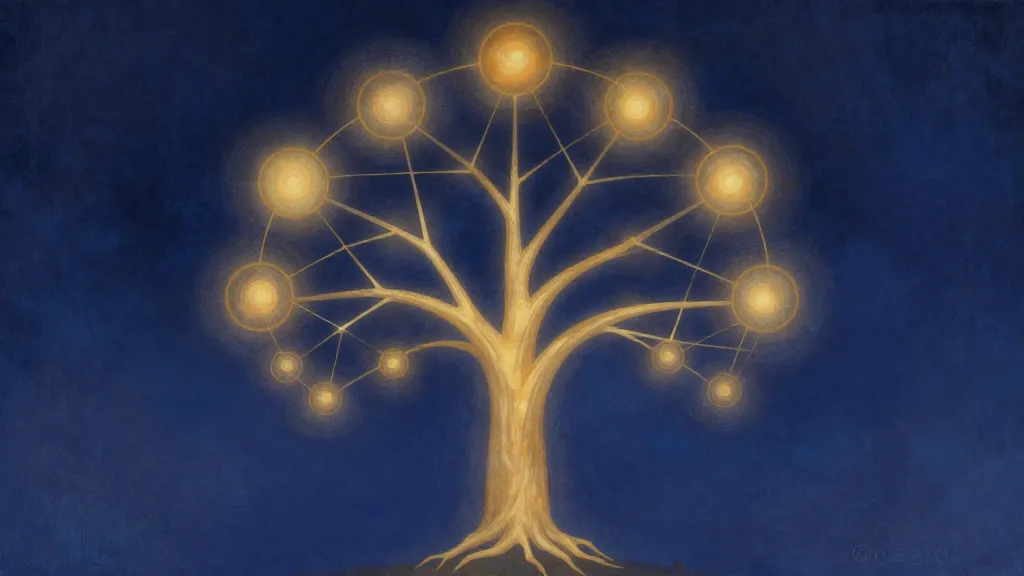
Have you ever looked at a tree and felt like there was a secret hidden inside its bark, or stared at the stars and wondered if they were actually a giant connect-the-dots puzzle?
For centuries, a group of thinkers called mystics have tried to find the hidden meanings behind everything we see. Within the tradition of Judaism, this search for the secret blueprint of the world is called Kabbalah, which means 'that which is received.'
Imagine you are walking through a garden at twilight. You see the flowers, the stones, and the tall grass, but you have a feeling that there is something more happening just out of sight.
Kabbalah is the study of that 'something more.' It is a way of looking at the world as if it were a coded message from the creator, waiting for us to learn how to read it.

Finn says:
"Wait, so the universe is like a giant puzzle with missing pieces? I wonder if I’ve ever stepped on one of those secrets without knowing it."
The Mystery in the Attic
Our story begins in the 1200s, in the sunny, rocky hills of Spain. A man named Moses de León began sharing a collection of ancient-looking books called the Zohar, or 'The Book of Splendor.'
He claimed these books were written over a thousand years earlier by a famous rabbi named Shimon bar Yochai, who had hidden in a cave for thirteen years to study the secrets of the universe.
For a long time, Kabbalah was considered so deep and difficult that teachers said you shouldn't even start studying it until you were 40 years old! They wanted students to be very grounded before they went looking for secrets.
Whether the books were ancient or newly written, they captured people's imaginations. They didn't just talk about rules or history: they talked about the very beginning of time and the 'energy' that keeps the world spinning.
A light that is not seen, which is the secret of all secrets.
The Infinite and the Light
To understand Kabbalah, you have to imagine a time before time. The mystics called this Ein Sof, which means 'the infinite' or 'without end.'
Imagine a light so bright and so huge that it fills up every single corner of space. In this state, there was no room for anything else: no planets, no people, and no trees.
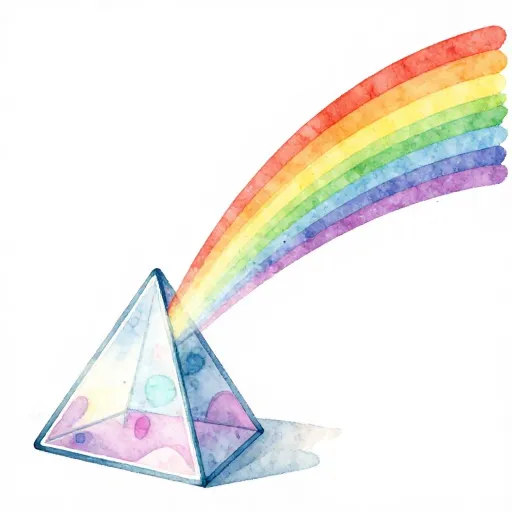
Imagine a dark room with a single lamp. If you put a shade over the lamp, the light doesn't go away, it just changes. Now imagine ten different shades, each one a different color. That is how the Sefirot work: they change the light so we can see it clearly.
To make room for the world, the Ein Sof had to pull back, like someone holding their breath or drawing back a curtain. This 'pulling back' is called Tzimtzum.
Once there was a little bit of empty space, the light began to stream back in, but it had to be carefully contained. If the light was too strong, it would simply melt everything it touched.

Mira says:
"It reminds me of how an artist has an idea in their head before they even touch the clay. The idea is huge, but they have to make it smaller to fit it into the real world."
The Ten Lenses
Think of the light of the universe like a beam of pure white sun. To make that light useful to us, it passes through ten different 'vessels' or lenses called the Sefirot.
Each of these ten vessels represents a different quality. One might be 'Wisdom,' another 'Strength,' and another 'Kindness' or 'Beauty.'
- Wisdom is like the first spark of an idea.
- Kindness is the urge to give and share.
- Strength is the ability to set boundaries and say 'no.'
Next time you are in a group, try to spot the different qualities. Who is showing 'Kindness' by sharing? Who is showing 'Strength' by standing up for a rule? These are the 'vessels' of Kabbalah in real life.
When these qualities are in balance, the world feels right. But when they get out of whack: like if there is too much strength and not enough kindness: things start to go wrong.
The Big Crash
Now, here is where the story gets dramatic. A famous teacher named Isaac Luria, who lived in the mystical city of Safed in the 1500s, told a story about a great accident.
He said that when the light first poured into the vessels, some of the vessels were too fragile to hold it. They weren't strong enough for all that power.
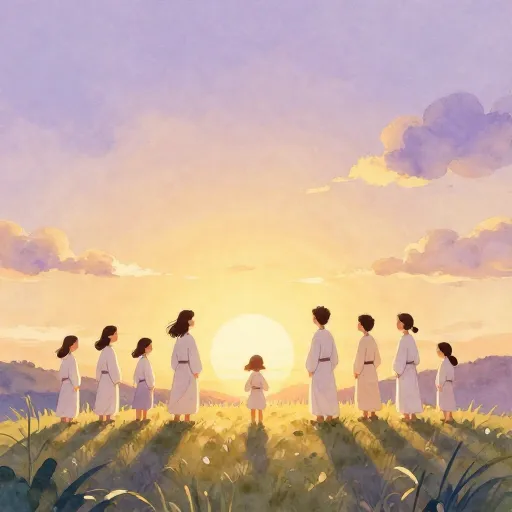
In the city of Safed, the mystics used to dress in white and go out into the fields to welcome the sunset. They believed that at that moment, the world of 'light' and the world of 'earth' were closer than ever.
With a sound like thunder, the vessels shattered! Shards of the vessels and 'sparks' of the holy light fell down into our world, becoming hidden inside physical things like rocks, animals, and even people.

There is no sphere in the world, not even among the lowest, that does not contain sparks of the divine light.
Because of this 'breaking of the vessels,' the world we live in is beautiful but also a little bit broken. There are sparks of light everywhere, but they are often covered in 'shells' of darkness or confusion.
The Great Repair
If the world is broken, who is supposed to fix it? In Kabbalah, the answer is: you are.
This idea is called Tikkun Olam, which means 'repairing the world.' Every time you do something kind, or learn something true, or act with justice, you are 'lifting up' one of those fallen sparks of light.
Finn says:
"So even if I do something really small, like being nice to someone who is lonely, I'm actually helping fix the whole universe? That’s a lot of power for a kid."
Imagine the world is a giant, glowing jigsaw puzzle that was dropped on the floor. Every person's job is to find a few pieces and put them back where they belong.
The world is fundamentally broken and it is our duty to work hard every day to fix the cracks and find the sparks.
The world isn't broken, it is just hidden. Our job is to learn how to see the beauty that is already there, even when it’s hard to find.
This makes our everyday lives very important. Washing the dishes, helping a friend, or even just noticing the beauty of a sunset isn't just a small task: it's a way of putting the universe back together.
Through the Ages
Through the Ages
Why it Matters Today
Even if people don't study the complex maps of the Sefirot, the ideas of Kabbalah have traveled far and wide. The concept of Tikkun Olam has become a huge part of how many people think about their responsibility to the planet and to each other.

Get yourself used to thinking about the goodness of every person, until that goodness becomes a part of you.
It teaches us that things are not always what they seem on the surface. Underneath the ordinary world, there is a hidden layer of wonder, and we are all part of the story of making it whole again.
Something to Think About
If you found a spark of light hidden in a very dark or messy place, what would you do with it?
There is no right answer to this. Some might want to protect it, some might want to share it, and some might want to use it to find other sparks.
Questions About Religion
Is Kabbalah a separate religion?
Do you have to be Jewish to learn about it?
What does the word 'Sefirot' mean?
Keeping the Spark Alive
Kabbalah reminds us that we are all interconnected, like branches on a single tree. Even when the world feels dark or confusing, there is always a spark of light waiting to be found. The next time you do something kind, remember: you aren't just helping a person, you are helping the whole universe.
