
Imagine a god who is also a mischievous child, a brave protector, and a wise teacher all at once.
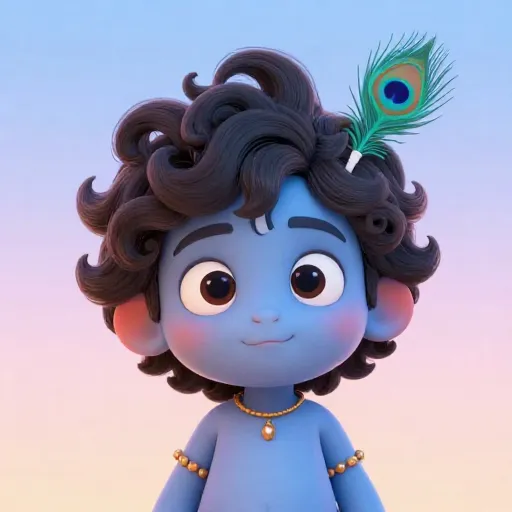
In the vast world of Hinduism, few figures are as beloved or as complex as Krishna. He is often shown with skin the color of a storm cloud and a peacock feather in his hair: a symbol of beauty and the natural world.
To understand Krishna, we have to travel back thousands of years to ancient India. This was a world of deep forests, mighty rivers like the Yamuna, and kingdoms where the line between the human and the divine felt very thin.
According to tradition, Krishna was born about 5,000 years ago in the city of Mathura. At the time, the land was ruled by a cruel king named Kamsa, who was actually Krishna's uncle. Krishna was born in a prison cell, but he was secretly carried across a raging river to a village of cowherds to keep him safe.

The name 'Krishna' comes from a Sanskrit word that means 'dark' or 'dark blue.' It can also mean 'all-attractive,' suggesting that his personality was so magnetic that everyone was naturally drawn to him.
Growing up in the village of Vrindavan, Krishna wasn't like other children. Even as a baby, he was said to have a power that was both quiet and immense. Yet, he didn't spend his time acting like a king or a distant judge: he spent it playing.
The Blue Skin of Infinity
One of the first things people notice about Krishna is his skin. In paintings and statues, he is almost always shown as blue. This isn't because he was actually a different color, but because blue represents things that are infinite and beyond our reach.
Think about the sky on a clear day or the deep ocean. You can see the blue, but you can't touch it or put it in a box. By being blue, Krishna reminds people that the divine is everywhere, like the air, even if we can't always grab hold of it.

Finn says:
"If Krishna is the color of the sky, does that mean he's everywhere at once? It’s kind of like he’s hiding in plain sight, just by being blue."
This idea of the infinite being present in a small, human-sized body is a big part of why people find Krishna so interesting. He is both a friend you can talk to and a mystery that covers the entire universe. It is a way of saying that the biggest ideas in the world can be found in the smallest moments.
The Mischievous Butter Thief
Krishna’s childhood is filled with stories of Lila, a Sanskrit word that means divine play. He was famous for being a bit of a troublemaker. His favorite trick was stealing freshly churned butter from the neighbors' houses.
He and his friends would climb on each other's shoulders to reach the pots of butter hanging from the ceiling. When he was caught, his mother, Yashoda, would try to be cross with him, but his charm and joy made it almost impossible to stay angry.
Stealing is always wrong, even if you are a god. It sets a bad example for children and breaks the rules of the community.
Krishna's 'stealing' isn't about the butter. It’s a metaphor for how God 'steals' our hearts and minds away from boring, everyday worries to focus on joy.
Why would a god steal butter? Philosophers say it shows that God wants our love and devotion as much as we want something delicious. It also suggests that life shouldn't be taken too seriously all the time: that there is something holy in laughter, games, and even a little bit of mischief.

It is better to live your own destiny imperfectly than to live an imitation of somebody else's life with perfection.
Lifting the Hill
As Krishna grew older, his stories became about protection. One of the most famous tales involves a great storm sent by Indra, the king of the gods and the ruler of rain. Indra was angry because the villagers had stopped making offerings to him, choosing instead to honor the local mountain, Govardhan Hill.
To protect the villagers and their animals from the torrential floods, Krishna did something incredible. He lifted the entire mountain on his little finger, holding it up like a giant umbrella for seven days and nights. Everyone took shelter underneath it until the rains stopped and Indra realized he was wrong.

Imagine standing under a massive mountain that is floating in the air right above your head. You can hear the thunder crashing outside, but inside, under the mountain's shadow, everything is dry and calm. You look up and see the smallest finger of a young boy holding the entire weight of the world.
This story taught the people that they didn't need to live in fear of distant, angry forces. Instead, they could find protection in nature and in their connection to Krishna. It shifted the focus from scary rituals to a relationship based on trust and care for the environment.
The Music of the Flute
Whenever Krishna played his wooden flute, or bansuri, time seemed to stop. The cows would stop grazing, the birds would stop singing, and the Gopis: the village girls who tended the cattle: would drop whatever they were doing to listen.

Mira says:
"I like the idea that we are all like flutes. If I'm too full of my own grumpiness or worries, the music can't get through. I have to be 'hollow' to be helpful!"
The sound of the flute is a metaphor for the call of the soul. In this tradition, every person is like a flute: hollow and waiting to be filled with music. When we are quiet and open, Krishna’s music can flow through us, creating harmony in our lives and the world around us.

When doubts haunt me, when disappointments stare me in the face, and I see not one ray of hope on the horizon, I turn to Bhagavad Gita and find a verse to comfort me.
The Prince and the Charioteer
Eventually, Krishna left his village and became a powerful prince. This is where he enters the Mahabharata, one of the longest and most important epic poems ever written. In this story, two branches of a royal family are about to go to war over who should rule the kingdom.
Krishna chooses not to fight as a soldier. Instead, he offers to be the chariot driver for his friend, the great archer Arjuna. Just as the battle is about to begin, Arjuna has a crisis of heart. He sees his cousins and teachers on the other side and doesn't want to fight.
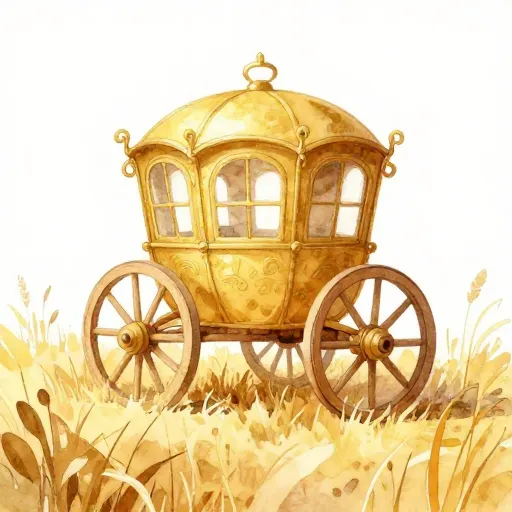
Picture a massive battlefield with thousands of horses and banners. In the middle of it all, two friends sit in a golden chariot. Time has frozen. The arrows are suspended in mid-air, and the only two people talking are the prince and his driver, discussing the meaning of life.
At this moment, Krishna stops time and has a long conversation with Arjuna. This conversation is known as the Bhagavad Gita, which means the Song of God. It is one of the most famous philosophical texts in history, covering life, death, and how to do the right thing when every choice feels difficult.
The Lesson of Dharma
Krishna explains to Arjuna the concept of Dharma, which means duty, purpose, or the natural order of things. He tells Arjuna that he cannot run away from his responsibilities, even when they are painful. However, he gives a very specific piece of advice: do your work, but don't worry about the results.
You have a right to perform your prescribed duties, but you are not entitled to the fruits of your actions.
This means that we should focus on doing our best right now, rather than worrying if we will win a prize or if people will cheer for us. By letting go of the outcome, we can find a kind of peace even in the middle of a struggle. Krishna showed Arjuna his true, cosmic form: a vision of the entire universe contained within one being.
Next time you are working on something hard: like a math problem or a drawing: try to forget about the grade or what people will think. Just focus on the feeling of the pencil in your hand and the shape you are making. That is practicing 'action without attachment,' just like Krishna taught.
Through the Ages
Krishna's story didn't end in ancient India. His influence has traveled across oceans and through centuries, changing how people think about love and action.
Krishna Through the Ages
In the Middle Ages, a movement called Bhakti swept across India. This was a time when poets and singers focused on a personal, emotional connection with Krishna. They didn't care about complicated rituals: they just wanted to sing about their love for the Blue God.
Today, you can find Krishna's influence in everything from modern yoga studios to popular comic books and movies. He remains a figure who bridges the gap between the serious business of being a grown-up and the pure, uninhibited joy of being a child.
Playing the Game of Life
One of the most profound ideas Krishna leaves us with is that the world is a stage and we are all part of a grand play. If we can see our challenges as part of a game, we might find the courage to face them with a smile rather than with fear.
This doesn't mean life isn't important. It means that even the most difficult parts of our journey are opportunities to learn, to grow, and to find the music within ourselves. Krishna invites us to be like the flute: simple, open, and ready for the song.
Finn says:
"So Krishna says we should do our best but not worry about the score at the end? That sounds like the hardest thing in the world to do during a soccer game!"
Something to Think About
If your life were a piece of music, what kind of song would you want to play through your 'flute' today?
There isn't a right answer to this: maybe your song is loud and energetic, or maybe it's quiet and peaceful. Think about what 'music' you bring to the people around you.
Questions About Religion
Was Krishna a real person?
Why does Krishna have a peacock feather?
Is Krishna the only Hindu god?
The Never-Ending Story
Krishna's life reminds us that wisdom doesn't always have to be heavy or sad. It can be found in a flute's melody, a stolen bit of butter, or a conversation between friends. As you go about your day, keep an eye out for the 'blue' moments: those times when life feels a little more mysterious, a little more playful, and a lot more connected.
