What does it actually mean to be 'rich'?
For thousands of years, people in Hinduism have looked to the goddess Lakshmi to understand the balance between material success and spiritual peace. She is more than just a figure of money: she represents the abundance of the natural world and the light within every person.
Imagine you are standing on the banks of a wide river in India three thousand years ago. The air smells of jasmine and damp earth, and the sun is beginning to set, casting a golden glow over everything.
You might see people placing small clay lamps onto the water, watching them float away like tiny stars. This is a scene that has repeated for centuries, all to welcome a goddess who is as bright as the sun and as fluid as the river.
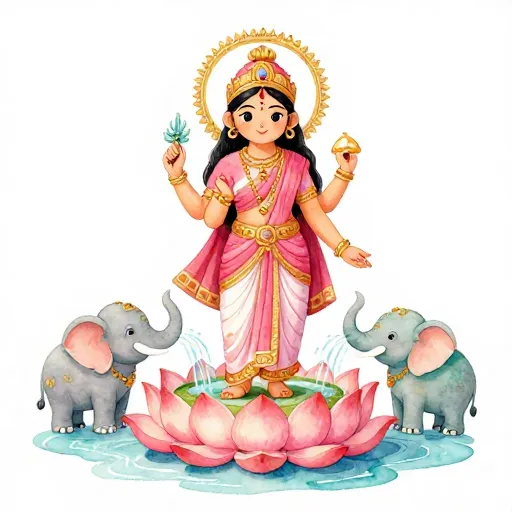
Imagine a woman with skin the color of golden honey, wearing a bright red sari trimmed with gold. She stands on a giant pink lotus flower that is floating on a calm, crystal-blue lake. Around her, two white elephants are gently spraying water from their trunks, creating a misty rainbow in the air. This isn't just a pretty picture: every detail is a code for something deeper about life.
Her name is Lakshmi, and she is one of the most beloved figures in the world. But she is also a bit of a mystery because she represents things that are hard to hold onto: luck, beauty, and wealth.
In the ancient texts called the Vedas, she is sometimes called Shri, a word that means 'radiance' or 'splendor.' To the people who first told her stories, wealth wasn't just about how many gold coins you had in a box.

Finn says:
"So wait, if she's 'radiance,' does that mean wealth is something you can see on someone's face, not just in their pocket?"
Wealth was the health of your cows, the rain that fell on your crops, and the feeling of peace in your home. It was the idea that the universe is naturally full of good things, if only we know how to invite them in.
The Great Churning of the Ocean
One of the most famous stories about Lakshmi begins at a time when the world had lost its luster. The gods, known as devas, were feeling weak and tired because they had lost their 'fortune.'
To get it back, they had to work with their rivals, the asuras, to churn the cosmic ocean. This event is known as the Samudra Manthan, and it is one of the grandest 'What If' stories in history.
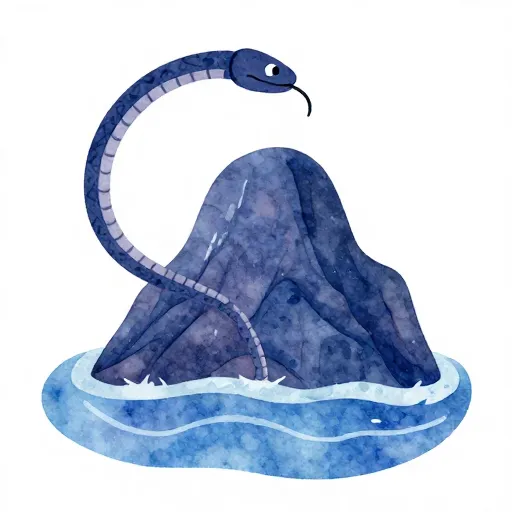
In the story of the 'Churning of the Ocean,' the first thing to come out wasn't Lakshmi: it was a deadly poison! The gods had to deal with the 'bad' stuff before the 'good' stuff could appear. This teaches us that sometimes, hard work and difficult moments are just the first step toward something wonderful.
They used a giant mountain as a stirring stick and a massive serpent as a rope. As they churned the milky waters for a thousand years, wonderful and terrible things began to pop up to the surface.
Out of the frothing waves, Lakshmi finally emerged, sitting on a fully bloomed lotus flower. She was so beautiful and radiant that everyone stopped fighting just to look at her.

I invoke Shri, who is the embodiment of all wealth, who is radiant like gold, and who is the source of all joy.
She didn't belong to the gods or the demons by right: she chose where to go. This is a very important 'Big Idea' in Hindu philosophy: wealth and luck have a mind of their own.
Lakshmi chose to join Vishnu, the preserver of the universe, because he represented order and kindness. This tells us that, in this tradition, wealth is happiest when it is used to keep the world running smoothly.
The Four Hands of Life
If you look at a picture of Lakshmi today, you will usually see her with four arms. In Indian philosophy, these aren't just extra limbs: they represent the four goals of a human life.
- Dharma: Doing the right thing and following your duty.
- Artha: Earning a living and having the things you need to survive.
- Kama: Enjoying life, art, and love.
- Moksha: Understanding the deep truth of the universe and being free.

Mira says:
"The four hands make so much sense. It's like a balanced diet, but for your whole life. You can't just eat dessert all the time!"
Lakshmi holds these four goals in balance. She suggests that you can't really have a 'rich' life if you only focus on one of them.
If you have lots of money (Artha) but you aren't a good person (Dharma), the money won't feel like a blessing. If you are very spiritual (Moksha) but you have no food to eat, it is hard to find peace.

The 'Wealth Audit': Grab a piece of paper and draw four circles for the four hands of Lakshmi. Label them: Health, Friendship, Learning, and Stuff. Inside each circle, write one thing you are grateful for today. Which circle feels the 'richest' right now? It's okay if they change every day!
She often holds two lotus flowers in her upper hands. The lotus is a special symbol because it starts its life in the mud at the bottom of a pond, but grows through the water to bloom in the clean air.
This reminds us that even when things feel 'messy' or difficult, there is always the potential to grow into something beautiful. Her other hands often show a gesture of giving, with gold coins flowing from her palms.
The Fickle Nature of Fortune
There is a nickname for Lakshmi that is very revealing: Chanchala. This word means 'restless' or 'one who moves quickly.'
It is a warning to anyone who thinks they can keep their luck forever. In many stories, Lakshmi leaves people who become greedy, lazy, or mean.

The earth has enough for everyone's need, but not for everyone's greed.
When she leaves, her sister Alakshmi arrives. Alakshmi is the goddess of bad luck and quarrels, and she is said to love places where people are always fighting or where everything is dusty and neglected.
This is why, during the festival of Diwali, people clean their houses until they sparkle. They aren't just tidying up: they are creating an environment that feels 'ready' for goodness to stay.
Some people believe that Lakshmi only stays with people who work incredibly hard, wake up early, and keep everything organized.
Others believe that wealth is a gift of 'grace' or luck, and that we should be grateful for it because it can arrive or leave at any time regardless of how hard we work.
Through the Ages
Lakshmi hasn't stayed in one place or one time. As people moved across the world, their ideas about her changed and grew, like a river branching out into the sea.
Through the Ages
In modern times, Lakshmi is celebrated during Diwali, the 'Festival of Lights.' Millions of people light lamps called diyas to show her the way to their homes.
But the 'Big Idea' behind the lamps is that the light of Lakshmi is also inside us. It is the part of us that is generous, the part that sees beauty in a sunset, and the part that works hard to learn new things.
The Eight Forms of Abundance
Sometimes, Lakshmi is shown as Ashta Lakshmi, which is a group of eight versions of the goddess. Each one represents a different kind of wealth that a person might need.
- Adi Lakshmi: The wealth of origins and ancient wisdom.
- Dhanya Lakshmi: The wealth of food and agriculture.
- Veera Lakshmi: The wealth of courage and strength.
- Gaja Lakshmi: The wealth of power and royalty (often shown with elephants).
- Santana Lakshmi: The wealth of family and children.
- Vidya Lakshmi: The wealth of knowledge and skills.
- Vijaya Lakshmi: The wealth of victory and perseverance.
- Dhana Lakshmi: The wealth of money and gold.
Finn says:
"If there's a goddess for 'the wealth of courage,' does that mean being brave is actually worth more than a pile of gold?"
When you look at this list, you realize that 'money' is only one-eighth of what it means to be wealthy. If you are brave but have no food, you are missing a form of Lakshmi.
If you have a big family but no knowledge, you are also missing a piece. This way of thinking helps people feel grateful for what they do have, even if they don't have a lot of money in the bank.

The butterfly counts not months but moments, and has time enough.
A World of Flow
One of the most beautiful ideas about Lakshmi is that she is like water. Water is only useful when it is moving: when it sits still for too long, it can become stagnant and unhealthy.
Wealth is the same way. In many Hindu families, it is a tradition to give away a portion of what you earn to help others. This keeps the 'flow' of Lakshmi moving through the community.

Lakshmi is often associated with the number 108. In many Indian traditions, this is considered a 'perfect' number. There are even 108 different names for Lakshmi, including 'Padmini' (Lotus-like) and 'Bhagya' (Luck). Imagine having 108 different ways for people to describe your personality!
By giving, you aren't losing wealth: you are participating in the natural rhythm of the universe. It is like breathing: you have to breathe out to be able to breathe in again.
Thinking about Lakshmi doesn't give us a simple map to getting rich. Instead, it invites us to wonder about why some people are lucky, how we handle success, and what we choose to value.
Something to Think About
If Lakshmi is like water that must keep flowing, what is one 'good thing' you have that you could help flow to someone else?
Think about things that aren't objects, like a joke, a skill, or a kind word. There is no right or wrong way to share your own 'wealth.'
Questions About Religion
Is Lakshmi only a goddess of money?
Why is Lakshmi always sitting on a lotus?
Why does Lakshmi have an owl for a vehicle?
The Light That Stays
Whether we see Lakshmi as a goddess in a story or as a symbol for the 'good life,' her message is about more than just getting what we want. It is about noticing the beauty that is already around us: the way the light hits a leaf, the safety of a home, and the chance to try again tomorrow. That kind of wealth is something that no one can ever truly take away.