Imagine a place so important that every person in a global community of two billion people knows exactly which direction it lies in, no matter where they are standing.
This is Mecca, the holiest city in Islam and the birthplace of the Prophet Muhammad. For centuries, it has acted as a spiritual magnet, drawing travelers across vast oceans and burning deserts to reach its center: the Kaaba.
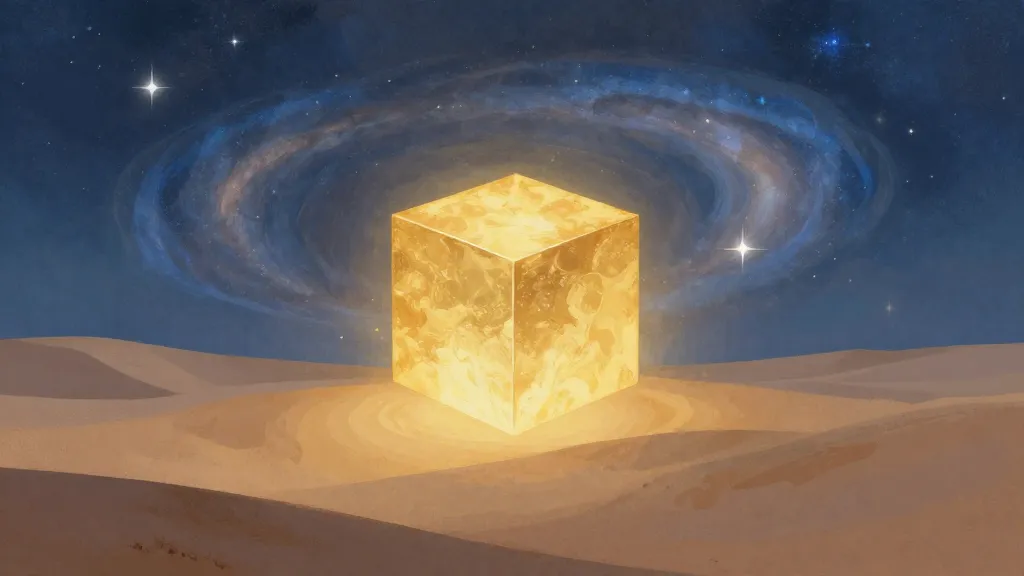
Imagine standing in the middle of a vast, golden desert. The air is so hot it shimmers like a ghost, and the silence is deep enough to feel in your bones. In the middle of this stillness, tucked between rugged hills, lies a city that has been a heartbeat for millions of people for over a thousand years.
This is Mecca, a place that is much more than just a point on a map. For Muslims all over the Earth, this city in Saudi Arabia is the Qibla, the sacred direction. It is like an invisible thread connects every person to this single, ancient valley.
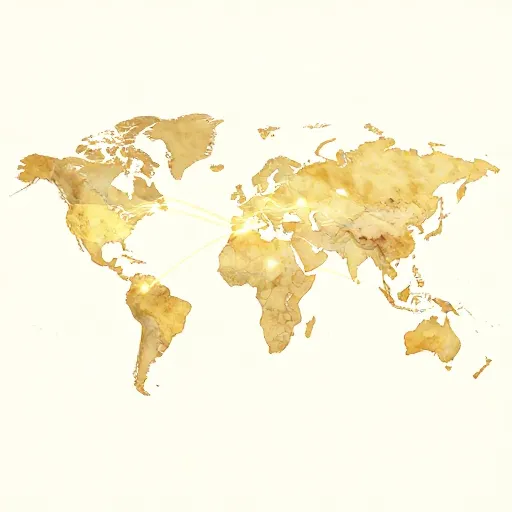
Imagine you are a bird flying high above the Arabian Peninsula. Below you, thousands of paths from every continent are slowly curving toward a single point. It looks like a giant spiderweb made of footsteps, all meeting in one small, rocky valley.
Before it was a city of soaring skyscrapers and grand arches, Mecca was a quiet stopping point for travelers. It sits in a valley called Bakkah, surrounded by the jagged peaks of the Sirat Mountains. Thousands of years ago, it was a place where caravans filled with spices, perfumes, and silks would rest.
These travelers were looking for water and safety in a harsh landscape. They found it in a place that seemed protected by the earth itself. Even then, people felt there was something special about the atmosphere of this hidden valley.

Mira says:
"It is like a giant compass! If everyone in the world is pointing toward one tiny dot, that dot must have a lot of 'gravity' for people's hearts."
The most famous part of the city is the Kaaba, a massive cube-shaped building that stands in the center of the Grand Mosque. It is draped in a heavy, black silk cloth that glitters with gold thread. To look at it is to see the physical anchor of a whole faith.
The Kaaba is not a tomb or a house for a statue. It is an empty room that represents the idea of one God. For many, its simplicity is what makes it so powerful and mysterious.
The Kaaba is the heart of the world, and the world is the body around it.
When people visit the Kaaba, they perform a ritual called Tawaf. This involves walking around the cube seven times in a counter-clockwise direction. Imagine thousands of people moving together like a slow, white whirlpool of prayer.
This movement is meant to show that God is the center of their lives. Just as the planets circle the sun, the people circle the Kaaba. It is a moment where individuals stop being just themselves and become part of a massive, flowing whole.
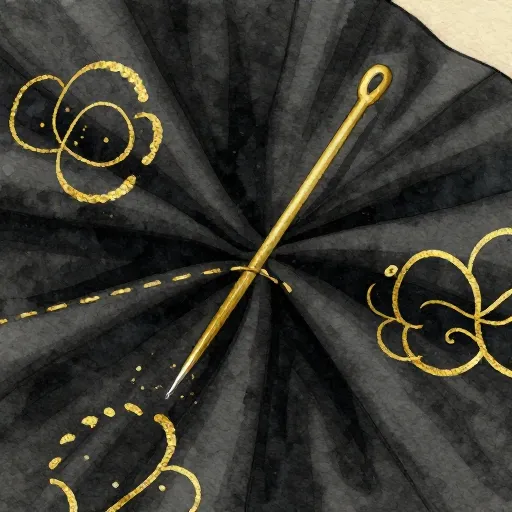
The black cloth covering the Kaaba is called the Kiswah. It is made of 670 kilograms of silk and is embroidered with 120 kilograms of gold and silver thread. Every year, a brand new cloth is made by hand and placed over the building!
Why do people travel so far to get here? This journey is called the Hajj, and it is one of the Five Pillars of Islam. Every Muslim who is healthy and can afford it hopes to make this trip at least once in their life.
During the Hajj, something very interesting happens to the way people look. Everyone puts on a special set of clothes called the Ihram. For men, this is two simple pieces of white, unstitched cloth: for women, it is a plain, modest dress.
Finn says:
"Wait, so if everyone wears the same white clothes, how do you find your friends in the crowd? It must feel like being part of one giant, blurry family."
In the Ihram, you cannot tell who is a king and who is a bus driver. You cannot tell who is rich or who has spent their last penny to get there. This uniform is a way of saying that in the eyes of the Divine, everyone is exactly the same.
This sense of equality is one of the most powerful ideas in Mecca. It challenges the world outside, where we often judge people by their clothes, their money, or their jobs. Inside the sacred space of Mecca, those things simply melt away.
I have never before seen sincere and true brotherhood practiced by all colors together, irrespective of their color.
The history of Mecca goes back much further than the birth of the Prophet Muhammad in the year 570 CE. According to Islamic tradition, the story begins with Ibrahim (known as Abraham in other faiths) and his son Ishmael. They are said to have built the first foundations of the Kaaba.
There is also the story of Hagar, Ishmael’s mother, who ran between two hills searching for water for her thirsty child. This story is remembered today through the Zamzam well, which still provides water to millions of visitors in the desert heat.
Take a piece of string and a globe (or a map). Pin one end of the string to Mecca. Now, pull the string to where you live. Try pulling it to five other cities around the world. Notice how Mecca is the 'hub' of this giant wheel of connections.
Because so many people from different cultures have met in Mecca over the centuries, the city became a massive library of ideas. People from Africa, Asia, and Europe would meet in the markets and mosques. They shared stories, scientific discoveries, and beautiful art.
Mecca was never just a place for prayer: it was a place where the world met. It was a global village long before the internet was ever invented. You could hear dozens of different languages being spoken in a single afternoon.
Mecca Through the Ages
How do we think about a place that is both a physical city and a spiritual idea? For some, Mecca is a place of history and stone. For others, it is a feeling of being "at home" even if they have never actually stepped foot there.
This is what philosophers call a sacred space. It is a location that feels different from the rest of the world. In Mecca, time seems to slow down, and the noisy distractions of modern life are replaced by a focus on the internal self.
Mecca is a real place with streets, hotels, and a very hot climate. You go there to touch the stones and hear the sounds of the crowd.
Mecca is a state of mind. You don't have to be there to feel the connection. It is the idea of unity and peace that travels with you everywhere.
As the city grows, it faces new questions. There are now giant clocks and luxury hotels overlooking the ancient Kaaba. Some people wonder if the city is changing too fast, while others feel the modern buildings help more people visit safely.
This tension between the ancient and the modern is part of Mecca’s story now. It is a city that must hold onto its 4,000 year old roots while making room for the millions of people who arrive by airplane every year.
Mira says:
"I wonder if the Kaaba feels small when you stand next to it, or if it feels like the biggest thing in the universe because of what it represents."
Even if you are not Muslim, the idea of Mecca is fascinating. It asks us: what is the center of your world? Is there a place, an idea, or a person that helps you find your way when you feel lost?
Mecca reminds us that humans have always looked for a "center." We look for places where we feel connected to something bigger than ourselves. It is a reminder that even in a world that feels very divided, millions of people can still find a common direction.
The heart is like a bird that flies toward the sanctuary of the desert.
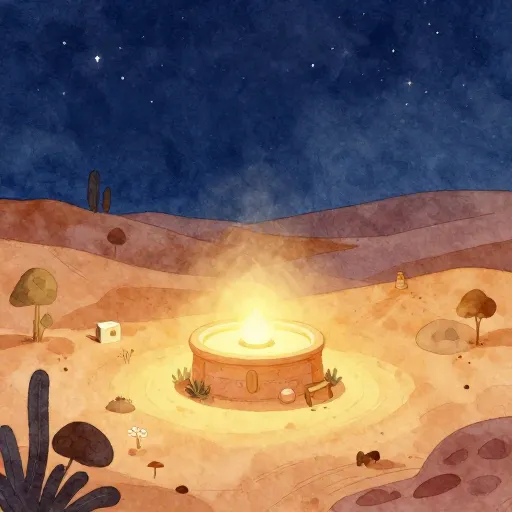
The Zamzam well has been providing water for thousands of years in the middle of a dry desert. Even though millions of people drink from it every year, it has never run dry. Scientists have even studied the water to see why it is so unique!
The city continues to be a place of deep wonder. It is a city of circles: the circles of people walking, the circles of the stars overhead, and the circles of history repeating itself. Every year, the story of Mecca begins again as a new group of travelers arrives at the edge of the desert.
They bring with them their hopes, their fears, and their questions. And the city, with its silent black cube and its ancient mountains, waits to receive them.
Something to Think About
If you had to choose one place that feels like the 'center' of your world, where would it be?
There is no right answer to this. It could be a physical place like your bedroom, or an invisible place like the feeling you get when you are reading a great book.
Questions About Religion
Can anyone visit Mecca?
Why is the Kaaba a cube?
What is the Black Stone?
The Journey Never Ends
Whether we see it through a camera lens or visit it in person, Mecca remains one of the most mysterious and magnetic places on our planet. It reminds us that no matter how much the world changes, humans will always look for a place to gather, a place to be equal, and a place to call home.