What if a single look could turn you into a statue forever?
The story of Medusa is one of the oldest tales from Ancient Greece, traveling through thousands of years to reach us today. She is a figure of mythology who challenges us to think about beauty, fear, and the power of being seen.
Imagine you are standing on a rocky shore in the Mediterranean, three thousand years ago. The air smells of salt and wild thyme: the sun is hot on your neck.
You hear stories whispered in the marketplace about the Gorgons, three sisters who live at the very edge of the night. Two of them are immortal, but the third, Medusa, is a mystery that has puzzled humans for centuries.
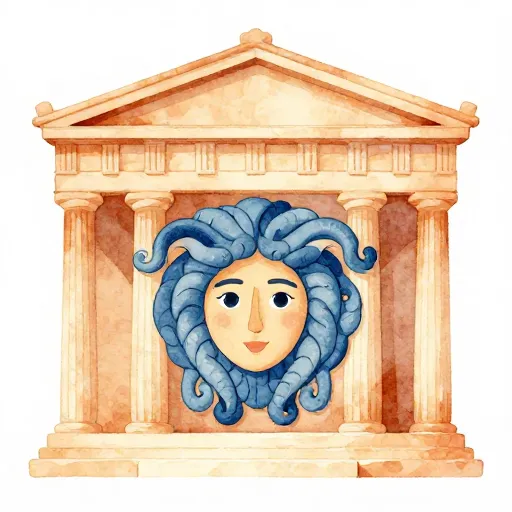
Imagine the Temple of Artemis on the island of Corfu. High up on the triangle-shaped roof (the pediment), there is a massive stone carving of Medusa. She is twice as tall as a person, her tongue is sticking out, and she is running in a 'knielauf' pose, which means she looks like she is sprinting through the air. She isn't hiding: she is standing right in the front for everyone to see.
Who was she, really? In the earliest Greek poems, Medusa was a terrifying creature with copper hands and wings of gold.
She was meant to be a monster: something so frightening that just catching a glimpse of her face would turn a person to stone instantly.

Finn says:
"If Medusa lived at the edge of the world where nobody ever went, was she actually lonely? Maybe she just wanted a friend who wouldn't turn into a statue!"
The Two Faces of Medusa
There are actually two different versions of Medusa’s origin story, and they tell us a lot about how the Greeks thought. In the oldest version, written by a poet named Hesiod, Medusa was born a Gorgon.
She lived in a land far to the west, near the garden of the Hesperides. In this version, she was simply a part of the natural world: a wild, dangerous force like a storm or a volcano.
The loud-sounding cry of the Gorgons, which issued from their maiden heads, was a sound to be feared.
Later on, a Roman poet named Ovid decided to change the story. He wrote that Medusa was once a human woman with hair so beautiful it caught the eye of the gods.
He claimed that the goddess Athena transformed Medusa’s hair into snakes as a punishment or a protection. This version makes us wonder: was Medusa a villain, or was she someone who had been treated unfairly?
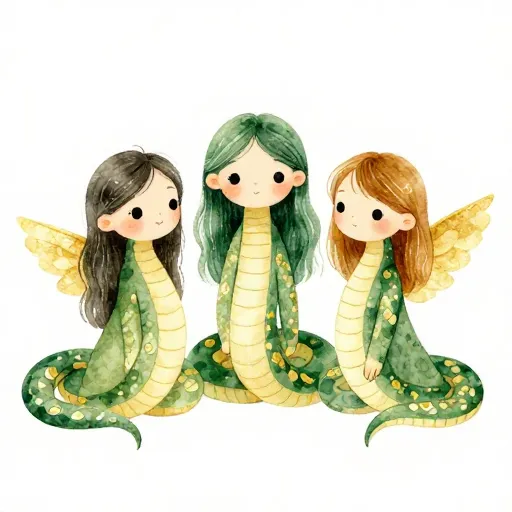
In some versions of the myth, Medusa’s sisters, Stheno and Euryale, had snakes for hair too, but their snakes were special: they could sting like wasps! Medusa was the only one of the three who was 'mortal,' which means she could grow old and pass away.
The Quest of Perseus
Most people know Medusa because of a hero named Perseus. He was sent on a dangerous mission by a king who wanted him out of the way.
Perseus didn't have to go alone, though. The gods gave him special tools: a pair of winged sandals, a bag to hold the Gorgon’s head, and a helmet of invisibility.

Mira says:
"The shield reminds me of how we watch scary movies. We know they aren't real, so the screen acts like a mirror that lets us feel the thrill without the danger."
But the most important tool was a polished bronze shield. Athena told Perseus never to look at Medusa directly.
Instead, he had to look at her reflection in the shiny surface of the shield. By looking at the reflection, he could see where she was without being turned into a statue.

The next time you feel a 'big' emotion like anger or fear, try the Perseus trick. Instead of letting the feeling face you directly, try to look at it in your mind's 'mirror.' Describe the feeling as if it were an object. What color is it? Is it heavy or light? By 'reflecting' on the feeling, you might find it loses its power to turn you to stone.
The Power of the Shield
Think about what it means to look at something through a mirror. When we look at something directly, it can feel overwhelming or scary.
But when we see it in a reflection, we have a little bit of distance. We can study the thing that scares us without letting it take over our minds.

The Gorgon is the mask of the underworld... it is the face of the terrible truth.
Perseus used the shield to find Medusa while she was sleeping. He used his sword to take the Gorgon's head, but the story doesn't end there.
Even after Medusa was gone, her face still held its magic. Perseus used the head to turn his enemies to stone and save his mother, Danae.
Medusa was a dangerous monster who had to be stopped because she turned innocent travelers into stone.
Medusa was a guardian who lived in isolation and only used her power to protect herself from people who came to hurt her.
The Guardian on the Doorstep
In Ancient Greece, Medusa’s face became a symbol called the Gorgoneion. You could find it everywhere: on shields, on breastplates, and even above the doors of houses.
People believed that by putting a scary face on their door, they could scare away bad luck and evil spirits. Medusa became a protector, a silent guardian watching over the people.
Finn says:
"I wonder if the snakes ever got tangled when she was trying to brush them. That would be a very complicated morning routine!"
This is a strange idea, isn't it? The very thing that was meant to be a monster became a lucky charm.
It suggests that sometimes the things we are most afraid of can also be the things that keep us safe. It is all about how we choose to look at them.
Medusa Through the Ages
The Science of the Stone
Sometimes, myths are a way for ancient people to explain things they saw in nature. Some historians wonder if the idea of Medusa came from the sight of octopus or squid.
Think about it: they have long, snake-like tentacles that swirl around their heads. If you saw one underwater for the first time, you might think you were seeing a monster.

According to the myth, when Perseus flew over the Red Sea with Medusa’s head, drops of her blood fell into the water. The Greeks believed those drops turned into the beautiful red coral reefs we see today! So, even in the story, something scary turned into something beautiful.
Others think the "turning to stone" part of the story comes from how we feel when we are very afraid. Have you ever been so startled that you couldn't move a muscle?
We call this the "freeze response." It is a natural part of being human. The Greeks just turned that feeling into a story about a woman with snakes for hair.

You only have to look at the Medusa straight on to see her. And she’s not deadly. She’s beautiful and she’s laughing.
Medusa Today
Today, we see Medusa in movies, video games, and even on the logos of famous fashion brands. She has changed from a terrifying monster into a symbol of power and mystery.
Some people see her as a victim of the gods, while others see her as a queen who didn't need anyone's help. The story stays alive because it is so flexible.
We are still trying to understand what it means to have a "stony" heart or a "paralyzing" fear. Medusa is like a mirror herself: we see our own questions reflected in her golden eyes.
Something to Think About
If you had a shield that could show you the 'truth' about things that scare you, what would you want to look at first?
There are no right or wrong answers here. Myths are tools for thinking, and your thoughts are just as important as the ones written down thousands of years ago.
Questions About Religion
Was Medusa actually evil?
Can Medusa turn other monsters to stone?
Why did she have snakes for hair?
The Gaze Continues
Medusa reminds us that the world is full of things that might seem frightening at first glance. But like Perseus with his shield, we have the power to look at things in our own way. Whether she is a monster, a protector, or a mystery, Medusa continues to watch us from the pages of history, waiting for us to decide what we see when we look back.