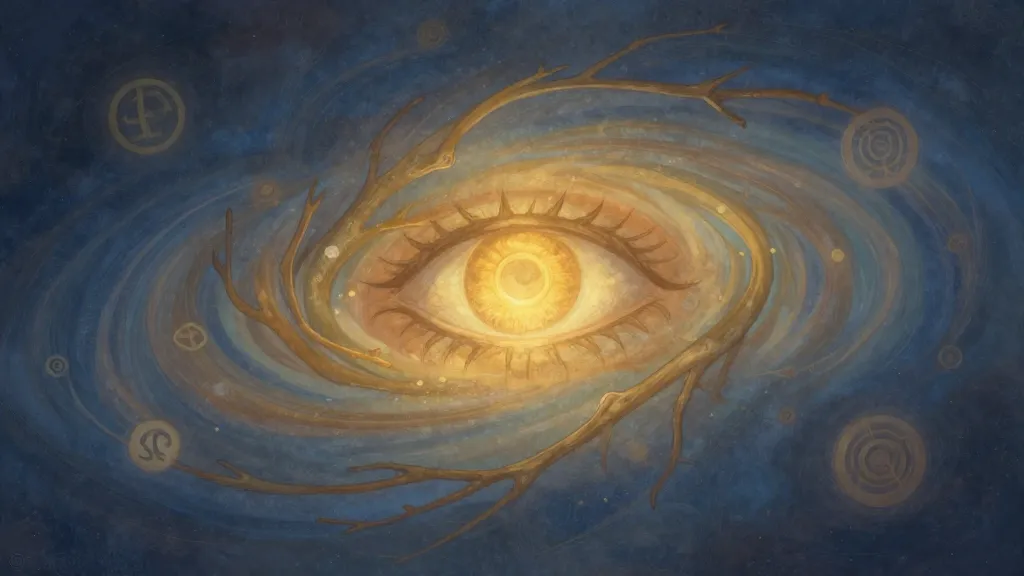
Would you trade something you love to know everything in the world?
In the cold, misty lands of Northern Europe, the ancient Vikings told stories of a god who did exactly that. Known as the All-Father, Odin was a king who preferred wandering the earth to sitting on a throne, proving that wisdom often comes at a heavy price.
Imagine a cold night in a longhouse made of timber and turf. Outside, the wind howls across the snowy mountains of Scandinavia. Inside, families huddle around a crackling fire, listening to a storyteller weave tales of the Viking Age.
They didn't talk about a god who was perfect or always kind. Instead, they spoke of a tall, mysterious man with one eye, wearing a wide-brimmed hat and a deep blue cloak. This was Odin, and he was always searching for secrets.
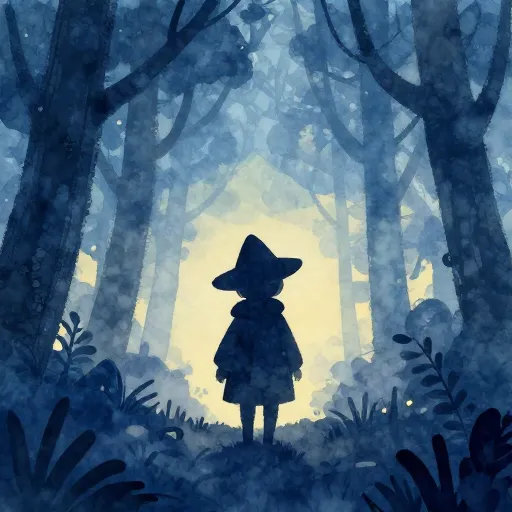
Imagine you are walking down a lonely dirt road as the sun begins to set. You see an old man leaning on a wooden staff. He has a long, flowing grey beard and wears a hat so wide it shadows his face. You realize he only has one eye, but it sparkles with more life than most people have in two. He nods to you, whispers a riddle, and disappears into the mist. That is how the Vikings imagined Odin visiting our world.
Odin wasn't just the king of the gods: he was a collector of experiences. To the Vikings, he was the god of war, but also the god of Poetry and Magic. He didn't just inherit his power: he went out into the dangerous world to earn it.
Finn says:
"If Odin knows everything that's going to happen, does he ever get surprised by a birthday party? Or does he just pretend to be surprised so people feel better?"
The Price of a Secret
In the center of the Norse universe stood a massive, magical ash tree called Yggdrasil. Its roots reached deep into different worlds, and under one of those roots was a well belonging to a very wise being named Mimir.
This wasn't an ordinary well: it was filled with the waters of cosmic knowledge. Odin traveled there because he wanted to see everything that had ever happened and everything that would ever be. But Mimir wouldn't let him drink for free.
Odin is a great protector and a teacher. He suffered and gave up his eye so that he could guide the gods and humans through the dark times of the future. He is a hero of knowledge.
Odin is a liar and a thief. He stole the Mead of Poetry and often tricks humans into starting wars just so he can get more warriors for his hall. He is selfish and dangerous.
Odin didn't argue or try to fight. He understood that something as valuable as the truth cannot be taken: it must be paid for. He reached up, plucked out his own right eye, and dropped it into the water.
By losing half his physical sight, Odin gained a different kind of vision. He could now see into the hearts of humans and the distant future of the gods. He became the god of Wisdom, but he carried the mark of his sacrifice forever.
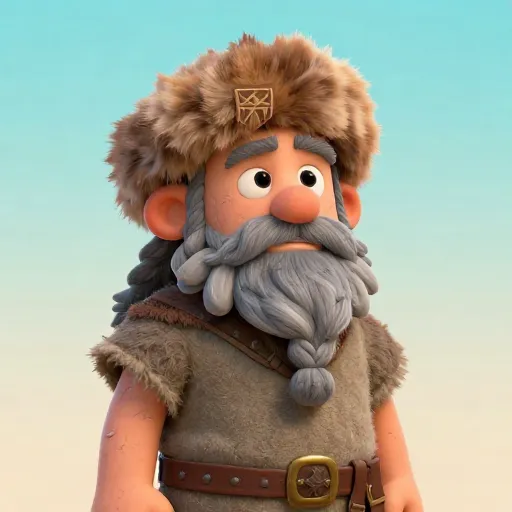
I know that I hung on a windy tree nine long nights, wounded with a spear, dedicated to Odin, myself to myself.
Hanging on the World Tree
Even after trading his eye, Odin wanted more. He saw that the universe was governed by mysterious symbols called Runes. These weren't just letters: they were magical signs that could heal wounds, unlock doors, or even control the weather.
To understand the runes, Odin performed a second, even more difficult Sacrifice. He hung himself from a branch of the world tree, Yggdrasil, for nine long nights. He didn't eat or drink: he simply stared down into the abyss, waiting for the symbols to reveal themselves.

Mira says:
"I think giving up an eye for wisdom is like growing up. You lose the way you used to see things when you were little, but you gain a way of seeing how the world actually works."
On the ninth night, the runes finally appeared in the shadows beneath the tree. Odin reached down, screaming with the effort, and seized them. In that moment, he became the master of hidden knowledge, bringing the gift of writing and magic to the world.
- The Runes were more than an alphabet: they were a way to speak to the universe.
- Each symbol represented a force like 'strength', 'joy', or 'ice'.
- Odin shared this knowledge with humans, which is why the Vikings believed words had power.
The Birds Who Tell the Truth
Odin didn't have to do everything alone. While he sat on his high throne, Hlidskjalf, he had two very special companions perched on his shoulders. These were his ravens, whose names tell us something very important about how the human mind works.
Their names were Huginn and Muninn. In the Old Norse language, these names mean Thought and Memory. Every morning at dawn, Odin sent them out to fly across the entire world.
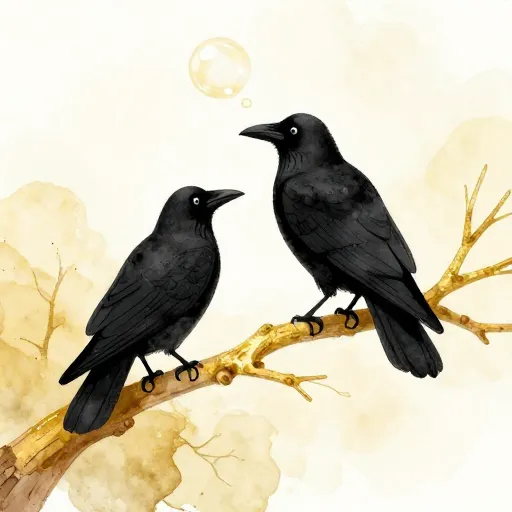
Odin's ravens, Thought and Memory, are more than just pets. In the Viking world, they were symbols of the 'soul' leaving the body. The Vikings believed that when you dream or think very hard, a part of you (like a raven) flies out into the world to find information.
By breakfast time, the ravens would return and whisper everything they had seen into Odin's ears. He worried that Thought might not come back one day, but he worried even more about Memory.
This shows us how the Vikings viewed the world. They knew that a leader needs more than just a big army: they need to be able to think clearly about the present and remember the lessons of the past. Without those two ravens, even a god would be lost.
He is called All-Father, because he is father of all the gods. He is also called Val-Father, because his chosen sons are all those who fall in the fight.
The Mead of Poetry
Odin was also a bit of a trickster. One of his most famous adventures involves the Mead of Poetry, a magical drink that made anyone who tasted it a brilliant speaker or a great poet. It was held by giants who didn't want to share it.
Odin used his Magic to change his shape, turning into a snake to slither through a tiny hole in a mountain. Once inside, he charmed the giantess guarding the mead and drank every single drop in three giant gulps.
Odin had a horse named Sleipnir who was even more unusual than his ravens. Sleipnir had eight legs! This made him the fastest horse in the universe, able to gallop over the sea and through the air. Archaeologists have found ancient stones in Sweden showing pictures of this eight-legged horse from over 1,000 years ago.
He then transformed into an eagle and flew back toward the home of the gods, Asgard. The giants chased him, but he made it home just in time, spitting the mead into golden vats for the gods to use.
This is why the Vikings believed that a great poem was a gift from Odin. To them, Mythology wasn't just a set of dusty old rules: it was an explanation for why some people are better at telling stories or singing songs than others.
The Journey of the All-Father
The Shadow of the End
Unlike the gods in some other religions, Odin and his family weren't immortal. They knew that one day, a great battle called Ragnarök would happen, and many of the gods would fall. This gave Odin's life a sense of urgency.
He spent much of his time preparing for this final day. He created a great hall called Valhalla, where the bravest warriors who died in battle were taken by the Valkyries. These warriors would feast and train until they were needed to fight alongside Odin one last time.
Finn says:
"It's kind of weird that he's preparing for a battle he knows he's going to lose. But I guess if you know the world is ending, you might as well have the biggest feast ever in Valhalla first!"
Odin's story is a bit sad, but it is also very brave. He knew the end was coming, but he didn't give up. He kept searching for more wisdom, kept making more friends, and kept trying to make the world a more interesting place for as long as he could.
He teaches us that even if we can't change the future, we can choose how we face it. We can choose to be curious, to learn as much as we can, and to be brave even when things feel a bit uncertain.
The Norse myths are the myths of a chilly place, with long, long winter nights and endless summer days. They are the myths of a people who did not entirely trust or even like their gods.
The Wanderer Today
You can still find traces of Odin all around you today, even if you don't live in a snowy mountain cabin. His influence on our stories and our language is much deeper than many people realize.
Have you ever noticed that we call the middle of the week Wednesday? In Old English, Odin was called Woden, and 'Woden's Day' eventually became Wednesday. Every time you check your calendar, you are giving a small nod to the one-eyed wanderer.
The Vikings believed the Runes were found by looking at the patterns of branches and shadows. Go outside and find a patch of trees or a pile of sticks. Look closely at how they cross each other. Can you find any shapes that look like letters? If you were to invent a secret code based on the shapes of nature, what would the symbol for 'Friendship' look like?
Authors like J.R.R. Tolkien were fascinated by Odin. When Tolkien created the wizard Gandalf for The Hobbit and The Lord of the Rings, he modeled him directly on the image of Odin: a wandering old man with a staff, a big hat, and a hidden power that could change the world.
Odin reminds us that the world is full of things we don't yet understand. He invites us to be like his ravens: to fly out into the world every morning, look at everything with curious eyes, and bring back stories worth telling.
Something to Think About
If you could trade something you love for an answer to any secret in the universe, what would you trade?
There isn't a right answer to this. Some things might be too precious to give up, and some secrets might be too heavy to carry. What do you think?
Questions About Religion
Why does Odin only have one eye?
Are Odin and Woden the same person?
Who are Odin's children?
Keep Wandering
The stories of Odin don't end with a happily-ever-after. They end with a new beginning. Even if the old gods fall, the world starts again, green and beautiful. Just like Odin, we are all wanderers in a world full of mysteries, and the best thing we can do is keep asking questions, keep learning, and keep our eyes (both of them!) wide open.