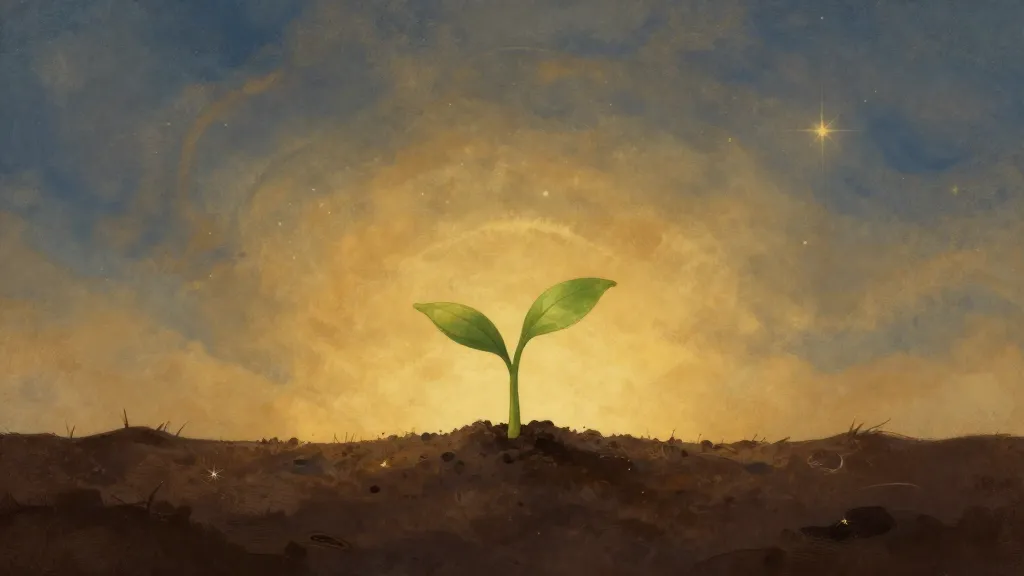
Have you ever looked at a brown, shriveled seed and wondered how something so small and 'dead-looking' could turn into a towering sunflower?
In Ancient Egypt, people asked this same question about everything. They looked at the cycles of the Nile river and the stars to understand Osiris, the god who became the king of the Underworld and the master of rebirth.
Thousands of years ago, the people living along the Nile River did not see the world the way we do. They did not think of life as a straight line with a beginning and an end. Instead, they saw life as a giant, beautiful circle.
Everything in their world moved in loops. The sun rose and set, the river flooded and shrank, and the crops grew and died. To help them understand why things had to die before they could live again, they looked to the story of a king named Osiris.
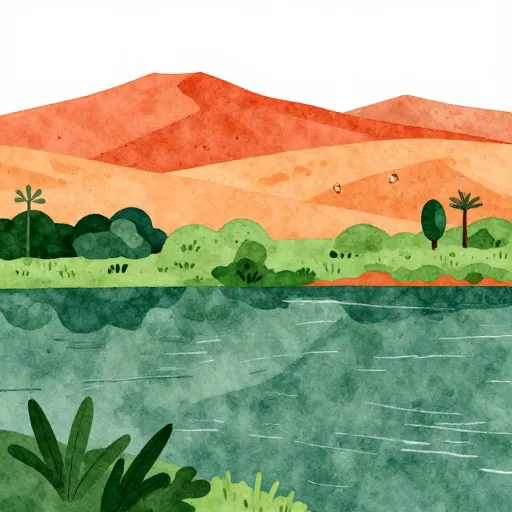
Imagine you are standing on the edge of the Nile. The sun is so hot it makes the air shimmer. To your left is the 'Red Land,' a burning desert where nothing grows. To your right is the 'Black Land,' where the mud is so thick and wet it smells like life. This black mud is where Osiris lives.
Osiris was one of the most important figures in the Pharaoh's kingdom. He was not just a god of the dead: he was also a god of life, agriculture, and the very soil itself. If you saw a painting of him on a tomb wall today, you might notice something very strange about his skin.
In many pictures, Osiris has bright green or deep black skin. For us, green might mean feeling sick, but for an Egyptian, it was the color of fresh sprouts and new life. Black was the color of the rich Silt left behind by the Nile after a flood: the most fertile dirt in the world.
The First King of the Earth
Long before he ruled the land of the dead, the myths say Osiris was the first great king of Egypt. He was a wise ruler who taught people how to farm, how to make laws, and how to honor the gods. He was the person who brought civilization to the valley.

Mira says:
"Think about how a garden looks in winter. It looks like everything is gone, but the roots are actually just waiting. Osiris is like the hidden energy in those roots."
Osiris had a wife named Isis, who was just as wise and powerful as he was. Together, they represented the perfect balance of a kingdom. But Osiris had a brother named Set, who was the god of storms, chaos, and the red desert sand.
Set was jealous of his brother's crown and his popularity. He didn't like the order and peace that Osiris brought to the land. While Osiris was the cool, green river bank, Set was the hot, unpredictable wind of the desert.
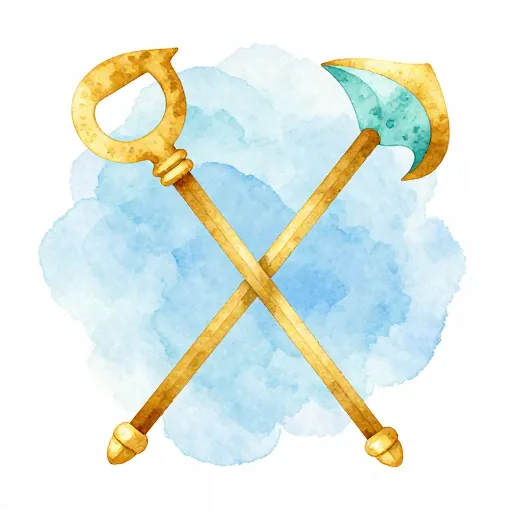
Osiris is often shown holding two things in his crossed arms: a crook and a flail. The crook is a shepherd's staff, showing he leads his people like a flock. The flail is a tool used to beat grain, showing he provides food. These became the symbols of every Pharaoh for 3,000 years!
The Trick and the Chest
One day, Set decided to get rid of his brother. He built a magnificent chest made of expensive wood and gold, decorated with beautiful patterns. At a grand party, he told the guests that whoever fit perfectly inside the chest could keep it as a gift.
Many people tried, but they were all too tall or too short. Finally, Osiris stepped inside, and because Set had measured him in secret, he fit perfectly. Set slammed the lid shut, sealed it with lead, and threw it into the Nile.
For Osiris is the lord of the eternity, who judgeth what is and what is not throughout the world.
This is the moment where the story of Osiris takes a turn toward the mysterious. The river carried the chest far away to a distant land called Byblos. It eventually became trapped inside the trunk of a massive cedar tree, which grew around the chest and hid Osiris inside.
Isis, heartbroken but determined, traveled across the world to find her husband. She eventually found the tree and brought Osiris's body back to Egypt. She hoped to use her magic to bring him back to life, but Set found them first.
The Body in Pieces
In a fit of rage, Set took the body of Osiris and tore it into fourteen pieces. He scattered these pieces all across the land of Egypt. He thought that if the body was gone, Osiris could never return.

Finn says:
"If Osiris was the first mummy, does that mean he was the first person to figure out how to be a ghost? Or is he more like a superhero who survived being broken?"
But Set underestimated the power of love and memory. Isis, along with her sister Nephthys, searched every corner of the Nile valley. They found every piece but one, and with the help of the jackal-headed god Anubis, they put Osiris back together.
This was the very first act of Mummification. By wrapping the body and preserving it, they created a permanent home for Osiris's spirit. Though he could no longer live on earth as a human king, he was transformed into something much greater.
Some historians think Osiris was a real person: a very early king of Egypt who was so successful that people turned him into a god after he died to remember him.
Others think he was always a 'nature god,' a way for humans to explain why seeds grow and why the moon has phases. He wasn't a person, but a poem about the earth.
The King of the Duat
Osiris descended into the Duat, the Egyptian underworld. He didn't go there as a prisoner, but as a ruler. He became the judge of all souls who died after him, sitting on a throne at the end of a long and dangerous journey.
Every Egyptian hoped that when they died, they would meet Osiris. To get there, they had to pass through gates guarded by monsters and answer riddles. Most importantly, they had to face the Weighing of the Heart.
The soul of Osiris is everlasting, but his body is the earth that gives us bread.
In the Hall of Truth, the heart of the dead person was placed on a scale. On the other side was the Feather of Ma'at, which represented truth, order, and justice. If your heart was as light as the feather, you were allowed to enter the Field of Reeds: a paradise that looked like a perfect version of Egypt.
Osiris presided over this trial. He was a kind judge because he had suffered himself. He knew what it was like to be lost, to be broken, and to be far from home. He offered everyone the chance for Eternity.
Take a piece of paper and draw a heart on one side and a feather on the other. Think of something 'heavy' you did today (like being mean to a friend) and something 'light' (like helping someone). In the Egyptian mind, 'light' things were the only things you could take with you to the afterlife.
Why This Story Mattered
To a child in Ancient Egypt, Osiris wasn't just a character in a book. He was the reason the grain grew. When they saw the dry summer heat turn the ground to dust, they thought of Osiris being hidden away. When the Nile flooded and the green shoots appeared, they saw Osiris rising again.
They called the grain "the sweat of Osiris." They even made "Osiris beds," which were small frames shaped like the god, filled with soil and seeds. When the seeds sprouted, it was a physical sign that life always wins over death.
Mira says:
"It's interesting that his brother Set isn't 'evil' like a movie villain. He's just the desert. You can't have a river without a desert to hold it, right?"
This idea is what philosophers call Regeneration. It is the belief that nothing is ever truly destroyed: it only changes form. A fallen leaf becomes soil, which becomes a tree, which becomes a leaf again. Osiris was the face the Egyptians gave to this deep, natural magic.
Osiris Through the Ages
Osiris Through the Ages
The way people looked at Osiris changed as the centuries passed. In the early days, only the Pharaohs were thought to become "an Osiris" when they died. They believed only the king was important enough to live forever.
Later, during the Middle Kingdom, this idea opened up to everyone. Ordinary people began to believe that they, too, could join Osiris in the afterlife. They saved their money for Papyrus scrolls filled with spells, which we now call the Book of the Dead, to help them find their way to his throne.

Osiris was the personification of the Nile which rose and fell, and of the sun which set and rose again.
Even when the Greeks and Romans conquered Egypt, they didn't stop honoring Osiris. They combined him with their own gods to create a new figure named Serapis. People across the Roman Empire, as far away as London, wore jewelry and carried statues of the god of the afterlife.
Eventually, the old temples were closed, and the Hieroglyphs were forgotten for a long time. But the big idea behind Osiris never really went away. We still talk about the "cycle of life" and find comfort in the way the seasons always return.
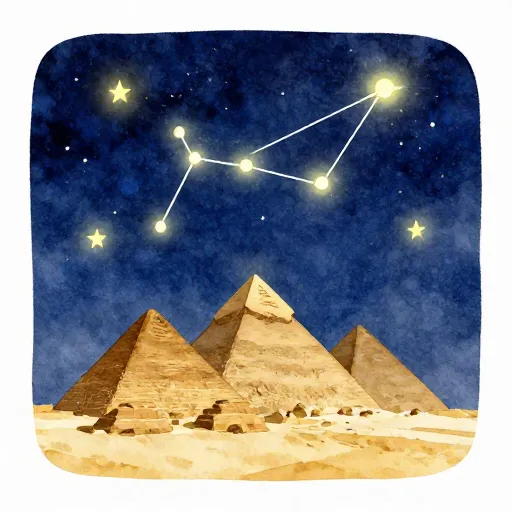
The Egyptians believed that the constellation we call 'Orion' was actually Osiris in the sky. When Orion appeared in the stars, they knew the Nile was about to flood and the Green King was returning to feed the land.
The Mystery of the Djed
One of the most famous symbols of Osiris is the Djed pillar. It looks like a column with four horizontal bars at the top. Some people think it represents a tree with its branches cut off, while others believe it is the backbone of Osiris himself.
Every year, the Egyptians held a ceremony called "Raising the Djed." They would use ropes to pull a giant wooden pillar upright. This was a way of saying that the world was stable again and that the king (and the land) had been restored to health.
Stability is a big word for an eight-year-old, but it just means knowing that the ground under your feet is solid. Osiris was that solid ground for the Egyptians. Even in the middle of a storm or a drought, they believed the Green King was waiting to bring the life back.
Something to Think About
If you could create a symbol for 'new beginnings,' what would it look like?
The Egyptians used a green-skinned man and a wooden pillar. There is no right or wrong answer here, think about what represents 'starting over' in your own life.
When we look at the stars or the changing leaves, we are seeing the same world the Egyptians saw. We might not name the forces of nature "Osiris" or "Set," but we still feel the wonder of things that disappear and then return. Perhaps the story of Osiris is just a very old way of saying that there is always a new beginning waiting to happen.
Questions About Religion
Why is Osiris's skin green in paintings?
What happened to the piece of Osiris that Isis couldn't find?
Was Osiris a scary god because he ruled the dead?
Beyond the River
The story of Osiris reminds us that even when things seem broken or finished, there is often a hidden process of rebuilding happening just beneath the surface. Whether you see him as a king, a constellation, or a spirit of the soil, his message of hope has lasted for five thousand years. Next time you see a sprout pushing through the dirt, you are seeing a little bit of the mystery that the Egyptians called Osiris.