What would it be like to live in a world where everyone was searching for a new way to understand the universe?
Around 1,500 years ago, a man named Muhammad lived in the desert city of Mecca. He was a person who spent a lot of time thinking about how to be kind and fair in a world that often felt harsh. This is the story of how he became the central figure of Islam and shared a message that billions of people follow today.
Imagine a world of endless sand, towering rocky mountains, and night skies so clear you could see every single star. This was Arabia in the year 570 CE. There were no cars, no electric lights, and no phones. Instead, there were camel caravans, bustling markets, and stories told around campfires.
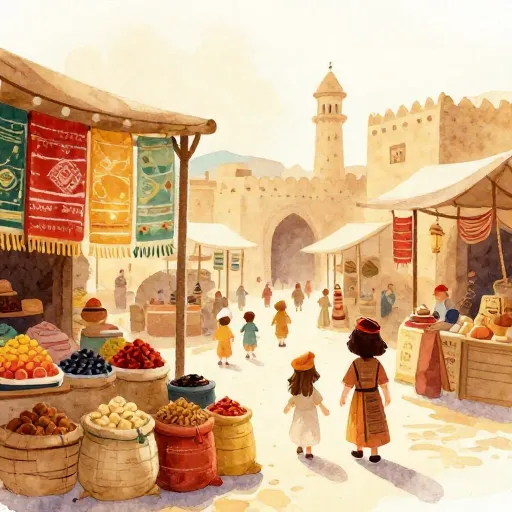
Imagine you are standing in a desert market. The air smells like toasted cumin and expensive perfume. You hear the grumbling of camels and the shouting of traders. It is incredibly hot, so you move into the shade of a palm tree to watch the world go by.
In the middle of this world was the city of Mecca. It was a famous place for trade where people from different tribes met to sell spices, perfumes, and silk. It was also a spiritual center where people came to visit a large, cube-shaped building called the Kaaba.
The Boy Who Was Trusted
Muhammad was born into a respected family, but his early life was not easy. He lost both of his parents when he was very young. He was raised first by his grandfather and then by his uncle, Abu Talib. Growing up as an orphan made him very sensitive to the needs of people who had very little.
As he grew older, Muhammad became a merchant. He traveled with caravans across the desert to places like Syria. People noticed something special about him. He was so honest in his business deals that they gave him a nickname: Al-Amin.

Mira says:
"I love that his first 'job' was being trustworthy. It's like his superpower was just being the kind of person you could rely on with your secrets or your lunch money."
This title meant "The Trustworthy" or "The Honest One." Even before he was a religious leader, people came to him to settle their arguments because they knew he would be fair. He was a man who looked for peace in a time when tribes often fought with one another.

The best of you are those who have the best manners and character.
The Silence of the Cave
Even though Muhammad had a successful life and a loving family, he felt a deep sense of unrest. He looked at the world around him and saw many things that troubled him. He saw the rich ignoring the poor and people worshiping many different statues instead of one creator.
To find answers, he started spending time alone. He would walk to a mountain called Jabal al-Nour, just outside of Mecca. There, he would sit inside a small, quiet place called the Cave of Hira. He would think, meditate, and wait for clarity.
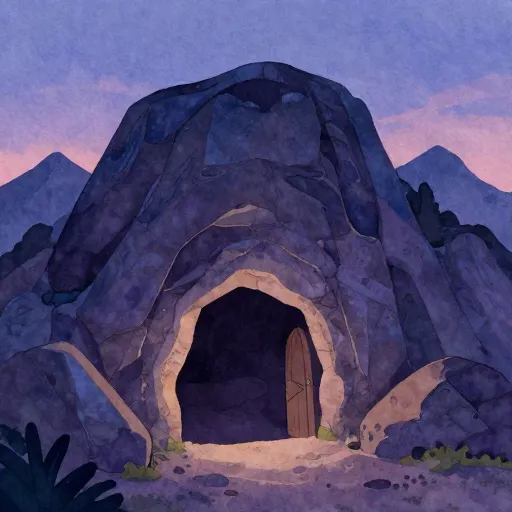
The Cave of Hira is actually quite small. It is only about 12 feet long and 5 feet wide. Even though it is tiny, thousands of people climb the 1,200 stone steps of the mountain every year just to see where the story began.
One night in the year 610 CE, something life-changing happened. Muslims believe that while Muhammad was in the cave, the Angel Gabriel appeared to him. The angel brought a message from God, which in Arabic is called Allah. This event is known as the first revelation.
The Message of One
At first, Muhammad was frightened and overwhelmed. He wasn't sure what to make of this experience. However, with the support of his wife, Khadija, he began to understand his role. He was to be a prophet, a person chosen to share God’s words with the world.

Finn says:
"If I were in a dark cave and heard a voice, I'd be terrified! It makes sense that he needed his family to help him figure out what it all meant."
His message was simple but radical for the time. He taught that there is only one God and that all people are equal, regardless of their wealth or tribe. He told his followers to care for the poor, be kind to animals, and live lives of honesty.
Muhammad was known for his nickname, Al-Amin (The Trustworthy). If you had to earn a nickname based on your best quality, what would it be? Ask a friend or a parent what they think your 'super-nickname' should be.
These messages were eventually written down in a holy book called the Qur'an. For Muslims, the Qur'an is the literal word of God. It provides a guide for how to live a good and meaningful life. Muhammad’s own actions and sayings, known as the Sunnah and Hadith, also became a blueprint for his followers.
The Great Journey
Not everyone in Mecca liked Muhammad's message. The powerful leaders of the city were worried that his teachings about equality would ruin their business and status. They began to treat Muhammad and his followers very poorly.
In 622 CE, Muhammad and his companions made a daring escape to a city called Yathrib. This famous journey is called the Hijra. It was such a big turning point that the Islamic calendar begins with this year.
A silent great soul: he was one of those who cannot but be in earnest.
The people of Yathrib welcomed Muhammad with open arms. They even renamed their city Medina, which means "The City of the Prophet." In Medina, Muhammad wasn't just a teacher anymore. He became a leader who helped build a new kind of community based on faith rather than family ties.
A Different Way of Seeing
One thing you might notice when learning about Muhammad is that you won't see any pictures of him. In Islamic tradition, there is a practice called aniconism. This means that Muslims generally do not create images of people, especially prophets or God.
Art and beauty are found in the words themselves. Instead of drawing people, artists create incredibly complex patterns and beautiful writing called calligraphy.
By not having a picture of Muhammad, every person can imagine his kindness and strength in their own way, making the connection feel more personal.
This isn't out of a lack of love. It is actually the opposite. By not drawing him, Muslims focus on his message and his character rather than what he looked like. It prevents people from accidentally worshiping the person instead of the ideas he taught.
The Return to Mecca
After several years and many challenges, Muhammad eventually returned to Mecca. He didn't come back seeking revenge against those who had been mean to him. Instead, he offered forgiveness to almost everyone.
Mira says:
"Think about how hard it is to forgive someone who was mean to you. Returning to Mecca and choosing peace instead of a fight is a huge move."
He entered the Kaaba and removed the statues of the different gods that had been placed there. He rededicated the building to the worship of one God. By the time he passed away in 632 CE, the message of Islam had spread across much of the Arabian Peninsula.
Through the Ages
A Legacy of Ideas
Muhammad’s life changed the course of history. He taught that the greatest struggle, or jihad, is the internal struggle to be a better person. He emphasized the importance of education, famously saying that the ink of a scholar is more holy than the blood of a martyr.

The seeking of knowledge is obligatory for every Muslim.
Today, the Five Pillars of Islam, which include things like daily prayer and giving to charity, continue to shape the lives of over 1.8 billion people. His life reminds us that even one person, starting in a quiet cave, can start a conversation that lasts for centuries.
The word 'Islam' comes from the Arabic root 's-l-m,' which relates to the word 'Salam,' meaning peace. The word Islam literally means 'submission' or 'surrender' to the will of God.
Something to Think About
If you could sit in a quiet cave for a day, what big questions would you ask the universe?
There are no right or wrong answers here. Some people find clarity in the silence, while others find more questions. What matters is the act of listening.
Questions About Religion
Why don't Muslims draw pictures of Prophet Muhammad?
What is the Qur'an?
What does the word 'Prophet' mean?
The Journey Continues
The life of Prophet Muhammad is a story about how ideas can travel across deserts, oceans, and centuries. Whether you are looking at the beautiful patterns of a mosque or reading a story about his kindness, you are seeing the ripples of a life that began in a quiet cave long ago. Keep asking questions and looking for the connections between the past and your own world.