If you could look up at the night sky and see a map of your family’s history, what stories would you find there?
For the ancient Romans, mythology was not just a collection of bedtime stories. It was a bridge between the dusty streets of their massive empire and the mysterious forces of the universe. By blending old traditions with borrowed ideas, they created a world where every hill, river, and law had a divine reason for being.
Imagine you are standing in the middle of a crowded, noisy market in the city of Rome two thousand years ago. You smell grilled meat and expensive perfume, you hear the clatter of iron wheels on stone, and you see marble statues everywhere. These statues are not just decorations: they are the faces of the gods who live among the people.
The Romans believed their city was special because it was built on a foundation of stories. While they are often compared to the Greeks, the Romans had their own unique way of seeing the divine. They were practical, organized, and deeply loyal to their home.
The Wolf and the Twins
Every great story has a beginning, and for Rome, that beginning was wild. Most civilizations claim they were founded by wise kings or great thinkers, but the Romans claimed they were born from a miracle in the mud. This is the story of Romulus and Remus, the twin brothers who were said to be the sons of Mars, the god of war.

Imagine the Tiber River flooding its banks. Two tiny babies in a basket get stuck in the roots of a fig tree. Instead of a predator, a large, furry she-wolf walks out of the woods, gently carries them to her cave, and keeps them warm. This image was so important that the Romans put it on their coins for hundreds of years.
According to the legend, the twins were abandoned by a river and saved by a she-wolf. This wolf did not eat them: she cared for them until a shepherd found them. Later, when the boys grew up, they decided to build a city on the spot where they were saved.

Finn says:
"If a wolf really raised two human babies, would they grow up acting like wolves? I wonder if Romulus ever tried to howl at the moon even after he became a king."
But the story takes a dark turn. The brothers argued over which hill to build on and how to rule. In the heat of the fight, Romulus killed Remus, and the city was named Rome after the brother who survived. It is a strange, heavy way to start a civilization, but it tells us something important: the Romans believed their history was written in blood and strength.
Borrowing and Building: The Greek Connection
As the Roman Republic grew, the Romans met other cultures, especially the Greeks. They fell in love with Greek art, theater, and most of all, their stories. Instead of throwing away their own gods, the Romans did something clever called Interpretatio Romana.
This meant they looked at a Greek god and said, "Wait, that looks just like our god!" They matched them up like puzzle pieces. The Greek Zeus became the Roman Jupiter. Hera became Juno. Ares, the chaotic god of war, became the more disciplined and respected Mars.
If we want to compare our own characteristics with those of foreign nations, we shall find that in other respects we are only at par: but in religion, that is, in the worship of the gods, we are much superior.
This borrowing was not about being unoriginal. It was about being part of a bigger world. The Romans were like builders who found beautiful stones in another city and used them to strengthen their own walls. They kept their own practical rituals but gave their gods the exciting personalities of the Greek myths.
The Greeks saw Ares as a terrifying, bloodthirsty god of the chaos of war. He was often the 'bad guy' in their stories because war was seen as a destructive disaster.
The Romans saw Mars as a noble father figure. Since he was the father of Romulus, he was the protector of the city. To them, war was a tool for bringing order and peace to the world.
Because of this, Roman mythology feels like a remix. It has the drama of Mount Olympus, but it is focused on the success of the Roman state. The gods were not just characters in a play: they were the silent partners in every Roman war and every harvest.
The Capitoline Triad
At the heart of Rome stood the Capitoline Hill, and on top of it was the most important temple in the empire. It was dedicated to the Capitoline Triad, the three most powerful gods who guarded the city. These were Jupiter, Juno, and Minerva.
Jupiter was the king of the gods, the "Optimus Maximus" (Best and Greatest). He ruled the sky and the lightning, and he was the witness to all oaths. Juno was his wife, the protector of women and the guardian of the empire's finances. Minerva was the goddess of wisdom, crafts, and strategic war.

Mira says:
"It is interesting that Juno was the goddess of money. It’s like the Romans thought that being organized and protecting your home was just as holy as throwing lightning bolts."
While Jupiter threw thunderbolts, he was also the god of the law. The Romans believed that if they followed the rules and respected the gods, the gods would protect Rome. This was a deal they called the Pax Deorum, or the Peace of the Gods. It was like a giant celestial contract.
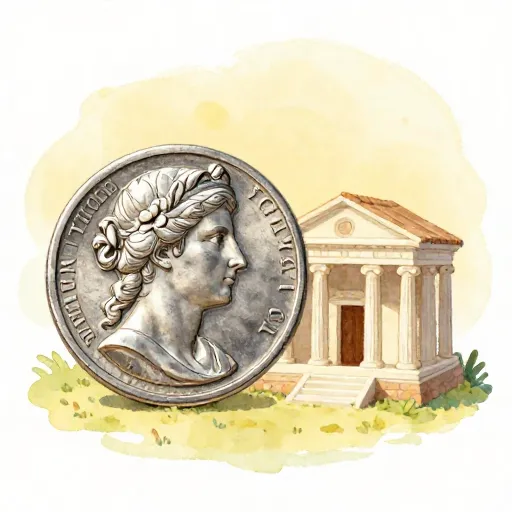
The word 'money' actually comes from the goddess Juno! One of her titles was Juno Moneta, and the Roman mint (where coins were made) was located right next to her temple on the Capitoline Hill.
Gods of the Every Day
While the big gods lived in grand temples, the Romans also believed in thousands of smaller spirits called numina. These spirits lived in everything: the front door, the kitchen fire, the grain in the fields, and even the boundaries of your backyard. They were the gods of the "small stuff."
Every Roman house had a small shrine called a lararium. Inside, the family would offer bits of food or wine to the Lares, the spirits of their ancestors and the guardians of the home. To a Roman child, the gods were not distant figures: they were as close as the steam rising from a bowl of porridge.
The Romans had a 'spirit of the place' called a Genius Loci. Try to find a place in your house or a nearby park that feels special. If that place had a guardian spirit, what would it look like? Would it be small and quiet, or bright and energetic? You can even draw a picture of it and keep it there.
One of the most interesting of these spirits was Janus, the god of beginnings and endings. He is always shown with two faces: one looking forward to the future and one looking back at the past. He was the god of doorways and transitions. Every time you walked through a gate or started a new year, you were in the territory of Janus.
The Journey of Aeneas
If the story of Romulus and Remus was about the city's birth, the story of the Aeneid was about its soul. Written by the poet Virgil, this epic story tells of Aeneas, a hero who escaped the burning city of Troy. He traveled across the seas to find a new home in Italy.
Aeneas was different from the Greek hero Odysseus. While Odysseus just wanted to get home to his family, Aeneas was driven by pietas, which means duty. He carried his elderly father on his back and led his people because the gods told him it was his destiny to start the line that would lead to Rome.
My mind is bent to tell of bodies changed into new forms.
This story taught Roman children that their lives were part of a long, grand plan. It suggested that even when things are difficult, doing your duty is the most important thing you can do. Aeneas showed that the Roman identity was about endurance and looking toward the future.
The Life of the Legends
The Stars and the Calendar
You might think Roman mythology is ancient history, but you are actually living inside it every day. When you look at a map of the solar system, you are looking at a Roman family tree. The planets are named after the gods because they seemed to rule the heavens just as the gods ruled the earth.
- Mars: The red planet, named for the god of war.
- Venus: The brightest planet, named for the goddess of love.
- Saturn: Named for the god of time and agriculture.
- Mercury: The fastest planet, named for the messenger god with winged shoes.
Even our calendar is a Roman invention. January is named for Janus. March is for Mars. July is for Julius Caesar, who was treated like a god after he died. We are still using the Roman way of organizing time and space to make sense of our lives.
Finn says:
"Do you think that in a thousand years, people will name new planets after our superheroes? Maybe the Roman gods were just the first version of the characters we love today."
The Mystery of Change
One of the most famous Roman writers, Ovid, wrote a massive book called the Metamorphoses. It is full of stories about people turning into trees, animals, and stars. For Ovid, the world was a place where nothing stayed the same for long. The gods were the ones who managed this constant changing.

The gods were a way of talking about the world and how it worked. They weren't just 'up there': they were part of the fabric of everyday life.
This idea of change is at the heart of Roman mythology. The Romans changed their government from a kingdom to a republic to an empire. They changed their religion from many gods to one. But they always held onto the idea that there is something bigger than us, something that guides the world through its many transformations.
Janus, the two-faced god, is the reason the first month of the year is called January. He looks back at the year that just ended and forward to the year that is just beginning. He is the only major Roman god who doesn't have a Greek version!
We might not sacrifice grain to a household spirit today, but we still have our own rituals. We still look for heroes to follow and stories to help us understand why things happen. Roman mythology reminds us that we are all part of a story that started a very long time ago, on a hill by a river, with a wolf and two brothers.
Something to Think About
If you could rename a planet today based on a quality you admire, what would you call it?
There are no wrong answers here. The Romans named things based on what they felt was most important in their world. What do you think is worth naming a star after?
Questions About Religion
Why did the Romans copy the Greek gods?
Were Roman myths true?
Who was the most powerful Roman god?
A Living Legacy
The next time you look at a calendar or a map of the stars, remember that you are looking at the fingerprints of the Romans. Their myths weren't just about magic: they were about how to build a world that lasts. By telling stories, they turned a small village into an empire that we still talk about today. What stories will people still be telling two thousand years from now?