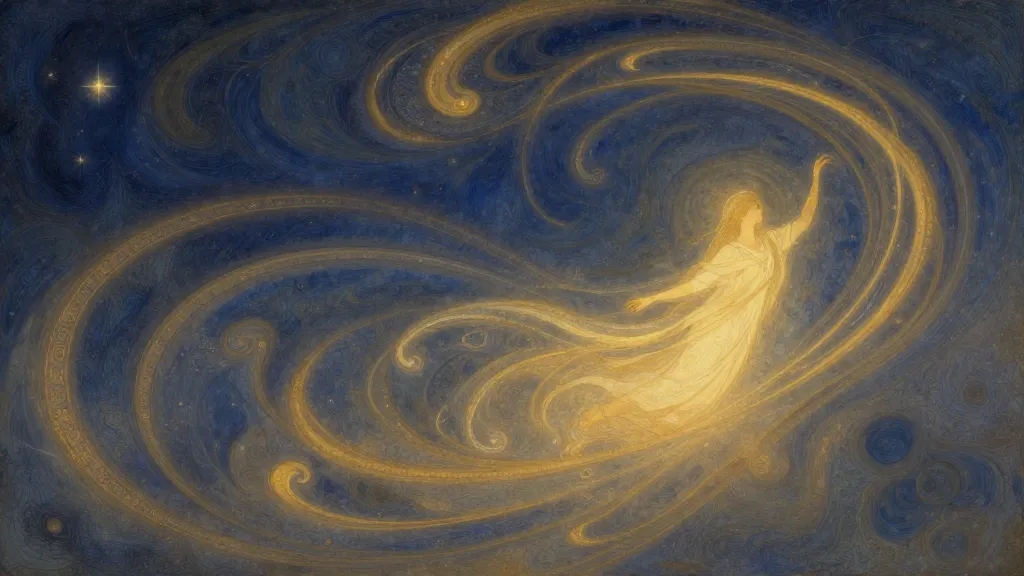
Have you ever felt so happy that you wanted to spin in circles until the world became a blur of color?
About 800 years ago, a man named Rumi lived in a world of dusty libraries, golden deserts, and deep questions. He was a scholar and a mystic who believed that the best way to understand the world was not just through books, but through the language of the heart.
Imagine a world where books are written by hand on thick parchment and the fastest way to send a message is by a galloping horse. This was the world of Jalal ad-Din Muhammad Rumi, a boy born in the year 1207 in a place called Balkh, which is in modern-day Afghanistan.
His family were famous thinkers and teachers, but their lives were about to change forever. A great army known as the Mongols was sweeping across the land, and Rumi's family had to flee their home to find safety.
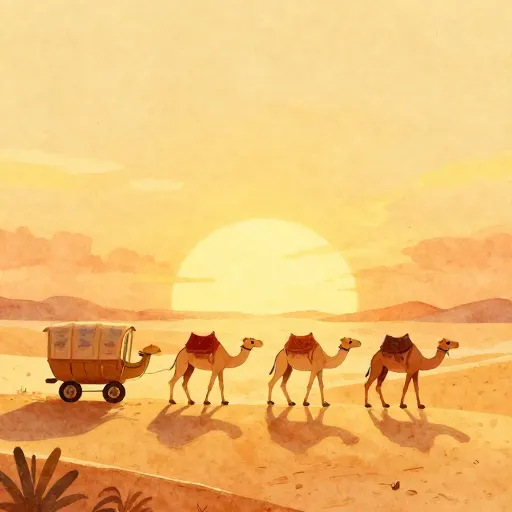
Imagine a long line of camels stretching across the horizon, their bells jingling in the hot air. Dust clouds rise as thousands of families travel together, carrying their most precious scrolls and silk rugs. This was the Great Migration, where people shared stories around campfires while escaping the Mongol armies.
They traveled thousands of miles across the Silk Road, passing through high mountains and busy marketplaces. Eventually, they settled in a city called Konya, in what is now Turkey.
Konya was a place where many different cultures met: Greeks, Turks, Persians, and Arabs all lived together. It was here that Rumi would grow up to become one of the most famous teachers in the world.
The Teacher and the Wanderer
For many years, Rumi lived the life of a very serious professor. He wore a large turban, taught hundreds of students, and spent his days studying law and religion.

Finn says:
"If Rumi was such a famous professor, why did he leave his books behind to follow a wanderer? I wonder if he felt like he was missing something that books couldn't explain."
Everything changed one day when he met a wandering man named Shams of Tabriz. Shams was not a typical teacher: he was a dervish, a person who had given up all their belongings to search for the truth.
Shams asked Rumi questions that no one else dared to ask, making him realize that knowing things in your head is different from feeling things in your soul. They became the best of friends, spending weeks talking about the mysteries of the universe.

Your task is not to seek for love, but merely to seek and find all the barriers within yourself that you have built against it.
When Shams eventually disappeared, Rumi was heartbroken. He realized that to find his friend again, he had to look inside his own heart.
This sadness turned into a flood of poetry. Rumi began to write thousands of verses about love, loss, and the way the world reflects the beauty of the Divine.

Rumi's full name was Jalal ad-Din Muhammad Balkhi. The name 'Rumi' actually means 'from Rome.' This is because the place where he lived in Turkey was once part of the Roman Empire, and people still called that area 'Rum.'
The Elephant in the Dark
Rumi loved to use stories to explain big, complicated ideas. One of his most famous stories is about an elephant that was brought to a dark room in a village where no one had ever seen such a creature.
Because it was too dark to see, the villagers went inside one by one and touched the elephant to figure out what it was. One person touched the trunk and said: This is like a water pipe!
Another person touched the ear and said: No, it is like a giant fan! A third person touched the leg and argued: You are both wrong, it is like a sturdy pillar!
Get a mystery object and put it in a box with a hole. Have three friends reach in and touch only one part of the object. Ask them to describe what it is. See how different their answers are before you pull the object out and show them the whole thing!
Rumi used this story to show that each person was only seeing a small part of the truth. He believed that we are often like those villagers, arguing about what we think is right while missing the whole picture.
He wanted people to stop arguing and start looking for the light that would show the whole elephant. This way of thinking is a big part of Sufism, which is the mystical side of Islam.

Mira says:
"The elephant story reminds me of a puzzle. If we all have one piece, we have to talk to each other to see the whole picture. I think Rumi wanted us to be more like listeners than talkers."
Sufis believe that God is not just a distant judge in the sky, but a presence that lives inside every living thing. To a Sufi, every flower, every stone, and every person is like a mirror reflecting a hidden beauty.
The Dance of the Planets
How do you talk to the universe? Rumi found the answer in movement. He began to practice a form of meditation where he would spin in circles, faster and faster, with one hand pointed toward the sky and the other toward the earth.
Some people believe that the best way to understand life is through logic, math, and clear facts that you can prove with experiments.
Rumi believed that while facts are useful, some truths can only be felt through music, dancing, and the way our hearts react to beauty.
This became the famous dance of the Whirling Dervishes. They weren't just dancing for fun: they were trying to mimic the way the planets orbit the sun and the way atoms spin in our bodies.
By spinning, Rumi felt that he was letting go of his own ego, the part of us that wants to be important or better than others. In that stillness at the center of the spin, he felt a deep peace and a connection to everything around him.

Out beyond ideas of wrongdoing and right-doing, there is a field. I’ll meet you there.
Many people in Rumi's time thought he was acting very strange for a serious scholar. But Rumi didn't mind because he felt he had found a secret language that everyone could understand, no matter what language they spoke or what country they came from.
He called this language Love. For Rumi, love wasn't just a feeling you have for a friend or family member: it was the energy that holds the entire universe together.
Finn says:
"I tried spinning in the garden until I got dizzy! I didn't feel the universe, but I did feel like the ground was turning into the sky. Maybe that's what he meant by letting go?"
Through the Ages
The Song of the Reed
Rumi's most famous book is called the Masnavi. It is a massive collection of over 25,000 verses, often called the Persian Quran because it is so full of wisdom and stories.
The book starts with a famous poem about a reed flute. The flute is sad because it was cut away from the reed bed where it grew, and now it makes a lonely, haunting sound when someone blows into it.

The reed flute, or 'ney,' is one of the oldest musical instruments in the world. It is made from a simple piece of hollow cane with holes carved into it. To Rumi, the ney was the perfect symbol for a human: empty on the inside so that the music of the universe can play through us.
Rumi said that humans are like that reed flute. We feel a bit lonely or out of place sometimes because we have been separated from our true home in the spiritual world.
Our jobs, our houses, and even our bodies are like the wooden flute, but our souls are the breath of music moving through us. He taught that we shouldn't be afraid of that longing or sadness, because it is what reminds us to keep looking for our way back home.
Wisdom That Never Grows Old
Even though Rumi lived centuries ago, his words are more popular today than they have ever been. People all over the world translate his poems into hundreds of different languages.

Yesterday I was clever, so I wanted to change the world. Today I am wise, so I am changing myself.
Why does he still matter? Perhaps it is because Rumi doesn't try to give us easy answers or tell us exactly what to do. Instead, he invites us to be curious and to look at the world with eyes full of wonder.
He reminds us that even when life is hard or confusing, there is a hidden rhythm to everything. Like the villagers in the dark room, we might only see a small piece of the truth right now, but that doesn't mean the rest isn't there waiting for us.
Something to Think About
If you could ask the universe one question that has no easy answer, what would it be?
Rumi loved questions more than answers. He believed that the 'I don't know' is where the most interesting ideas grow. There is no right or wrong question to ask!
Questions About Religion
Was Rumi a religious person?
Why do the Dervishes wear tall hats?
Can children read Rumi's poems?
Keep the Spin Going
The next time you see a bird flying or feel a breeze on your face, remember Rumi. He would tell you that the world is constantly talking to you in a secret code of beauty. You don't need a map or a textbook to understand it: you just need to be still enough to listen.