
Have you ever met someone who seems to shine with a different kind of light?
Throughout history, humans have looked for Saints, people who lived lives so full of courage, kindness, or mystery that they seemed to be a bridge between our world and something much bigger. These figures aren't just characters in old books: they are Moral Heroes whose stories have shaped how we think about goodness for nearly two thousand years.
Imagine walking through a dark, underground tunnel in Rome nearly two thousand years ago. The air is cool and smells like damp earth and old stones. You are in a catacomb, a place where the very first people honored as saints were laid to rest.
In those early days, being a saint wasn't about a long checklist of rules. It was about bravery. Many of these people were Martyrs, which means they were willing to give up their lives rather than give up their beliefs.
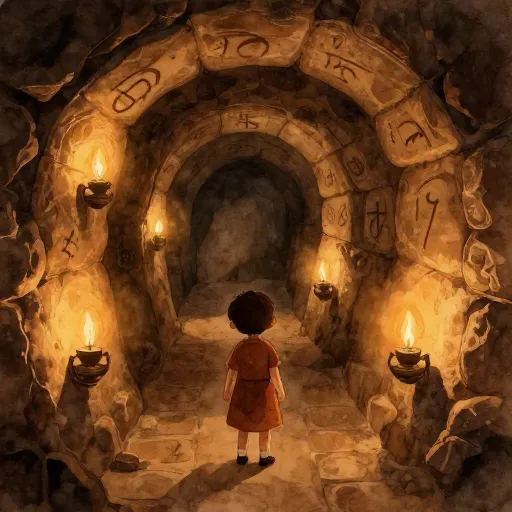
Imagine a room with no windows, lit only by the flickering orange light of a small oil lamp. On the walls, people have scratched symbols: a fish, an anchor, and a shepherd. These were secret codes used by early Christians to mark the places where their heroes were buried. In the silence, you realize that for these people, 'saints' weren't distant figures in stained glass: they were friends and family members who had shown incredible courage.
These early heroes were like the superstars of their time, but they didn't have social media. People told stories about them instead. They talked about how these men and women faced lions in the arena or stood up to powerful emperors with nothing but their words.
But as time went on, the idea of what made a saint started to change. It wasn't just about dying for a cause anymore. It became about how you lived your everyday life.

Finn says:
"If a saint is supposed to be a 'friend of God,' does that mean they never get grumpy or make mistakes? I feel like I'd be a very loud saint."
By the time we get to the middle of the history of Europe, the desert became a popular place for people seeking holiness. These people were called Hermits. They left the noisy cities behind to live in caves or simple huts.
They believed that if they were very quiet, they could hear the voice of the divine more clearly. This was the start of Monasticism, a way of life where people lived together in communities called monasteries to focus entirely on their faith.

The world is a book and those who do not travel read only one page.
One of the most famous thinkers of this time was a man named Augustine. He wasn't always a saintly person. In fact, he spent a lot of his youth making mistakes and getting into trouble.
Augustine wrote a book called 'Confessions' where he told the truth about his flaws. He showed the world that a saint isn't someone who is born perfect. A saint is someone who keeps trying to grow, even after they fail.
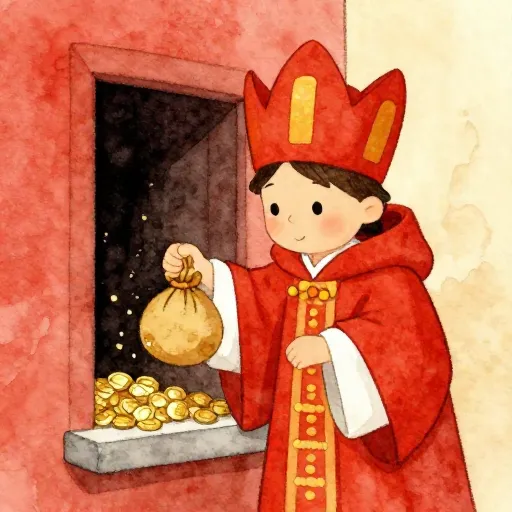
Did you know that the modern Santa Claus is actually based on a real saint? St. Nicholas was a bishop in the 4th century who was famous for his secret gift-giving. One legend says he dropped bags of gold down a chimney to help a poor family! Over hundreds of years, his name and story morphed into the 'Sinterklaas' of the Netherlands and eventually the Santa Claus we know today.
As the centuries passed, the Church decided they needed a formal way to decide who was officially a saint. This process is called Canonization. It's a bit like a giant, historical investigation into a person's life.
Today, this process involves looking for 'heroic virtue.' This means the person did more than just follow the rules: they went above and beyond to show love or courage. Usually, the Church also looks for evidence of a Miracle, an event that can't be explained by science.

Mira says:
"I think saints are like historical time-travelers. Their stories start in one century, but people keep using their ideas to solve problems today."
Think of a saint like a prism. When sunlight hits a glass prism, it breaks into a rainbow of different colors. In the same way, the idea of 'goodness' is huge, but different saints show us different colors of that goodness.
For example, St. Francis of Assisi is famous for his love of nature. Legend says he even preached to birds and made peace with a hungry wolf. He showed the 'green' side of holiness: being a protector of the earth and animals.
Saints are like spiritual superheroes. They were born with a special connection to the divine and performed miracles that prove they were different from us.
Saints were regular people with flaws and doubts. What makes them special isn't that they were 'super,' but that they chose to be good even when it was difficult.
Then there is St. Joan of Arc. She was a teenager who felt called to lead an army and save her country. She showed the 'fiery' side of holiness: the kind of bravery that stands up to bullies and fights for what is right, even when it’s scary.
These stories are often recorded in books called a Hagiography. These aren't exactly like history textbooks. They are meant to inspire us, so they often include wonder, mystery, and maybe even a few legends that grew over time.

I will spend my heaven doing good on earth.
Thérèse of Lisieux, who lived in France in the 1800s, had a very different idea. She didn't lead armies or talk to wolves. She called her path the 'Little Way.'
She believed that you don't have to do 'big' things to be a saint. You can just do small things with great love. Picking up a pencil for someone or smiling when you feel tired can be a way of practicing Virtue.

Look for an 'Everyday Saint' today. This isn't someone with a halo, but someone who does something kind without being asked. It could be someone who holds the door for a stranger, a teacher who stays late to help a student, or a friend who shares their lunch. Once you spot one, think about what 'color' of goodness they are showing. Is it the color of patience? Of generosity? Of courage?
If you go into an old church, you might see paintings or statues of these people. Many of them have a glowing circle around their head called a Halo. This is a symbol of their inner light or 'sanctity.'
Often, they are holding an object that tells you who they are. This object is called an Icon. For example, St. Peter often holds keys, and St. Jerome is often pictured with a lion. These symbols help people recognize the story of the saint immediately.
Finn says:
"Wait, if there's a patron saint of the internet, does that mean they help when the Wi-Fi goes down? I need to look that up."
Many people also have a Patron Saint. This is like having a specific mentor or friend in the spiritual world who looks out for a certain group of people. There is a patron saint for almost everything you can imagine.
There is a patron saint for bakers, for students, for pilots, and even for the internet! People choose a patron saint because they feel a special connection to that person's story or the work they did while they were alive.
The Journey of a Saint
In the modern world, the idea of a saint has expanded. Even people who aren't religious sometimes talk about 'secular saints.' These are people like Mahatma Gandhi or Martin Luther King Jr., who changed the world through their moral strength.
While they aren't 'canonized' in the same way, they occupy the same space in our minds. They are people who show us that a human being is capable of incredible things. They remind us that history isn't just made by kings and queens, but by people who care deeply.

Be who God meant you to be and you will set the world on fire.
Does every saint have to be famous? Most traditions say no. There is an idea of the 'unnamed saints.' These are the people who do kind things every day without anyone noticing.
They might be the person who always listens when you're sad, or the neighbor who takes care of the local park. These 'everyday' saints don't get statues or feast days, but their influence on the world is just as real.

There is a patron saint for almost everything! St. Isidore of Seville is the patron saint of the internet because he tried to write an encyclopedia of all human knowledge. St. Drogo is the patron saint of coffee (and unattractive people!), and St. Lydwina is the patron saint of ice skaters. If you have a hobby, there's a good chance there's a saint who 'looks after' it!
When we look at the lives of the saints, we see a wide variety of personalities. Some were loud and bold, others were quiet and shy. Some were very rich and gave it all away, while others were very poor and shared the little they had.
This variety is important because it means there isn't just one way to be 'good.' There are as many ways to be a saint as there are people in the world. Each person brings their own unique flavor to the idea of a life well-lived.
Something to Think About
If you were to be remembered as a 'saint' for one specific quality, what would you want that quality to be?
There are no right or wrong answers. Some people might want to be remembered for their bravery, others for their ability to make people laugh, and others for their quiet steadiness. What kind of light would you want to add to the world's rainbow?
Questions About Religion
Do you have to be dead to be a saint?
What is the difference between a saint and a god?
Why do some saints have such weird stories?
The Unending Story
The list of saints is never finished. Every year, new names are added to the calendar, and new stories are discovered. Whether you see them as religious figures, historical heroes, or simply examples of what humans can achieve, saints remind us that the world is always in need of a little more light. You don't need a halo or a statue to start your own 'little way' of making the world a bit better than you found it.