
Have you ever wondered what keeps a group of people together when things get difficult?
Long ago, in a vast desert, a group of people called the Israelites were looking for a way to live as a free community. They were given a set of ancient rules known as the Ten Commandments, or the Decalogue, which became the foundation for how many cultures think about right and wrong today.
Imagine you are standing at the base of a massive, jagged mountain. The air is hot and dry, and the sound of the wind is like a low hum.
This is the setting of a story that is more than 3,000 years old. It is a story about how a group of people decided that to be truly free, they needed more than just a lack of chains: they needed a shared set of values.

Imagine you are one of the people waiting at the bottom of the mountain. You see flashes of light and hear a sound like a giant trumpet coming from the clouds. You aren't just waiting for a leader: you are waiting for a new way of life to be born.
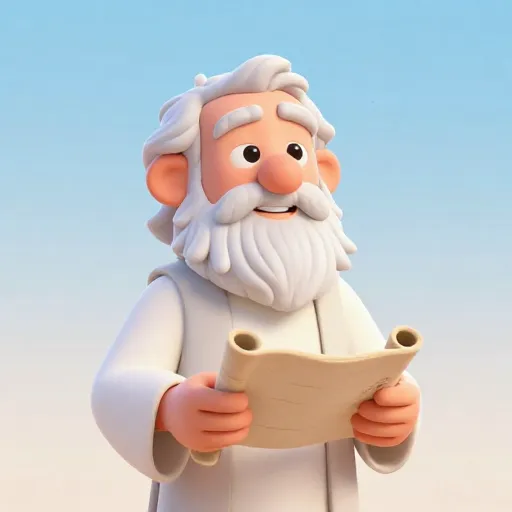
At the center of this story is a man named Moses. He had led his people out of Egypt, where they had been enslaved, and into the wilderness.
But once they were free, they faced a new problem. How do you live together without hurting each other? How do you build a society that lasts?

Finn says:
"If they were just escaping from Egypt, why did they stop at a mountain to get rules? Wouldn't they want to just keep running until they found a home?"
The Israelites believed that Moses climbed a mountain called Sinai and stayed there for forty days. While he was there, he received two stone tablets.
On these tablets were carved ten instructions. These weren't just simple tips for a good day: they were the Covenant, a sacred agreement between the people and God.
The First Half: Looking Up
If you look at the Ten Commandments, they are usually divided into two distinct groups. The first group is about how people relate to the Sacred, or the divine part of life.
These rules ask people to focus their attention on one thing and not to get distracted by shiny statues or false promises. They are about respect for the source of life and the importance of taking time to rest.

In some traditions, the Ten Commandments are counted differently! While the words are the same, Jewish, Catholic, and Protestant groups sometimes group the sentences into different numbers. But no matter how they are counted, the core ideas remain exactly the same.
One of the most interesting rules in this first group is the one about the Sabbath. It says that everyone, even animals and servants, must have a day of rest every week.
In the ancient world, this was a radical idea. Most people worked until they couldn't work anymore. The idea that rest was a right for everyone changed how humans thought about their time.
The Decalogue is like the heads of all the other laws... it is a summary of all that is good.
The Second Half: Looking Around
The second group of commandments is different. These are the rules that help us live with our neighbors, our parents, and even our enemies.
These rules cover things like telling the truth, respecting other people's families, and not taking things that don't belong to you. They are the "Do Not" list that actually says "Yes" to safety and trust.

Mira says:
"It feels like these rules are building a circle of trust. If everyone follows them, the circle stays strong, but if one person breaks them, the whole circle wobbles."
When we say "Do not steal," we are also saying "You can trust that your things are safe." When we say "Do not lie," we are saying "We can talk to each other and believe what we hear."
In philosophy, we call this Ethical Monotheism. It is the idea that there is one God who cares deeply about how humans treat one another.
The commandments are literal laws that must be followed exactly as they are written to maintain order.
The commandments are symbols or 'big ideas' that we have to interpret and apply differently as the world changes.
Rules as a Room to Play In
Sometimes rules feel like they are just there to stop us from having fun. But think about a game of soccer or a board game.
If there were no rules, you couldn't actually play. If everyone could pick up the ball with their hands or move their piece whenever they wanted, the game would fall apart.

Think of your own 'Top Three' rules for your bedroom or your classroom. Do they start with 'Do not' or 'Always'? Try to rewrite a 'Do not' rule (like 'Do not leave toys on the floor') into a positive goal (like 'Keep the floor clear for walking'). Which one feels more powerful?
Philosophers often talk about Natural Law, which is the idea that some rules are so obvious that we would figure them out even if they weren't written down.
The Ten Commandments were like a physical version of those obvious truths. They were carved in stone so that no one could claim they had forgotten them when things got messy.

The purpose of the Law is to bring about the well-being of the soul and the well-being of the body.
The Power of the "No"
Most of the commandments start with "Thou shalt not," which is an old-fashioned way of saying "You must not."
Why are they so negative? Some thinkers believe that by setting clear boundaries, we create a safe space inside those boundaries where we can be creative and kind.
Finn says:
"What if there was an eleventh commandment? I wonder what rule we would need today that people didn't need thousands of years ago."
If you know for a fact that no one in your town is going to steal your house or lie about you in court, you have more energy to focus on building things and helping people.
The "No" acts like a fence. A fence doesn't just keep things out: it defines the space where you are free to play and grow without fear.
Through the Ages
The Journey Through Time
As the centuries passed, these ten rules traveled far beyond the desert. They were translated into hundreds of languages and became part of the foundation for Civil Law in many countries.
They influenced how kings made their decrees and how judges decided what was fair. Even people who don't follow the religion of the Israelites often agree with the basic ethics of the commandments.

True peace is not merely the absence of tension: it is the presence of justice.
Today, we see these ideas in our courtrooms, our schools, and our homes. They remind us that while the world changes, the basic needs of humans to be respected, heard, and safe stay the same.
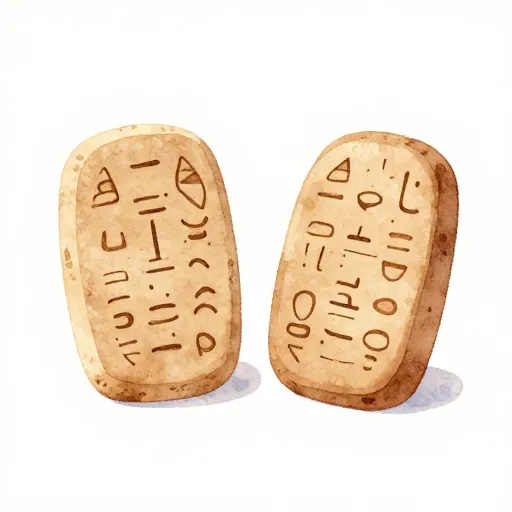
The tablets Moses carried were likely not the giant, rounded tombstones you see in movies! Historically, stone tablets used for writing in the ancient Near East were usually small, rectangular slabs that could be held in one hand.
Some people see these commandments as ancient history, but others see them as a living conversation. Every time we choose to tell the truth when it would be easier to lie, we are participating in that 3,000-year-old story.
It is a story about choosing to be better, not because we have to, but because we know that rules are the invisible glue that holds our world together.
Something to Think About
If you had to keep the world safe using only one rule, which of the ten would you choose?
There isn't a single right answer: some might choose the rule about honesty, while others might choose the rule about respect or rest. What does your choice say about what you value most?
Questions About Religion
Why are they called 'commandments' and not just 'rules'?
What is the most important commandment?
Did Moses really break the first set of tablets?
The Conversation Continues
The Ten Commandments aren't just ink on a page or carvings on a stone: they are a living part of how we understand our responsibilities to each other. Whether we see them as religious instructions or historical artifacts, they challenge us to think about what kind of world we want to build. The next time you see a rule, ask yourself: what is this rule trying to protect?