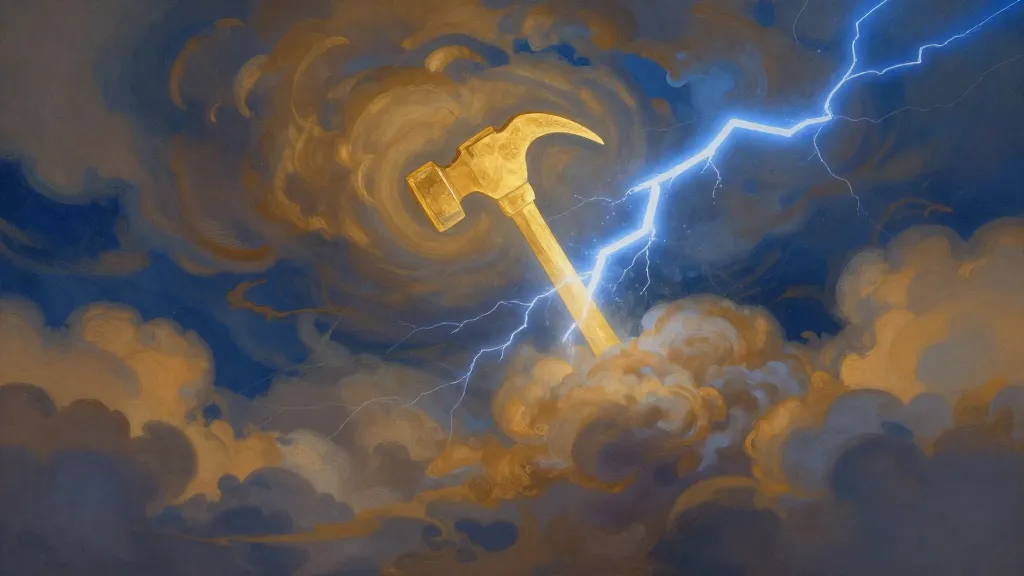
If you heard a crack of thunder a thousand years ago, you wouldn't look for a weather report: you would look for a giant.
For the people of the Viking Age, Thor was the ultimate guardian of the human world. He was the most popular of the Norse Gods, known for his incredible strength and his short temper, but also for his deep commitment to keeping the world safe from chaos.
Imagine standing on a rocky coast in Scandinavia over ten centuries ago. The wind is biting, the sea is gray and churning, and the sky is turning a heavy, bruised purple.
To the people living there, this wasn't just nature doing its thing. It was a sign that the gods were active.
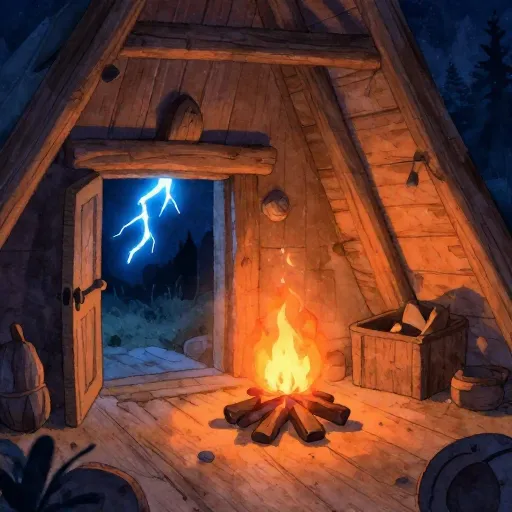
Imagine a world with no electricity. When the sky goes dark and the wind howls, there are no streetlights or sirens. Only the fire in your hearth and the stories you tell. In that silence, every roll of thunder feels like a giant footstep nearby.
These people were the Norse, a group of cultures from Northern Europe who shared a language and a set of wild, beautiful stories. We often call them the Vikings.
They lived in a world where the wilderness felt huge and dangerous. To make sense of it, they imagined Thor, a red-bearded god who spent his days fighting the forces of destruction.
The God of the Common Person
While his father, Odin, was the god of kings, poets, and magic, Thor was the god of everyone else. Farmers, sailors, and blacksmiths felt a special connection to him.
They didn't just fear him: they trusted him. They believed that while the other gods were often tricky or mysterious, Thor was straightforward.
Mira says:
"I like that the farmers felt he was on their side. It's like having a big brother who's also a thunderstorm."
Thor lived in a great hall called Bilskirnir, which supposedly had 540 rooms. It was the largest building ever imagined by the Norse.
He didn't travel by horse like the other gods. Instead, he rode in a heavy chariot pulled by two massive goats named Tanngrisnir and Tanngnjóstr.
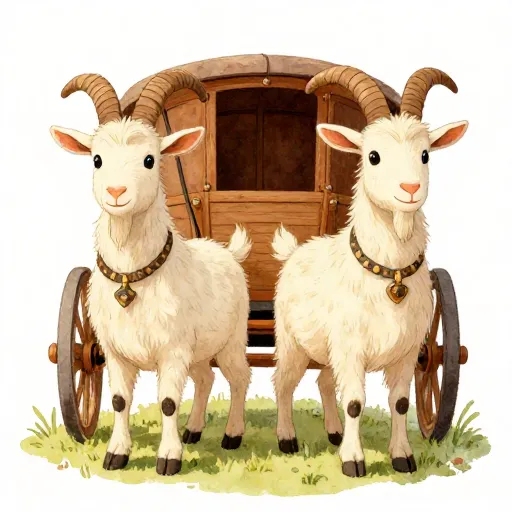
Thor's goats were magical in a very strange way. If Thor was hungry, he could eat them for dinner. As long as he didn't break any of their bones and saved the skins, he could use his hammer to bring them back to life the next morning, perfectly healthy.
The Power of Mjölnir
If you think of Thor, you probably think of his hammer, Mjölnir. In the myths, this wasn't just a heavy piece of metal: it was a symbol of protection and order.
According to the stories, Mjölnir was forged by two clever dwarves. It was slightly flawed because the handle was too short, but it was still the most powerful object in the universe.
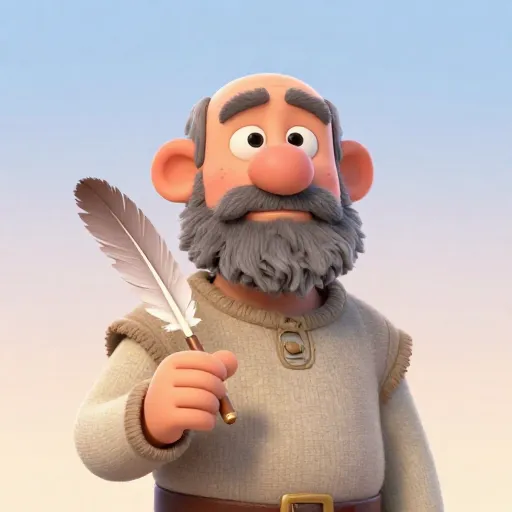
Then he gave the hammer to Thor, and said that he might smite as hard as he desired, whatsoever might be before him, and the hammer should not fail.
Whenever Thor threw the hammer, it would always hit its target and then fly back to his hand like a boomerang. He had to wear special iron gloves, called Járngreipr, just to catch it without getting hurt.
But the hammer did more than just fight. The Norse used its symbol to bless weddings, births, and even funerals.
- It was used to hallow (make holy) a space
- It acted as a boundary between the safe human world and the wild world of giants
- Small hammer amulets were worn by people as a sign of their faith
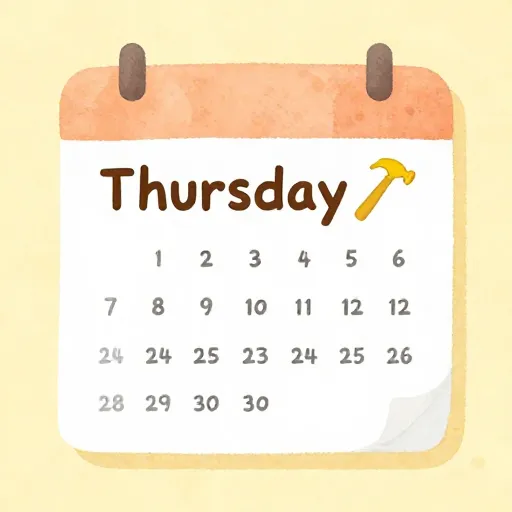
Look at a calendar: you'll find Thor right there! The word 'Thursday' comes from 'Thor's Day.' In many languages, like German (Donnerstag) and Dutch (Donderdag), the name literally means 'Thunder's Day.'
Living in the Shadow of Giants
The Norse believed the universe was split into different realms. Humans lived in Midgard, which means "Middle Enclosure."
Outside Midgard was the realm of the Jötunn, often translated as giants. These weren't just big people: they were the raw, untamed forces of nature like blizzards, rockslides, and earthquakes.
Finn says:
"Wait, if the giants were just 'nature,' does that mean Thor was fighting the weather? Or was he the weather fighting itself?"
Thor's main job was to keep these giants from destroying Midgard. He was the wall between the cozy fire of a human home and the freezing darkness of the wild.
One of his most famous enemies was the World Serpent, a snake so large it circled the entire earth and bit its own tail. Thor and the serpent were destined to be rivals until the very end of time.
Thor is often seen as a warrior who solves problems with his hammer. He represents the muscle needed to survive a harsh environment.
Others see Thor as a protector. His strength isn't just about hitting things, but about the courage to stand up for those who are smaller or weaker than you.
The Through the Ages
How did a red-bearded god from the freezing North end up in modern comic books and movies? The journey of Thor’s story is as long as a Viking voyage.
Thor Through the Ages
In the early days, Thor was a figure of real religious belief. People sacrificed to him for good harvests, because as the god of storms, he brought the rain that made crops grow.
As the Viking Age ended and Christianity spread through Scandinavia, the old gods didn't disappear. Instead, they became characters in folklore and epic poems.
Thor was the god of the physical world, the god of the hammer that strikes the spark, the protector of the order of things against the chaos of the giants.
Thor’s Strange Sense of Humor
Unlike many other religions where gods are perfect, the Norse gods were often messy, loud, and even funny. Thor was known for his massive appetite: he could eat an entire ox in one sitting.
One of the most famous stories involves a giant stealing Mjölnir. To get it back, Thor had to dress up as a bride and pretend to get married to the giant.
Finn says:
"I can't imagine a god wearing a wedding dress just to get his hammer back. That takes a lot of confidence, actually."
He sat at the wedding feast, trying to hide his beard under a veil, while accidentally eating eight whole salmon and three barrels of mead. The giants were suspicious, but Loki, the trickster god, convinced them that the "bride" was just very hungry.
This story shows us something important about the Norse. They respected their gods, but they also found them relatable and even a bit ridiculous sometimes.
The Vikings loved 'kennings,' which are two-word metaphors. Instead of saying 'the sea,' they might say 'the whale-road.' Instead of 'Thor,' they might say 'The Giant-Cracker.' Can you think of a kenning for something in your house? Maybe a 'food-cold-box' for a fridge?
The Final Battle: Ragnarök
The Norse myths are unique because they have an ending. They believed in Ragnarök, a great battle where many of the gods, including Thor, would finally fall.
In this final confrontation, Thor finally defeats the World Serpent, but the serpent's venom is too strong. Thor takes nine steps after his victory and then passes away.
The sun turns black, earth sinks into the sea, the hot stars drop from the sky.
But even in this tragedy, there is hope. The Norse believed that after the world was destroyed, a new, green world would rise from the sea, and two humans would emerge to start life over again.
Thor’s children, Magni and Móði, would survive the battle. They would find their father’s hammer in the grass, a sign that the protection of the world would continue.
Something to Think About
If you were a god, what would your 'hammer' be?
Thor's hammer was a tool for both building and protecting. Think about something you are good at or something you love. How could that thing be used to make the world feel a little safer or more 'hallowed'? There are no wrong answers here, just different ways to be a protector.
Questions About Religion
Did the Vikings really believe Thor was real?
Was Thor really the son of Odin?
Why did Thor have red hair in the myths but blonde hair in movies?
Keep Your Ears to the Sky
The next time you hear a storm rolling in, take a moment to listen. You don't have to believe in goats pulling a chariot to feel the wonder of the thunder. Thor's story reminds us that even when the world feels wild and chaotic, there is always a force working to keep the 'Middle Enclosure' safe. Whether that force is a god with a hammer or the courage inside of you, it's an idea worth holding onto.