What if every time you picked up a pen, you were performing a small act of magic?
In Ancient Egypt, people believed that knowledge wasn't just something you learned in school. They saw it as a gift from Thoth, the mysterious, ibis-headed god of wisdom, writing, and the moon.
Imagine you are standing on the banks of the Nile River four thousand years ago. The sun is setting, and the heat of the day is finally beginning to fade. In the tall papyrus reeds, a long-legged bird with a curved beak stands perfectly still. This is the ibis, a bird the Egyptians watched with great curiosity.
They noticed how the ibis used its beak like a pen, dipping it into the mud to search for food. To the Egyptians, this looked like a scribe dipping a brush into ink. They began to tell stories of a god who moved with that same quiet grace. They called him Thoth.
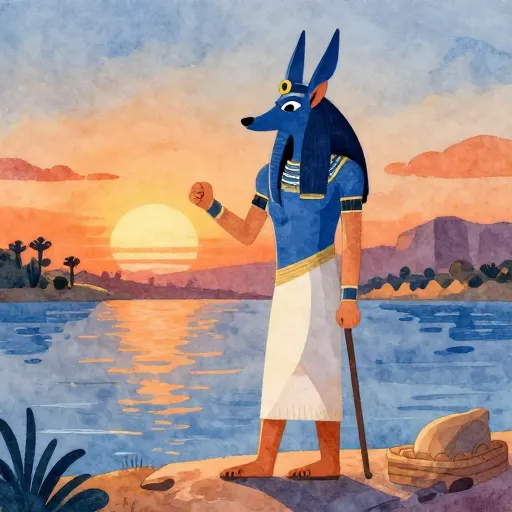
Imagine a god with the body of a man but the head of a tall bird. His beak is long and curved like a crescent moon. He carries a wooden palette with two wells of ink and a sharpened reed. He doesn't need to shout to be heard; his power comes from the ink he spills on the page.
The Inventor of the World's Alphabet
Before Thoth, the Egyptians believed the world was a bit of a jumble. Ideas existed, but there was no way to catch them and keep them. Thoth changed everything by inventing hieroglyphs, which the Egyptians called medut netjer, or the "words of the gods."
He didn't just give people a way to make lists or write receipts. He gave them a way to make thoughts permanent. This was a radical idea because it meant that a person’s voice could live on even after they were gone. Writing was a bridge between the human world and the divine.

Mira says:
"If Thoth invented writing, does that mean he's responsible for all the homework in the world? Or is he the one who helps us find the right words when we're stuck?"
Thoth was the personal secretary of the gods. Whenever the king of the gods, Ra, made a decree, Thoth was there with his palette and reed pen. He made sure the universe ran on a schedule, recording the movements of the stars and the rising of the Nile.
However, not everyone thought that writing was a perfect gift. Some feared that if we wrote things down, we would stop using our brains. They worried that our memories would grow weak and lazy because we no longer had to carry our stories inside us.
For this discovery of yours will create forgetfulness in the learners' souls, because they will not use their memories.
The Lord of the Silver Moon
While Ra was the god of the bright, hot sun, Thoth was the master of the moon. The Egyptians noticed that the moon changed its shape every night, yet it always followed a predictable pattern. Thoth was the one who measured this time, creating the first calendars.
They called him the "Silver Aten," or the night-sun. When the world grew dark and the sun traveled through the underworld, Thoth took over the watch. He was the light that helped people find their way when things felt uncertain or hidden.
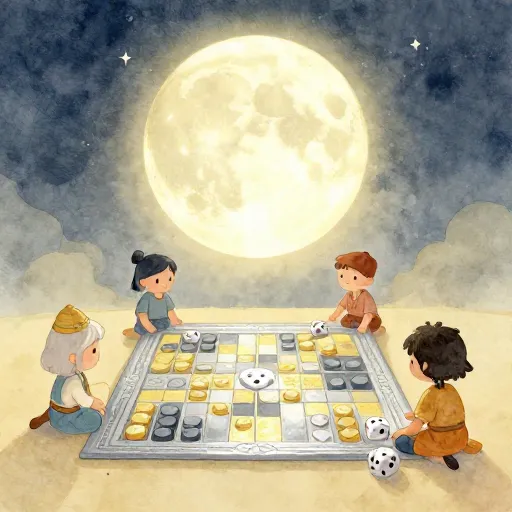
According to myth, the year used to be only 360 days long. Thoth gambled with the Moon god in a game of dice and won enough moonlight to create 5 extra days! This is why we have 365 days in a year. He used those extra days so the goddess Nut could give birth to her children.
This connection to the moon made Thoth the god of math and science, too. He was the one who calculated the geometry of the pyramids and the boundaries of the farmers' fields. To Thoth, there was no difference between a magic spell and a math equation. Both were ways of understanding how the world fits together.
He was often pictured not just as an ibis, but as a baboon. If the ibis represented the quiet, focused scribe, the baboon represented the loud, fierce protector of truth. Baboons were known to chatter at the sunrise, which the Egyptians saw as a greeting to the light of wisdom.

Finn says:
"I wonder why he’s a moon god. The sun is so easy to see, but the moon changes every night. It’s like a mystery you have to solve over and over again."
The Weighing of the Heart
Thoth’s most important job happened at the very end of a person's life. In the Egyptian afterlife, every soul had to enter the Hall of Ma'at. There, their heart was weighed on a giant scale against a single ostrich feather, the symbol of truth and balance.
Thoth stood by the scales, ready to record the result. He didn't take sides, and he didn't get angry. He simply watched and wrote down the truth of who that person had been. If you were kind and honest, Thoth’s pen would capture that forever.
The gods believed that writing was a divine gift that allowed humans to communicate across time and space, preserving wisdom for thousands of years.
Some philosophers argued that writing was a 'poison' for the memory, making people think they were wise when they were actually just repeating things they had read.
Did you know? In Egyptian art, Thoth is often shown holding a palette with two circles of ink: one black and one red. Black ink was used for the main text, while red ink was used for important headings or to mark the names of dangerous demons.
Being the scribe of the afterlife meant Thoth was the ultimate librarian. He kept the Book of the Dead, a collection of spells and directions to help souls navigate the dangerous underworld. He was the one who knew the secret names of the monsters and the passwords for the magical gates.
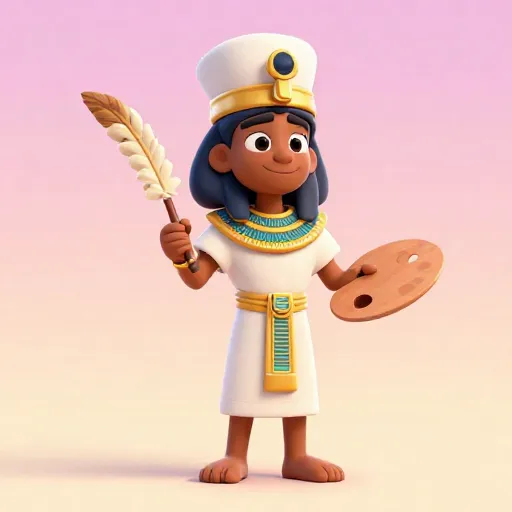
I am Thoth, the perfect scribe, whose hands are pure. I am the lord of purity, the destroyer of evil, the scribe of right and truth.
The God of Magic and Balance
Thoth was also the great mediator. When the other gods got into massive, earth-shaking fights, Thoth was the one who stepped in to negotiate. He didn't use a sword or a shield. He used his words to bring back Ma'at, the Egyptian concept of cosmic balance and justice.
One of the most famous stories involves the Eye of Horus. During a terrible battle, the god Horus had his eye torn out and scattered into pieces. Thoth didn't just find the pieces; he healed them and put them back together, making the eye whole again.
Thoth was the 'Lord of the Palette.' Try making your own 'Book of Thoth' this week. Find a small notebook and, instead of writing what you did, write down one thing you observed each day that felt like a secret. Maybe it's the way a shadow moves or a word you've never heard before.
This story shows us that Thoth wasn't just about facts and figures. He was about healing things that were broken. He believed that knowledge should be used to make the world "right" again. To the Egyptians, a person who was truly wise was someone who could bring peace to a room just by speaking.
Mira says:
"It's cool that he fixed the Eye of Horus. It's like he was the first doctor, but for the whole universe instead of just for people."
Through the Ages: How Thoth Traveled
Thoth didn't disappear when the Egyptian Empire faded. Ideas have a funny way of wearing new clothes and showing up in different centuries. As the world changed, people kept finding new ways to talk about the god of wisdom.
Through the Ages
When the Greeks arrived in Egypt, they were amazed by Thoth. They saw their own god, Hermes, in him. They eventually combined them into a super-god called Hermes Trismegistus, which means "Hermes the Thrice-Great." This version of Thoth became a hero to medieval alchemists and scientists.
Thoth wrote the books, but it is we who must read the stars.
The Silence of the Scribe
Today, we might not worship Thoth in temples, but we live in a world he would recognize. Every time you code a computer program, write a poem, or solve a tricky puzzle, you are walking in Thoth's footsteps. You are taking the messy, invisible thoughts in your head and turning them into something real.
Thoth reminds us that there is a certain power in being quiet. The ibis doesn't sing a loud song; it watches and waits. Sometimes, the best way to understand the world isn't to shout about it, but to look closely and wait for the truth to show itself.
The library at Alexandria, the most famous library in the ancient world, was often associated with Thoth. It was a place where people from all over the world came to share ideas, proving that Thoth's 'magic' of writing could bring completely different cultures together.
Something to Think About
If you had to choose an animal to represent 'Wisdom' today, what would it be?
The Egyptians chose the ibis and the baboon, but the world has changed. Think about an animal you've seen and what kind of knowledge it might hold. There's no right or wrong choice, just a new way of seeing.
Questions About Religion
Why does Thoth have a bird head?
Was Thoth a 'good' god?
Did Thoth really write books?
The Infinite Inkwell
Thoth invites us to see the world as a giant book waiting to be read. Whether you are looking at the stars or the ink on this page, you are participating in a story that began thousands of years ago. Keep your eyes open, your pen ready, and your heart balanced.
