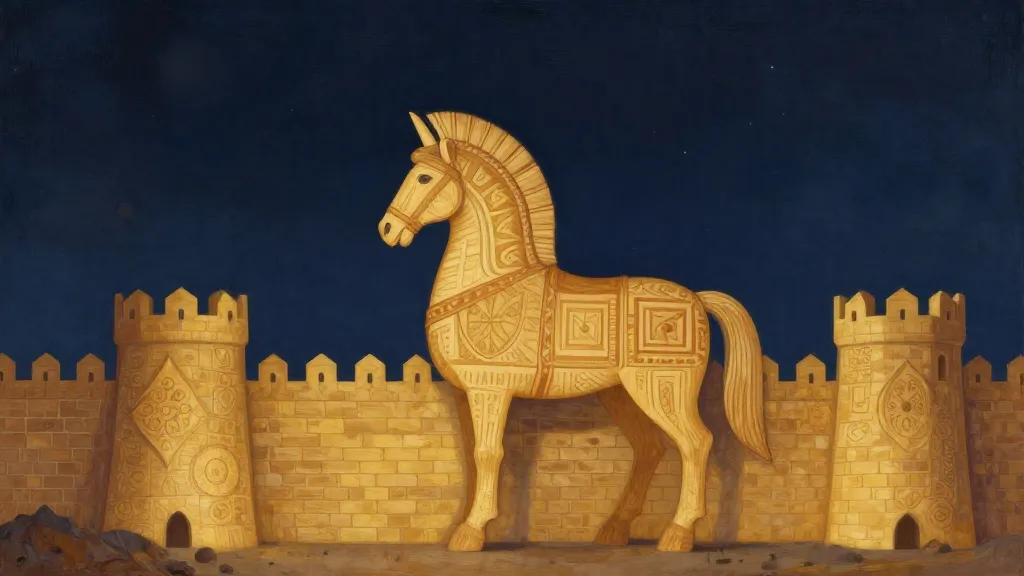
Could a single golden apple really start a war that lasted ten years and changed the world forever?
The Trojan War is one of the oldest stories ever told, blending ancient history with the magical world of mythology. It tells the tale of a great siege on a city called Troy, where heroes and gods fought side by side in a struggle for honor and power.
Imagine you are standing on a dusty hill in what is now the country of Turkey. The sun is hot, and the wind smells of salt from the nearby Aegean Sea.
Below you are the ruins of massive stone walls that were built more than three thousand years ago. For a long time, people thought these walls were just part of a fairy tale, but we now know they were very real.
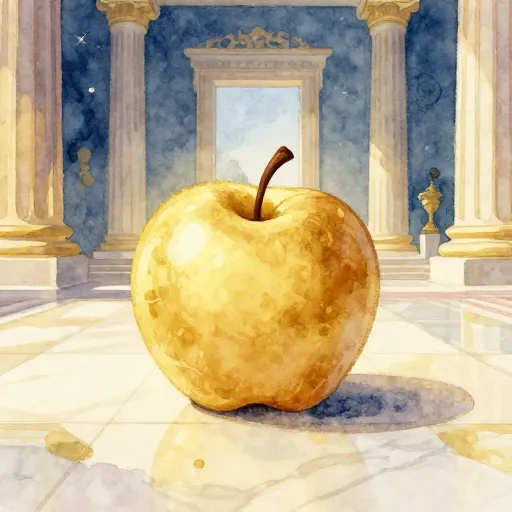
Imagine a wedding where the guests are all powerful gods and goddesses. The air is filled with the smell of nectar and ambrosia. Suddenly, a bright gold apple rolls across the floor, and everyone stops talking. The silence is heavy, because everyone knows that a gift from the goddess of discord is never just a gift.
The story begins not with a soldier, but with a wedding party on Mount Olympus. All the gods were invited except for Eris, the goddess of discord, who was famously grumpy.
To get her revenge, she threw a golden apple into the crowd with the words "To the Fairest" written on it. This led to a huge argument between three goddesses, Hera, Athena, and Aphrodite, about who was the most beautiful.

Finn says:
"Wait, so a whole war started because of a piece of fruit? That sounds like the most extreme version of 'he started it' ever!"
They asked a young prince named Paris to decide, and he chose Aphrodite because she promised him the love of the most beautiful woman in the world. That woman was Helen, the queen of a Greek city called Sparta.
When Paris took Helen back to his home in Troy, the Greek kings were furious. They gathered a fleet of one thousand ships and sailed across the sea to get her back, starting a war that would last a decade.

Sing, O goddess, the anger of Achilles, son of Peleus, that brought countless ills upon the Achaeans.
This war happened during the Bronze Age, a time when weapons were made of heavy metal and kings lived in fortified palaces. Historians believe there really was a city called Troy that was attacked by Greek invaders around 1200 BC.
However, the story we know best was written down hundreds of years later by a poet named Homer. He turned the history into an epic poem called The Iliad, adding in gods who could fly and heroes who were nearly invincible.
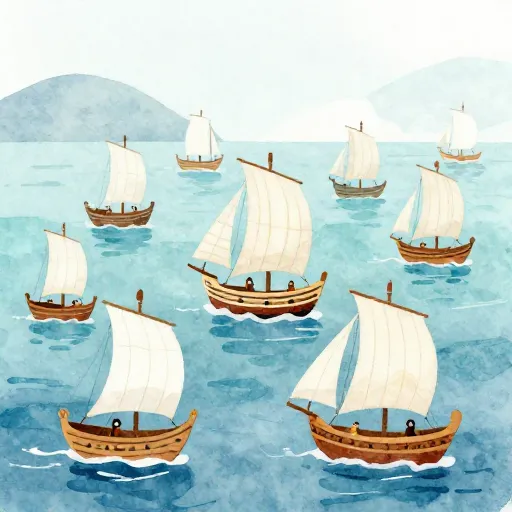
The famous phrase 'the face that launched a thousand ships' refers to Helen of Troy. It means she was so beautiful that an entire navy was built and sent to war just to find her.
The Greeks set up camp on the beach and surrounded the city, but Troy’s walls were too strong to break. Year after year, the two armies clashed in the dusty plains between the city and the sea.
It was not just a war of soldiers, but a war of personalities. On one side was the Greek hero Achilles, who was said to be the greatest warrior to ever live. On the other was Hector, the noble prince of Troy who fought to protect his family.

Mira says:
"It's interesting how Hector fought because he had to protect his home, but Achilles fought because he wanted to be remembered forever. They both wanted to be heroes, but for totally different reasons."
Achilles was a complicated character who was often driven by his pride and his temper. His mother was a sea nymph who had dipped him in a magical river to make his skin impossible to pierce.
She held him by the heel, though, which stayed dry and became his only weak spot. This is why today we call someone's greatest weakness their "Achilles' heel," a reminder that even the strongest people have a part of them that is fragile.
The war lasted ten years because the gods kept interfering and protecting their favorite heroes from being hurt.
The war lasted a long time because Troy was a massive fortress with enough food and water to survive a very long siege.
For nine years, the war was a stalemate, meaning neither side could win. The gods watched from above like spectators at a giant football match, sometimes even jumping down to help their favorite heroes.
Ares and Aphrodite helped the Trojans, while Hera and Athena cheered for the Greeks. It was as if the human world and the divine world were stitched together, and every choice a person made was influenced by a god’s whisper.

Force is as pitiless to the man who possesses it, or thinks he does, as it is to its victims.
Eventually, the anger of Achilles reached a breaking point when his best friend was killed by Hector. Achilles returned to the battle with a fury that terrified everyone, eventually defeating Hector outside the gates of Troy.
But even with their greatest hero gone, the city of Troy refused to fall. Its walls remained tall and silent, mocking the Greeks who were tired, homesick, and ready to give up on the whole mission.
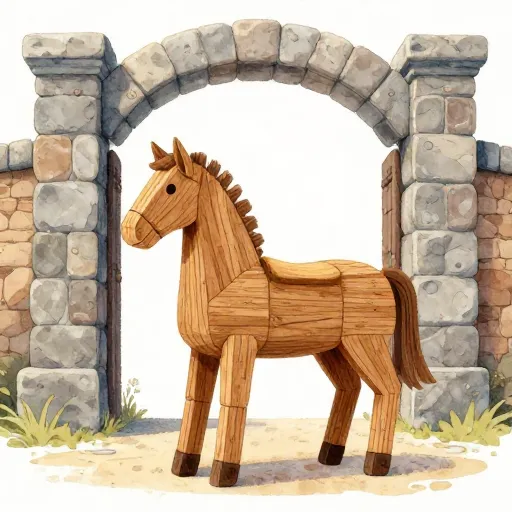
Picture the Trojan Horse standing outside the gates. It is made of pine planks from old ships, smelling of resin and salt. It is taller than a house, and its eyes are made of polished stone that seem to watch the Trojans as they decide whether to bring it inside.
That was when the Greek king Odysseus, who was famous for being clever rather than just strong, came up with a plan. He realized that if they couldn't get over the walls, they would have to be invited in.
The Greeks built a giant, hollow wooden horse and left it outside the city gates. Then, they burned their camp and sailed their ships just out of sight, making it look like they had finally gone home.
Finn says:
"I wonder what it felt like to be inside that horse. It must have been so quiet and scary, waiting for the Trojans to stop cheering and go to bed."
The Trojans were overjoyed and thought the horse was a gift to the gods to ensure a safe journey home for the Greeks. Despite warnings from some who sensed a trap, they pulled the massive statue into the heart of their city.
That night, while the Trojans celebrated and eventually fell into a deep sleep, a secret trapdoor in the horse’s belly opened. Odysseus and a band of elite soldiers climbed down, opened the city gates, and let the rest of the Greek army back in.
Think of a problem you have been trying to solve with 'strength' or force, like a difficult level in a game or a disagreement with a friend. How could you use a 'Trojan Horse' approach, meaning a creative or unexpected idea, to solve it instead?
The city was taken not by a sword, but by a trick. This idea of deception is one of the biggest themes of the story, asking us to think about whether winning by lying is the same as winning by being brave.
Troy was burned to the ground, and the survivors were scattered across the Mediterranean. Many of the Greek heroes found that their journey home was just as difficult as the war itself, leading to even more famous stories like the Odyssey.
Through the Ages
For centuries, people wondered if Troy was just a legend, like Atlantis or King Arthur’s Camelot. Then, in the 1870s, an archeologist named Heinrich Schliemann used the clues in Homer’s poems to find a buried city in Turkey.
He found gold jewelry, charred wood, and layers of ancient buildings that proved a great conflict had happened there. Today, we look at Troy not just as a story about gods, but as a real place where people lived, traded, and struggled.
The Trojan Horse is not a myth. It is the only thing that could ever have taken Troy.
Why do we still tell this story after three thousand years? Perhaps it is because the characters feel so human, even though they lived in a world of monsters and magic.
We understand Achilles' anger, Hector's fear for his children, and Odysseus’s desire to go home. The Trojan War reminds us that history is often made of the small choices people make, and that even the strongest walls can be overcome by a single good idea.
Something to Think About
If you were a Trojan and saw the wooden horse, would you have been suspicious, or would you have wanted to believe it was a gift?
There is no right answer here. Sometimes we see what we want to see, especially when we are tired of fighting.
Questions About Religion
Was the Trojan Horse real?
Did Helen really go to Troy willingly?
Where can I see Troy today?
The War That Never Ends
Whether the Trojan War happened exactly as Homer told it or was a much smaller battle over trade routes, it has become a part of how we think about the world. It teaches us about the dangers of pride, the value of cleverness, and the way that even the biggest conflicts can start with a very small spark. The next time you face a 'walled city' of your own, remember Odysseus and his wooden horse.