Have you ever wondered why your neighbor celebrates Diwali while your best friend goes to Church, or why some people pray in silence while others dance and sing?
Human history is a giant tapestry of different traditions and beliefs. For thousands of years, people in every corner of the world have looked at the stars and asked the same big questions about our existence.
Imagine you are standing on a high mountain peak looking down at the world. From up there, you can see thousands of different towns, cities, and villages. In each of these places, people have their own ways of dressing, their own favorite foods, and their own unique languages.
Religions are a lot like languages. Just as people in different places developed different words for 'water' or 'love,' they also developed different ways to talk about the things they cannot see. They created rituals to mark special moments like births and deaths, and they told stories to explain how the world began.

Finn says:
"If there were only one religion, would that mean we'd finally have the 'right' answer, or would it just be really boring because everyone thought the exact same thing?"
The Geography of God
Long ago, before airplanes and the internet, the world felt much larger than it does today. If you lived in a deep valley in Greece, you might never meet someone from the snowy mountains of Tibet. Because people were separated by vast oceans, high mountains, and burning deserts, they developed their ideas in isolation.
In ancient India, the lush landscape and the rhythm of the monsoon rains influenced the early Vedas, which are some of the oldest religious texts in the world. Meanwhile, in the dry, rocky deserts of the Middle East, people developed a different kind of faith that focused on a single, powerful voice guiding them through the wilderness.
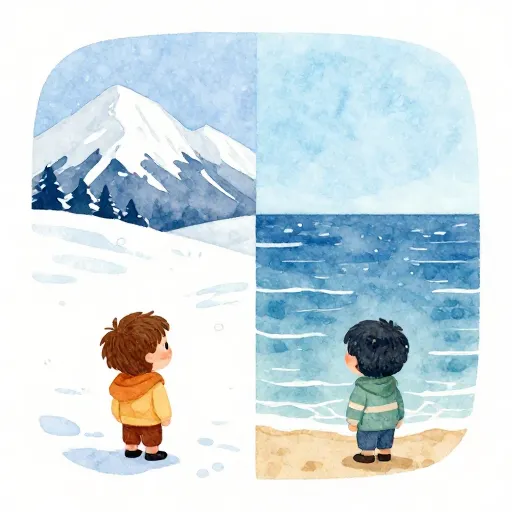
Imagine a world with no maps and no phones. You live in a village surrounded by high, snowy mountains. You believe the gods live on those peaks because they are the highest things you can see. Meanwhile, thousands of miles away, someone living on a tiny island believes the spirits live in the deep ocean waves. You aren't wrong, and they aren't wrong: you are both just looking at the most powerful thing in your world.
These different environments shaped the 'flavor' of each religion. A religion born in a forest might see the divine in every tree and river, which is often called polytheism. A religion born in a place where survival depends on following a strict law might focus more on a single creator, known as monotheism.
Geography acted like a protective wall. It allowed unique cultures to grow their own beautiful gardens of belief without being crowded out by others. This is why we have so many different stories today: because for a long time, we were all living in our own separate worlds.
The lamp is different, but the Light is the same.
The Great Questions
Even though the stories are different, the questions are usually the same. Every human being who has ever lived has probably wondered about a few big things. These questions are the seeds from which all religions grow.
- Where did we come from?
- How should we treat other people?
- Why do bad things happen?
- What happens to us after we die?
Get a group of friends together and sit in a circle. Ask everyone to describe 'happiness' without using the word 'happy.' You will find that some people talk about family, some talk about ice cream, and some talk about quiet moments. You all mean the same feeling, but your descriptions are totally different. This is exactly how different religions try to describe the 'Mystery' of life.
Some religions answer these questions with stories about powerful gods and goddesses. Others, like Buddhism, focus more on a philosophy of how to train your mind to be kind and calm. Even though the answers vary, the 'wonder' behind the questions is something all humans share.
Think of it like a group of artists all trying to paint the same sunset. One artist might use bright oranges and reds, while another uses deep purples and blues. One might focus on the clouds, and another might focus on the way the light hits the water. Each painting is different, but they are all looking at the same sun.

Mira says:
"I noticed that almost every religion has a rule about being kind to others. It's like they all found the same treasure but hid it in different shaped boxes."
When Worlds Collide
As humans began to travel and trade, their religions began to meet. This happened famously along the Silk Road, a massive network of paths that connected China to the Mediterranean Sea. Traders didn't just carry silk and spices: they carried their mythology and their prayers.
Imagine a dusty market in Central Asia two thousand years ago. You might see a Buddhist monk from India talking to a merchant who follows the ancient Persian religion of Zoroastrianism. They might discover that they both value honesty and light, even if their rituals look very different.

There are over 4,000 different religions and belief systems in the world today! While some have billions of followers, others are practiced by only a few hundred people in small villages. Every single one of them represents a unique piece of human history.
Sometimes, when religions met, they blended together to create something new. Other times, they stayed separate but learned from each other. However, these meetings weren't always peaceful. Sometimes, people felt so strongly that their way was the 'right' way that they fought over their differences.
Understanding history helps us see that most conflicts weren't really about the ideas themselves. Often, they were about power, land, and the fear of things that are different. When we look closely, we see that the heart of most religions is actually very similar.

Religion is like a pair of shoes. If it fits you, that's great, but don't try to make me wear yours.
The Family Tree of Faith
It helps to think of religions as belonging to families. Just like you might have cousins who look a bit like you but live in a different house, many religions share the same ancestors. This is why some religions seem so similar while others feel quite distant.
For example, Judaism, Christianity, and Islam are often called the Abrahamic religions. They all share the same starting point and many of the same stories about prophets and kings. It is like a tree trunk that split into three big branches.
That all religions are essentially the same thing, just with different names and stories. They think they are all paths leading to the same mountain top.
That the differences between religions are very important. They believe that each religion offers a totally unique way of seeing the world that can't be replaced.
On the other side of the world, traditions like Hinduism, Buddhism, and Jainism grew from a different set of roots in ancient India. These traditions often talk about Dharma, which is a word for the natural law or duty that keeps the universe in balance. They focus on the idea that all life is connected in a great cycle.
Through the Ages
The Wisdom of Diversity
Today, we live in a world where we can learn about any religion with the click of a button. We no longer live in isolated valleys. This gives us a special opportunity to look at the 'Big Library' of human thought and see what we can learn from everyone.
Some people believe that having many religions is a mistake and that we should all believe the same thing. But others think that diversity is what makes the human race beautiful. Just as a garden is more interesting with many types of flowers, the human experience is richer because we have so many different ways to express our spirituality.
The word 'religion' actually comes from a Latin word, 'religare,' which means 'to bind or tie together.' It was meant to describe the things that connect people to each other and to something bigger than themselves.
When we study different religions, we aren't just learning facts about what other people do. We are learning about the different ways humans have tried to be brave, kind, and hopeful. We are learning about the many ways to say 'thank you' for the mystery of being alive.
The soul of all religions is one, but it is encased in many forms.
Carrying the Torch
Every religion is a tradition that has been passed down like a precious torch from one generation to the next. Your ancestors, whoever they were and wherever they lived, likely had a way of making sense of the world. They passed those ideas to their children, who passed them to theirs, all the way down to you.
Finn says:
"It's wild to think that a story someone told 3,000 years ago in a desert is still making people feel better today. Those ideas are like time travelers."
Whether you follow a specific religion, or your family prefers to look at the world through science or personal philosophy, you are part of this long human journey. We are all explorers trying to map out the territory of what it means to be a good person.
In the end, maybe the reason there are so many religions is simply that the world is too big and too wonderful to be explained by just one story. Each religion is a different window into the same vast sky. Depending on which window you look through, you might see a different constellation, but it is all the same universe.
Something to Think About
If you were to create a special ritual to celebrate being part of the human family, what would it look like?
There is no right or wrong answer to this. Your ritual could involve music, food, silence, or even a certain way of walking. Think about what feels most 'true' to you.
Questions About Religion
Which religion was the first one?
Do I have to choose just one religion?
Why do people sometimes fight about religion?
A World of Wonder
The next time you see a temple, a mosque, a synagogue, or a church, remember that it is a monument to human curiosity. We are a species that loves to ask 'why?' and 'how?' and 'what if?' Having so many different religions is a sign of how creative and diverse our human family really is. Keep asking your own big questions, and you'll find that you are part of a conversation that has been going on for thousands of years.