10 Fun Facts

Moon Facts for Kids

Get ready to have your mind blown, because the Moon isn't just a pale, glowing disc in the sky-it's a world full of crazy history and extreme science! We're taking you on an adventure to uncover ten absolutely specific and surprising facts about our closest cosmic neighbor. Forget what you think you know; by the time we're done, you'll be the expert ready to tell everyone else what's really up there!

1

The Moon Weighs About 7.3 x 10²² Kilograms

TL;DR

The Moon's mass is a giant 7.3 x 10²² kg!

Cartoon representation of the Moon's mass written in scientific notation.

That massive number, 7.3 × 10²² kg, is how much the Moon weighs in scientific notation. That's a 73 followed by 21 zeros!

To put that in perspective, the Moon’s mass is only about 1.2% of Earth's mass.

It's smaller than Earth, but that lower mass is why you weigh only one-sixth of your Earth weight when you stand on the Moon!


2

You Can't See the 'Dark Side' Because It Always Faces Us

TL;DR

The Moon rotates at the same speed it orbits, so one side always faces Earth.

Illustration showing the Moon's tidal locking, where one side always faces Earth.

The Moon takes about 27 days to spin once on its axis—and it takes 27 days to go around the Earth!

Because these times match perfectly, the same side of the Moon is always pointed toward us. This is called tidal locking.

The side we don't see is called the far side, not the dark side, because it gets just as much sunlight as the side we see!

3

The Apollo 11 Trip Took Over 3 Days, Not 10 Hours

TL;DR

Apollo 11 reached a top speed of 25,000 mph but still took 3 days to get there.

Cartoon rocket ship traveling fast through space on its way to the Moon.

After launching, the Apollo 11 spacecraft hit a speed of nearly 25,000 mph—that’s faster than most bullets!

Even at that incredible speed, it took the astronauts about 3 days to cover the 238,855 miles to the Moon.

They couldn't just blast straight there; they had to carefully coast on a long, curved path where Earth’s gravity slowed them down first.

4

The Coldest Spot in the Solar System is in a Moon Crater

TL;DR

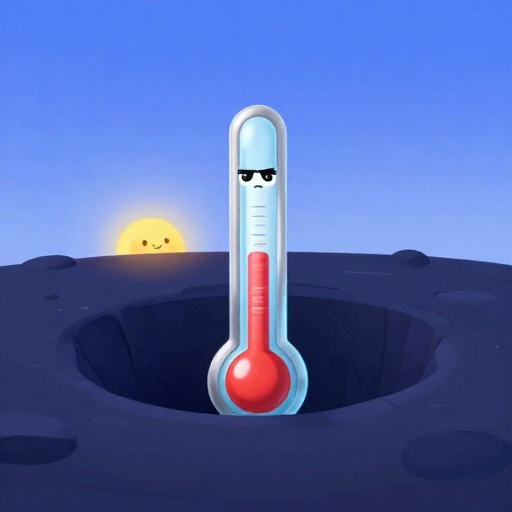
Temperatures in one moon crater dropped to -253°C!

Cartoon crater on the Moon showing extreme cold temperatures.

While the sunny side can bake at 120° Celsius (250° F), shadows on the Moon get unbelievably cold!

Deep inside a crater near the North Pole, scientists measured a chilling -253° Celsius (-424° F).

That's colder than the average temperature of empty space itself—brrr! No wonder the astronauts stayed in the sun!

5

The Moon is Moving Away from Earth by About 1 Inch Per Year

TL;DR

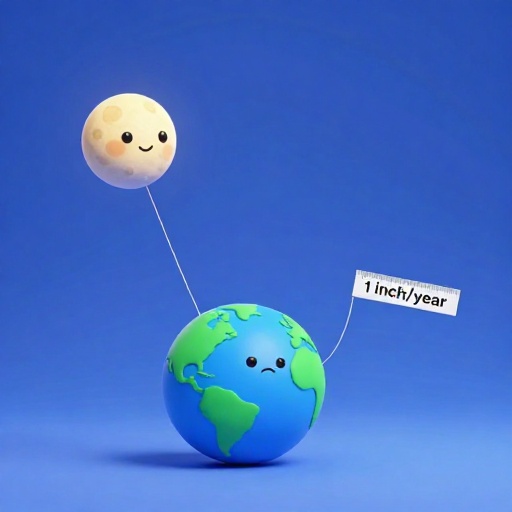
Our satellite is slowly drifting about 1 inch farther every year.

Cartoon Earth and Moon slowly drifting apart by one inch per year.

The Moon is moving away from Earth at a speed of roughly 3.8 centimeters per year—that’s about 1 inch!

This is because of the tidal forces—the pull between the Earth and Moon causes energy transfer that pushes the Moon outward.

Don't worry, it will take billions of years before this makes any noticeable difference to our nights.

6

The Biggest Moon Crater is 2,500 km Wide

TL;DR

The South Pole–Aitken basin is 2,500 km across, covering a quarter of the surface!

Cartoon depiction of the giant South Pole-Aitken basin on the Moon compared to a map of France.

Meet the South Pole–Aitken basin, the Moon’s biggest, oldest, and deepest impact scar, about 4.2 billion years old.

It's about 2,500 kilometers (1,600 miles) in diameter—that’s wider than the entire country of France!

This gigantic hole covers nearly a quarter of the Moon's entire surface area!

7

Astronauts Left 6 Missions' Worth of Gear on the Surface

TL;DR

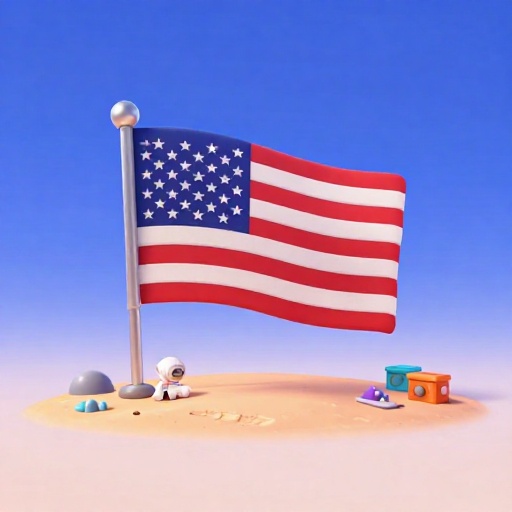
12 Moonwalkers left behind equipment, flags, and scientific tools across six landing sites.

Cartoon image of an American flag and scientific gear left on the Moon's surface.

The six successful Apollo landings between 1969 and 1972 left behind tons of equipment.

This includes six American flags, scientific instruments, and even cameras left by the Moonwalkers.

The Apollo astronauts collected a total of 382 kilograms (842 pounds) of rocks and soil to bring back to Earth for study.

8

It Takes Radio Signals 2.6 Seconds for a Round Trip

TL;DR

Radio waves take 1.3 seconds to get there, and 1.3 seconds to return.

Cartoon showing the 2.6-second round-trip time for radio signals between Earth and the Moon.

Light (and radio waves) take about 1.3 seconds to travel from Earth to the Moon at its average distance.

When mission control talked to astronauts, there was always a 2.6-second delay for the 'hello' and 'I copy' response.

This proves the Moon is 238,855 miles away on average, showing us how fast light really is!

9

The Moon's Official Age is 4.46 Billion Years Old

TL;DR

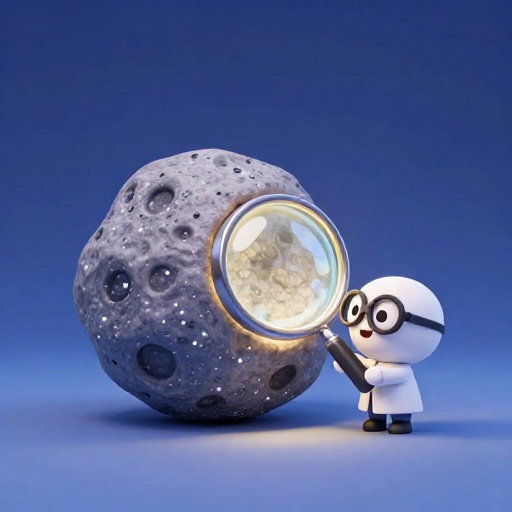
The oldest rock samples collected by Apollo 17 show the Moon formed 4.46 billion years ago.

Cartoon scientist examining an ancient Moon rock sample.

By studying tiny zircon crystals in lunar dust brought back by the Apollo 17 mission, scientists dated the Moon.

The oldest sample they found sets the age at a stunning 4.46 billion years old.

This means the Moon formed about 50 million years after the Solar System started, likely from a massive Mars-sized planet collision!

10

Tides Are Caused by the Moon's Pull on Earth's Water

TL;DR

The Moon's gravity tugs on our oceans, causing high and low tides daily.

Cartoon showing the Moon's gravity pulling Earth's ocean water to create tides.

The Moon's gravity is weak compared to Earth's, but it’s strong enough to pull on our planet’s water.

This pull creates a bulge of water on the side facing the Moon, causing high tide.

As Earth spins beneath these bulges, coastal areas experience two high tides and two low tides every 24 hours (or so)!

Frequently Asked Questions

What is the 'dark side' of the Moon?

It's better called the far side! Because the Moon rotates at the same speed it orbits Earth, the far side never faces us. It still gets sunlight, though—it's only dark when it's a New Moon phase for us.

How long does it take to get to the Moon?

The trip takes about 3 days! While the maximum speed for Apollo 11 was nearly 25,000 mph, the journey is long and curved, taking around **75 hours and 55 minutes** for the actual travel time.

What causes the Moon's phases?

The phases—like crescent or full—are just how much of the sunlit part of the Moon we can see from Earth. The entire lunar cycle, from one New Moon to the next, takes **29.5 days**.

Will we ever go back to the Moon?

Absolutely! NASA’s **Artemis program** is actively working to send astronauts back to the Moon in the coming years, with the goal of establishing a long-term presence there!

Your Moon Mission is Just Beginning!

See? The Moon is way more complex and exciting than just a nightlight! Now you know about its massive craters, its slow drift away from us, and the incredible journey it took for humans to actually walk on its surface. Keep looking up tonight—your next great adventure in learning is waiting right above your head!

Explore More Facts
Audience Debug