10 Fun Facts

Space Facts for Kids

Hey Space Explorers! Are you ready to ditch the boring textbook stuff and launch into the REAL, jaw-dropping truth about outer space? Forget 'space is big'—we're talking billions of years old and trillions of times heavier! We're digging up the most specific, wildest numbers and stories from our amazing universe, from super-hot planets to giant black holes. Get ready to discover things that will make you question everything you thought you knew!

1

Venus is Hot Enough to Melt Lead!

TL;DR

Venus has surface temperatures of 473°C, hot enough to melt metal!
Cartoon planet Venus glowing intensely hot

You might think Mercury is the hottest because it’s closest to the Sun, but nope! Venus wins the heat contest with a sizzling average surface temperature of 473°C.

That is hot enough to melt lead—a metal you might use in a pencil lead or fishing weight! Why? Because Venus is wrapped in a thick atmosphere mostly made of carbon dioxide that traps all the heat.

This runaway greenhouse effect is so intense that there’s almost no temperature difference between the day side and the night side, or even the poles and the equator. It’s hot all the time!

2

Our Sun is 99.86% of Everything!

TL;DR

The Sun holds 99.86% of all the mass in our entire Solar System!

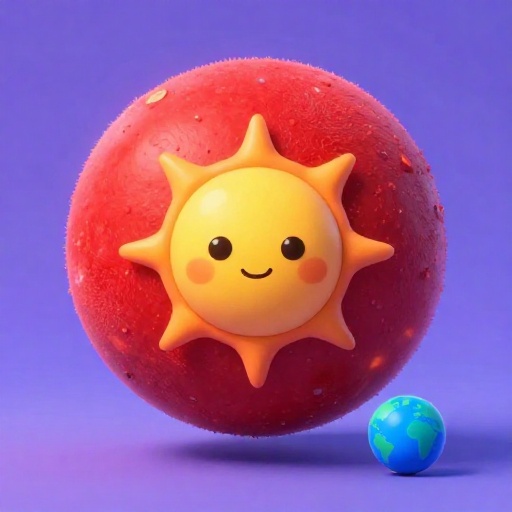
Cartoon Sun much larger than a tiny Earth

The Sun isn't just a big, bright light—it’s the ultimate heavyweight champion of our neighborhood! It holds a staggering 99.86 percent of the entire mass of the Solar System.

Think of everything in space around us: all eight planets, every moon, every asteroid, every comet. Put it all on one giant scale, and the Sun is still heavier by almost all the remaining 0.14 percent!

It’s so massive that about one million Earths could fit inside it. Talk about being the center of attention!

3

The ISS is an International Club of 15 Nations!

TL;DR

The Intergovernmental Agreement for the ISS was signed by 15 countries in 1998.

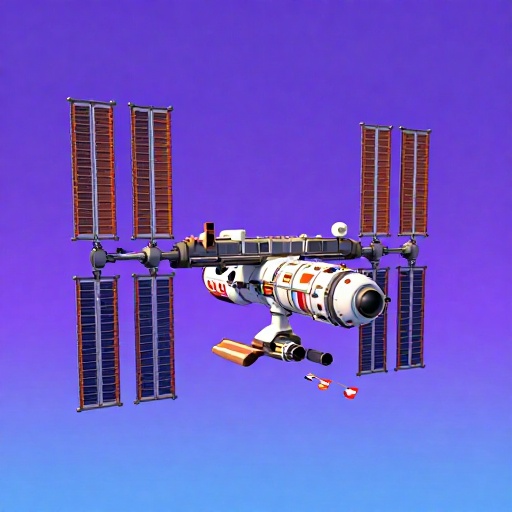
Cartoon International Space Station with many small flags

The International Space Station (ISS) isn't just an American or Russian project—it’s a giant floating clubhouse built by an amazing global team!

The Space Station Intergovernmental Agreement was signed by fifteen countries back in 1998 to make this happen.

The core partners are the US, Russia, Canada, and Japan, but that agreement includes eleven Member States of the European Space Agency too. That’s cooperation on a galactic scale for kids' science!

4

The Closest Star is 4.25 Light-Years Away

TL;DR

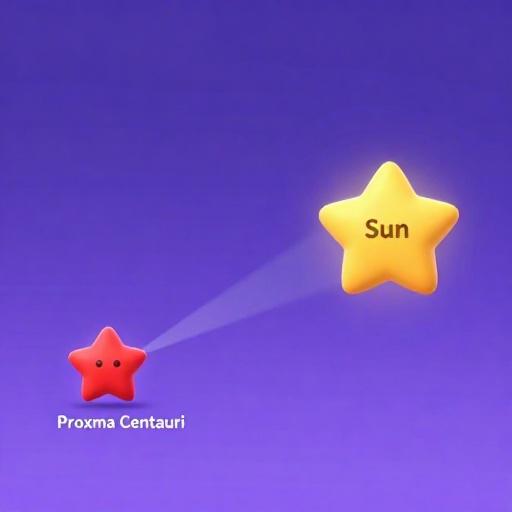
The closest star to us, Proxima Centauri, is 4.25 light-years away.

Cartoon Proxima Centauri star with a long light beam pointing to the Sun

The Sun is our closest star, obviously, but the next nearest star is Proxima Centauri, and it is 4.25 light-years away.

A light-year is how far light travels in one year—that’s about 9.46 trillion kilometers! So, light from Proxima Centauri takes 4.25 years to reach your eyes.

If you could zoom there in the fastest rocket, it would still take you about 6,300 years to get there. Talk about a long road trip!

5

The Largest Star's Edge is Past Jupiter's Orbit

TL;DR

The biggest known star, UY Scuti, is 1,708 times wider than our Sun.

Cartoon UY Scuti star shown as a massive red sphere eclipsing the Sun

Our Sun is huge, but the star UY Scuti makes it look like a tiny marble! UY Scuti’s radius is estimated to be 1,708 times wider than our Sun’s.

If you could swap our Sun for UY Scuti, its outer edge would reach beyond the orbit of Jupiter—that's the 5th planet out!

This giant red supergiant is so big that the volume inside it could hold almost 5 billion Suns!

6

Our Galaxy Completes One Lap Every 230 Million Years

TL;DR

It takes our Solar System about 230 million years to orbit the Milky Way's center.

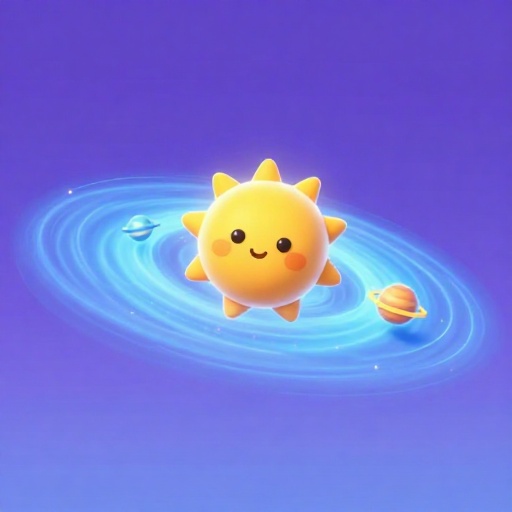
Cartoon Solar System orbiting within the spiral arms of the Milky Way galaxy

We aren't just floating still; our entire Solar System is on a massive merry-go-round called the Milky Way galaxy!

It takes us about 230 million years to complete just one orbit around the galactic center. That means the last time we were in this spot, dinosaurs were walking the Earth!

We are zooming along at a speed of about 515,000 miles per hour (829,000 kph) just to keep up the pace on this ride!

7

The First Spacewalk Lasted Only 12 Minutes and 9 Seconds

TL;DR

Alexei Leonov completed the first spacewalk for 12 minutes and 9 seconds on March 18, 1965.

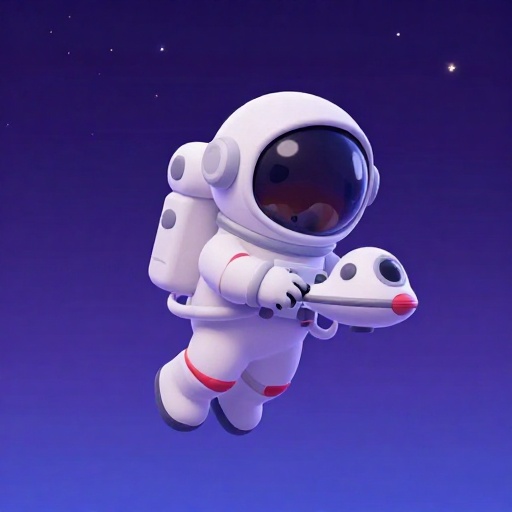
Cartoon astronaut performing the first spacewalk

On March 18, 1965, Soviet cosmonaut Alexei Leonov bravely became the first human to leave his spacecraft and float freely in the vacuum of space!

His historic extravehicular activity (EVA) only lasted 12 minutes and 9 seconds, but it was long enough for his suit to balloon up so much he almost couldn't get back inside!

This test paved the way for all future spacewalks, showing scientists how the human body handles working outside the capsule.

8

The Biggest Black Hole is 66 Billion Times the Sun's Mass

TL;DR

The black hole TON 618 is estimated to have a mass of 66 billion Suns.

Cartoon black hole swirling, dwarfing a cartoon Sun

Black holes are super weird, but the biggest ones are ultramassive, like TON 618, which is estimated to be 66 billion M☉ (solar masses)!

That’s 66,000,000,000 times the mass of our Sun!

It's so unbelievably heavy that its size (Schwarzschild radius) is 1,300 Astronomical Units across—that’s more than 40 times the distance from Neptune to the Sun!

9

Saturn’s Rings Are Mostly Water Ice Chunks

TL;DR

The beautiful rings around Saturn are made almost entirely of water ice particles.

Cartoon Saturn with bright, chunky water-ice rings

Those famous rings around Saturn? They aren't solid hoops, but billions of chunks of ice and rock orbiting the planet!

The particles are mostly made of water ice, ranging in size from tiny specks of dust up to chunks as big as a school bus!

It’s like a giant, glittering cosmic snowball fight happening millions of miles away from us.

10

Our Solar System is Flying 515,000 mph!

TL;DR

The Solar System orbits the center of the Milky Way at 515,000 mph.

Cartoon Earth moving very fast in orbit around the Sun

We are all constantly moving! Our entire Solar System is hurtling around the center of the Milky Way galaxy at an incredible speed of 515,000 miles per hour.

That’s fast enough to travel from New York to Los Angeles in about 5 minutes!

Even with that insane speed, because space is so huge, it still takes us about 230 million years for one full lap!

Frequently Asked Questions

How far away is space?

That depends on where you start measuring! The edge of the Earth's atmosphere, the Kármán line, is **100 kilometers (62 miles)** up. But the ISS orbits much higher, at about 420 km (260 miles). True outer space begins much, much further out!

What is a light-year, really?

A light-year is a **distance**, not a time! It's how far light travels in one Earth year, which is about **9.46 trillion kilometers**. We use it because regular miles or kilometers become too small to talk about star distances.

How many planets are in our Solar System?

There are **eight** official planets that orbit the Sun: Mercury, Venus, Earth, Mars, Jupiter, Saturn, Uranus, and Neptune. Don't forget about the cool dwarf planets like Pluto, too!

What is the biggest thing in space?

That title is always changing! Right now, we know of ultramassive black holes, like TON 618, that are **billions of times the mass of our Sun**. Galaxies are even bigger collections of stars, gas, and dark matter!

Your Mission Control is Ready!

See? Space is more wild and full of specific records than any video game! You've just learned facts that even some grown-ups don't know. Every number, every date, every comparison proves that the universe is waiting for curious explorers like you. Keep asking 'Wait, WHAT?!' and never stop looking up—your next amazing discovery is just a telescope away!

Explore More Facts
Audience Debug