You have got money from your part-time job and you want to manage it yourself, but every bank seems to need your parent's signature.
Understanding a bank account for minors is the first step toward independence. Because of how legal contracts work, most people under 18 face specific rules and restrictions on how they can move their money.
It feels like a rite of passage. You get your first paycheck or a stack of birthday cash, and you head to the bank to keep it safe. Then you hit the wall: the bank teller asks for your mom or dad.
Imagine you have saved up $2,000 for a car. You walk into a dealership or a bank to sign a loan, but the law says your signature isn't 'binding.' This means you could technically walk away from the deal later because you are a minor. Banks require a parent co-signer to ensure someone is legally bound to the agreement.
This happens because, in the eyes of the law, people under 18 are minors. This status comes with many protections, but it also means you generally cannot enter into a legal contract on your own. A bank account is technically a contract between you and the financial institution.

Finn says:
"So wait, even if I earned the money at my job, I still need my dad's signature just to put it in a safe place? That seems backwards!"
The Reality of the Co-Signer
To bridge the gap between your desire for a bank account and the law, banks require a co-signer. This is usually a parent or legal guardian who signs the signature card with you. By doing this, they take legal responsibility for the account.

An investment in knowledge pays the best interest.
When a parent co-signs, they aren't just giving permission. They are often becoming a joint owner of the account. This means they have the same legal rights to the money as you do, which is why choosing a person you trust is important.

In almost every state in the U.S., you must be at least 18 to open a bank account alone. However, some credit unions and local banks have specific 'student' programs that offer more independence starting at age 16.
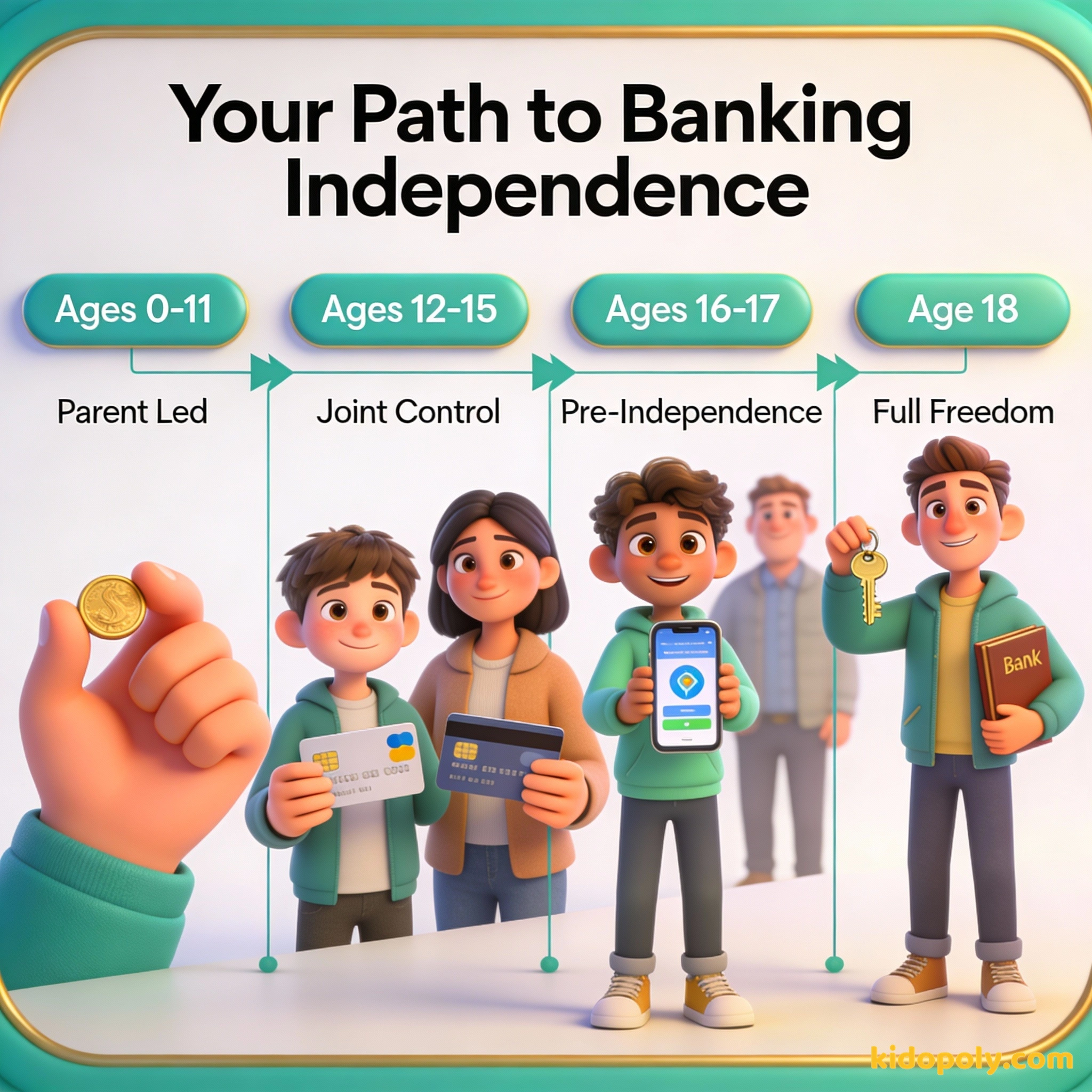
Age Tiers: The Road to 18
Not all minor accounts are created equal. Banks often group young customers into age tiers that determine how much freedom you have. While every bank is different, the stages usually look something like this:
- Under 11: These accounts are almost entirely parent-managed. The child might have a passbook, but the parent does the heavy lifting.
- Ages 11-15: This is the joint account stage. You might get your first debit card and limited access to mobile banking, but your parent can see every transaction.
- Ages 16-17: At this stage, many banks offer near-full access. You might have higher spending limits and more control, though a parent's name is still on the account for legal reasons.
Joint Accounts vs. Custodial Accounts
It is important to know which type of account you actually have. Most teens use a joint account, which is designed for daily spending and saving. Both you and your parent can put money in and take money out.
You and your parent share the account. Both can see every purchase, and both are responsible for any fees.
A parent manages the account for you. You own the money, but you cannot usually spend it until you turn 18 or 21.
On the other hand, you might have a custodial account, often called a UGMA or UTMA account. In this setup, you are the legal owner of the money, but a "custodian" (your parent) manages it for your benefit. You usually cannot touch this money until you reach the age of majority.

Mira says:
"My parents set up a custodial account for my college fund. I can see the balance, but I know I can't spend it on concert tickets right now!"

The chains of habit are too light to be felt until they are too heavy to be broken.
The "Speed Limiters" on Your Money
Banks put certain restrictions on minor accounts to prevent big mistakes. These are like training wheels for your financial life. Even if you have thousands of dollars, you might find you can only spend a few hundred per day.
- Transaction Limits: Most teen accounts have a cap on daily ATM withdrawals and debit card purchases.
- No Overdraft: Many minor accounts are set up to decline a purchase if you do not have enough money, rather than charging an overdraft fee.
- Transfer Restrictions: You might be blocked from sending large amounts of money to outside accounts or using certain peer-to-peer payment apps.
Let's look at how daily limits work: - Daily ATM limit: $200 - Daily Purchase limit: $500 - Total possible spending: $700 Even if your balance is $1,500, if you try to buy a $600 laptop in one go, the transaction will likely be declined unless your parent calls the bank to raise the limit.
The Big Shift at 18
Everything changes when you blow out the candles on your 18th birthday. At this point, you are a legal adult. You now have the power to sign your own contracts and open a solo account without any help.
Finn says:
"I am counting down the days until 18. I want to be the only person who can see how many times I visit the taco shop each week."
When you turn 18, most banks will offer an account conversion. This process removes your parent from the account and turns it into a standard adult account. However, some people choose to close their minor account and open a brand new one to ensure they have total privacy.

A budget is telling your money where to go instead of wondering where it went.
Are There Exceptions?
There is one main way to get a bank account alone before 18: being an emancipated minor. This is a legal process where a court decides you are financially self-sufficient and independent from your parents. If you have the court papers, banks will treat you like an adult.
Ask your parents what kind of account you have. Is it a joint checking account? Or is it a custodial UTMA account? Knowing the name of the account type will help you look up the specific rules for your bank online.
For everyone else, the path to banking is a team sport. It involves talking to your parents about your goals and showing them you can handle the responsibility of a debit card. Once you prove you can manage a small balance, the transition to adulthood becomes much easier.
Something to Think About
If you could have a bank account with zero parental supervision today, what is the first thing you would do differently with your money?
Think about whether your spending habits would change or stay the same. There is no right or wrong answer: this is about understanding how you feel about financial freedom.
Questions About Banking
Can I get a debit card if I'm under 18?
Does my mom see everything I buy?
Will my minor account automatically close when I turn 18?
Your Next Step Toward Independence
Now that you know the rules, it is time to look at the tools. Check out our guide on the best bank accounts for kids to see which banks offer the features you want most.