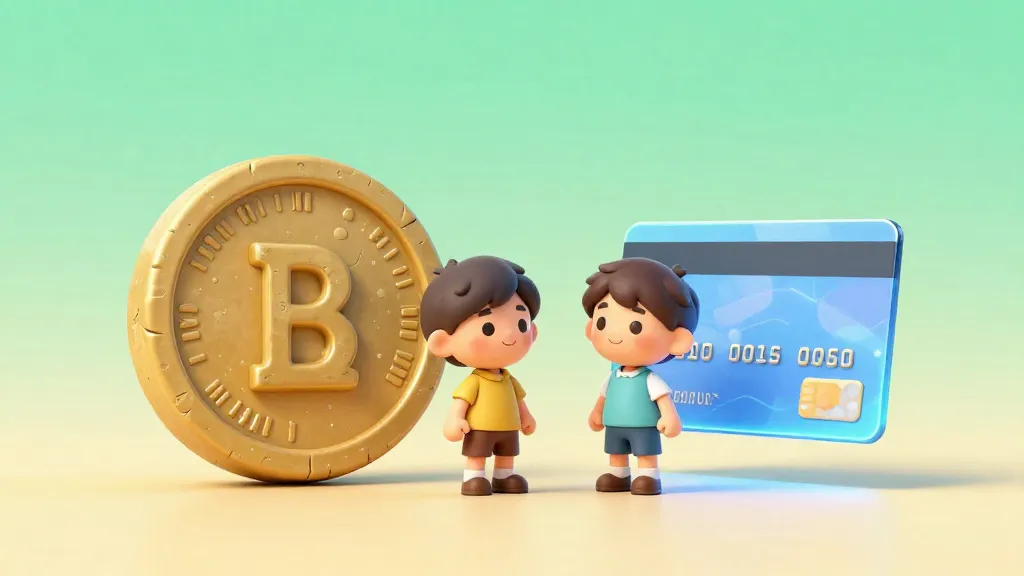
Imagine lugging a heavy sack of barley to the market just to buy a pair of sandals.
That was real life 5,000 years ago. The history of money is really the story of people getting fed up with heavy, annoying objects and inventing something better through innovation and problem solving.
Before there were shops or websites, people had to figure out a way to get what they needed. This led to the era of barter, which started around 6000 BCE in Mesopotamia. If you had extra grain and needed a cow, you had to find someone who had a cow and specifically wanted your grain.
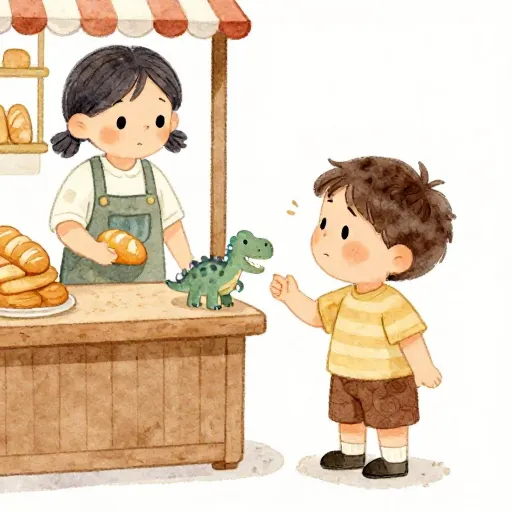
Imagine you have a rare holographic game card. You want a slice of pizza. But the pizza shop owner doesn't like games: they only want new sneakers. You'd have to find someone with sneakers who wants your card, then take those sneakers to the pizza shop. That is bartering!
This was called the double coincidence of wants. It basically meant that for a trade to work, you both had to want exactly what the other person had. If the cow owner only wanted wool, you were out of luck. People realized this was way too complicated for everyday life.

Finn says:
"Wait, so if I wanted a new bike in 5000 BCE, I'd have to find a bike-maker who really needed a giant pile of my old toys? That sounds like it would take forever!"
To solve the barter problem, people started using commodity money. These were items that everyone in a community agreed were valuable. In different parts of the world, people used salt, peppercorns, tea bricks, or even cowry shells as a way to pay.
The Birth of the Coin
While shells were great, they could break or be found too easily on the beach. Around 600 BCE, in a kingdom called Lydia (which is now part of Turkey), King Croesus helped change everything. The Lydians invented the first standardized coins made from a mix of gold and silver.
An investment in knowledge pays the best interest.
These coins were revolutionary because they had a government seal stamped on them. This seal was a promise that the coin was the real deal. You didn't have to weigh the gold yourself anymore: you just counted the coins. This made trading much faster and safer for everyone.
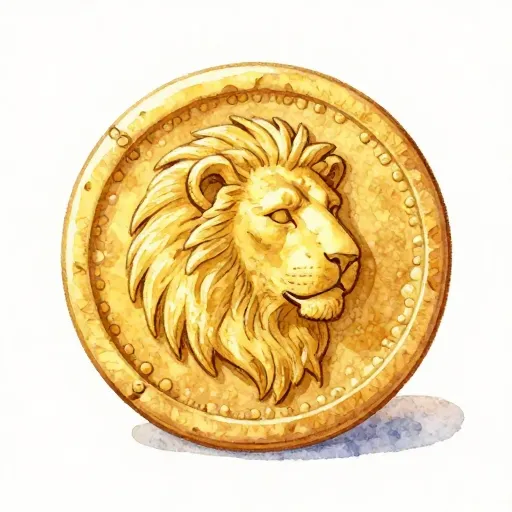
In ancient Lydia, the coins featured a roaring lion. King Croesus was so famous for his wealth that today people still say someone is 'as rich as Croesus' if they have a lot of money!
Once coins existed, trade exploded. People could travel further because coins were small and easy to carry. Merchants from different countries started meeting in markets, and the world began to feel a lot more connected.
The Paper Revolution
Even though coins were better than bags of salt, they had one big problem. They were heavy! If you were a rich merchant in China during the Tang Dynasty, carrying thousands of metal coins was exhausting and dangerous. You became a target for thieves.

Mira says:
"It's like how we use gift cards today. The card isn't the actual toy or game, but it represents the value of it. The Chinese merchants just did it with paper first!"
To solve this, the Chinese began leaving their heavy coins with a trusted person. In exchange, they received a piece of paper money that acted as a receipt. This receipt promised that the paper could be traded back for the real coins whenever the owner wanted.
The 'Paper Trust' Experiment. Draw your own 'currency' on a piece of paper. Try to 'buy' a small chore or a snack from a family member by promising that your paper is worth one high-five or one hug. If they accept it, you've just created paper money based on trust!
When the explorer Marco Polo visited China in the 1200s, he was stunned. He saw people trading bits of paper as if they were gold. When he returned to Europe and told people about it, many didn't believe him. It took hundreds of years for the rest of the world to catch up to the idea of paper currency.
Milestones in Money History
The Invisible Money Era
For a long time, paper money was part of the gold standard. This meant that every dollar or pound printed was backed by actual gold kept in a safe vault. If you wanted to, you could theoretically trade your paper for a tiny piece of gold.
Price is what you pay. Value is what you get.
Eventually, countries moved away from this. We realized that money works because we all trust the government that issues it. In the 1950s, the first credit cards appeared, allowing people to buy things without carrying any physical cash at all.
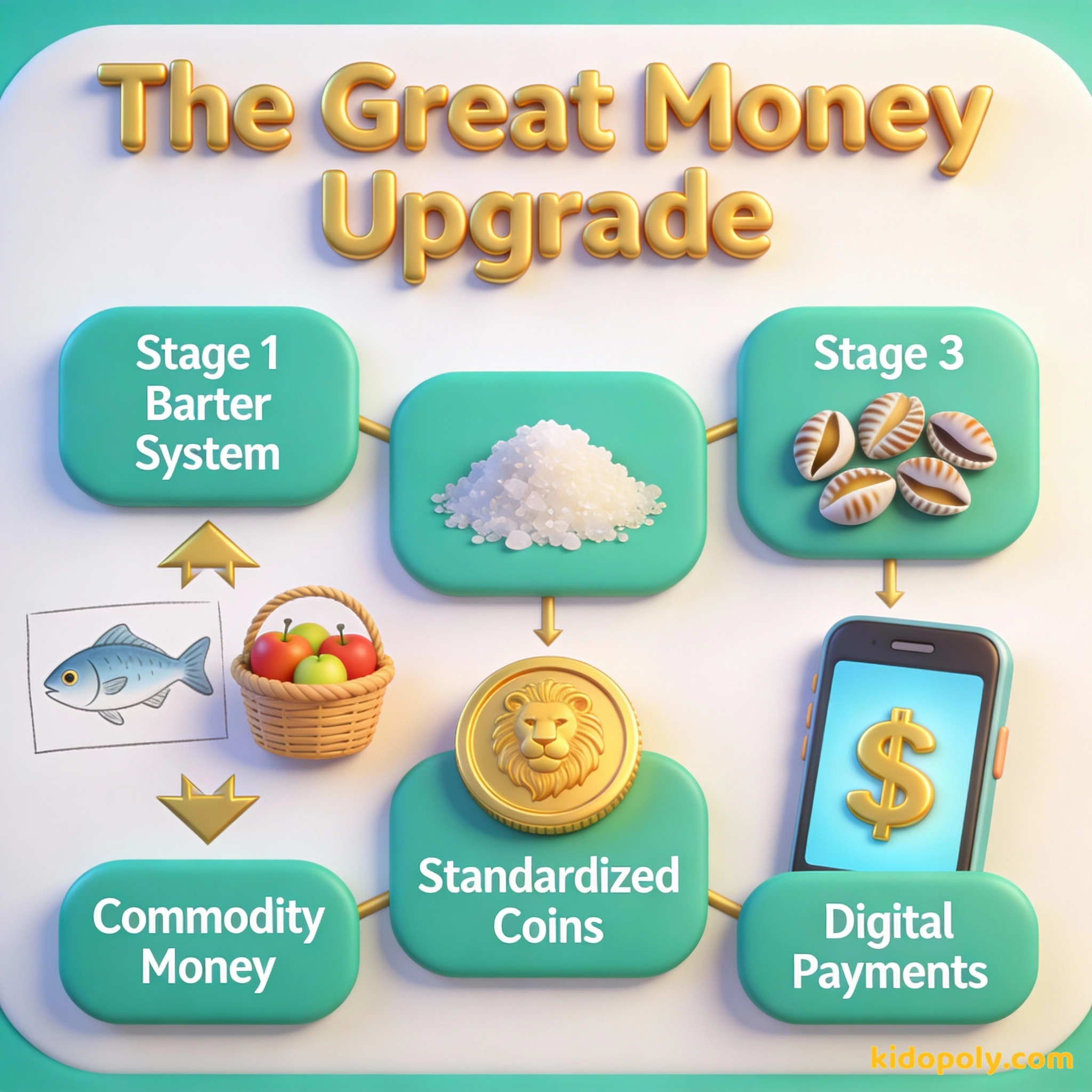
Today, most of the money in the world is actually invisible. It exists as digital code in bank computers. When your parents tap their phone at a store, they are sending a digital signal that moves numbers from their bank account to the shop's account in seconds.
The Next Chapter
We are currently living through the next big shift: the move to a cashless society. Some people prefer digital payments because they are fast, while others like cash because it works even when the internet is down.
Let's weigh the history: - 1,000 ancient coins = about 8 kilograms (as heavy as a large bowling ball). - 1,000 paper bills = about 1 kilogram (as light as a bag of sugar). - 1,000 digital transactions = 0 kilograms. Moving money digitally is millions of times lighter than using coins!
New inventions like Bitcoin and other digital currencies are trying to change money again. These are built using complex computer science to see if we can have money that doesn't need a central bank at all. While the tools change, the goal is always the same: making it easier for you to trade your hard work for the things you want.

The future of money is digital currency.
Finn says:
"If money keeps changing, what will it look like when I'm a grown-up? Will we pay for things with thumbprints or just by thinking about it?"
Understanding where money came from helps you see that it isn't just paper or metal. It is a tool for human connection. Every time you use a coin or a digital app, you are using a technology that took thousands of years to perfect.
You can see it and touch it, which makes it easier to keep track of. It works even if the power goes out!
It is super fast and you can't lose it under the sofa. It allows you to buy things from across the world in one click.
Something to Think About
If you could invent a new form of money for the future, what would it be?
Think about what people value today. Would we trade in 'clean energy units' or maybe 'time tokens'? There is no right answer: money is whatever we all agree has value.
Questions About How Money Works
Who invented money first?
Why did we stop using the gold standard?
Will cash ever disappear?
You are part of the story!
Money is always evolving to solve new problems. Now that you know where it came from, you can better understand how it works in your world today. Ready to see how different countries use money right now? Check out our guide to money-around-the-world!
