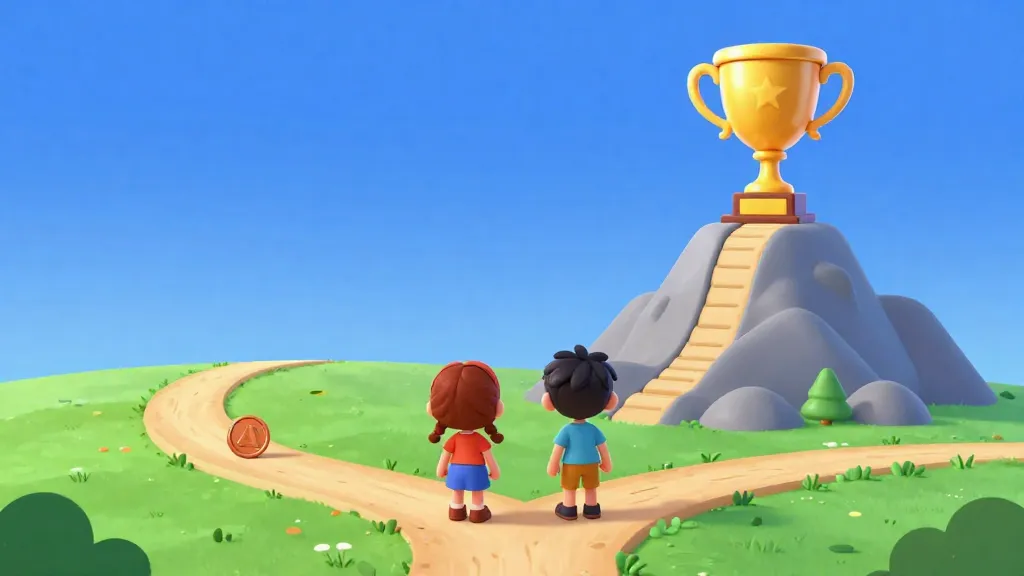
In football, you can play it safe and pass the ball backwards. You probably won't lose it, but you will never score a goal.
Or, you can try a through-ball to the striker. You might lose possession, but you might also score the winning goal! Every investment works the same way: the bigger the potential reward, the bigger the risk you have to take.
Imagine you are standing on the playground. You have two ways to get across the monkey bars: the slow, safe way where you use every rung, or the fast way where you skip two rungs at a time. The fast way gets you to the slide sooner, but there is a much higher chance you might slip and fall. This is the core of investing.

Imagine you have $10. You can keep it in your pocket (safe, but it stays $10), or you can use it to buy lemonade supplies for a stand. There's a risk it might rain and no one buys a drink, but if it's sunny, you could turn that $10 into $30!
In the world of money, risk is the possibility that your investment might lose value or not make as much as you expected. Reward is the profit you hope to make in exchange for taking that chance. These two are like a see-saw: you cannot usually have a huge reward without accepting some level of risk.

Mira says:
"It's like choosing the difficulty level in a video game. Easy mode is safe but you don't get the high score. Hard mode is where you get the biggest trophies, but you might lose a few lives along the way!"
Why is Investing Risky?
Investing is risky because nobody can see into the future. When you put your money into a company or a project, you are betting that it will do well. But companies can fail, trends can change, and the whole economy can have bad days. This is why investment risk exists: things don't always go according to plan.
Risk comes from not knowing what you're doing.
If there was an investment that was 100% safe and also made you a millionaire overnight, everyone would do it. Because that doesn't exist, the market uses rewards to tempt people into taking risks. If a company is a bit risky, they have to offer the chance of a higher return to convince you to give them your money.
Keeping all your money in a jar is safe from market drops, but your money doesn't grow. Over time, things like toys and snacks get more expensive, so your money actually loses its 'buying power.'
Investing in stocks gives your money a chance to grow faster than prices rise. However, the value can go down, and you might have less than you started with for a while.
The Risk Spectrum
Think of investments on a sliding scale from "Super Safe" to "Super Wild." On the super safe side, you have a savings account at a bank. The risk is almost zero because the government usually protects that money, but the reward is also very small. You might only earn a few cents in interest each year.
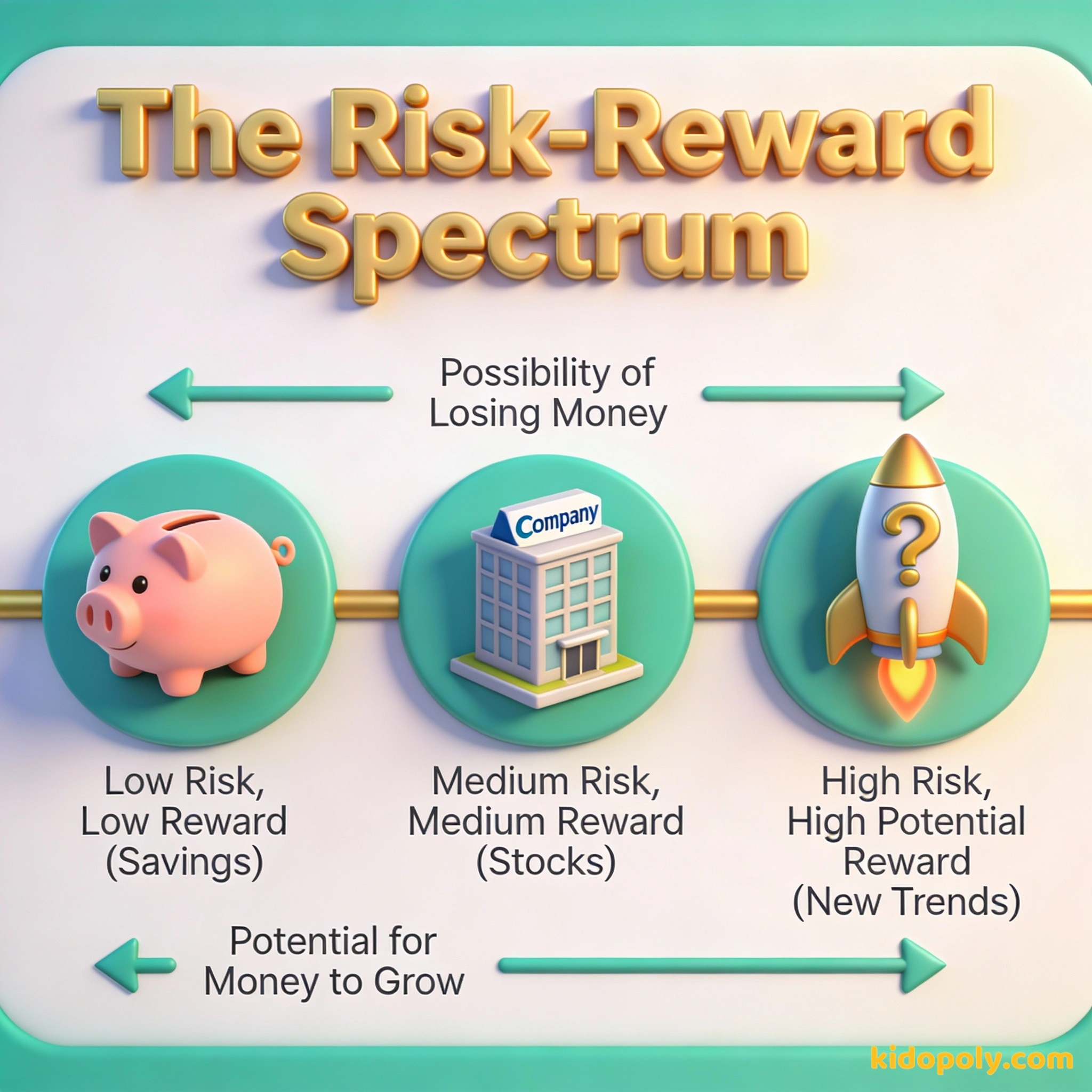
On the higher side of the spectrum, you find stocks. When you buy a stock, you own a tiny piece of a company. If the company does great, your reward could be huge! But if the company goes out of business, you could lose all the money you put in.

Finn says:
"Wait, so if I put my money in a sock under my bed, is that zero risk? Or is there a risk that I'll forget where the sock is or that things will just get more expensive over time?"
Time: Your Secret Shield
Here is some great news: as a kid, you have a superpower called time horizon. This is the amount of time you plan to keep your money invested. If you need your money tomorrow to buy a new video game, a sudden drop in stock prices is a big risk. But if you are investing for 10 or 20 years, a bad week doesn't matter much.
Over long periods, like 10 or 20 years, the stock market has historically gone up more than it has gone down. While any single year can be risky, time tends to smooth out the bumps for patient investors.
Young investors can often afford to take more risk because they have decades to recover from the "dips" in the market. If a stock you own drops in price this year, you don't have to sell it. You can wait for it to grow back over the next five years. This is why many experts suggest that kids can focus more on growth-oriented investments like stocks rather than just safe bonds.

The greatest risk is the risk of doing nothing.
Risk vs. Gambling
Some people think investing is just like gambling at a casino, but they are very different. Gamblers rely on luck and the "house" usually wins. Investors use research, look at facts, and use diversification to spread their money around.
Let's look at $100 over 5 years: - Savings (0.1% interest): $100.50 - Stock Market (7% average return): $140.25 The extra $39.75 is the 'reward' for taking the risk that the stock market might have a bad year.
When you gamble, you are hoping for a random win. When you invest, you are putting your money to work in the real economy. You are helping companies build new things and hire people. Over time, the entire world economy tends to grow, which is why long-term investing usually pays off while gambling usually results in losing money.
Mira says:
"Exactly, Finn! That's called inflation risk. Even doing nothing has a hidden cost. It's all about finding the balance that lets you sleep at night while still helping your money grow."
The Danger of Panic
One of the biggest risks in investing isn't the market itself: it is your own brain! When prices drop, it can feel scary. This is called emotional risk. Some people get so nervous when they see their balance go down that they sell their investments immediately to "save" what is left.
Next time you are at a shop, look at two products. One from a famous brand you know, and one from a brand you've never heard of. Which one feels 'riskier' to buy? Why? This is exactly how investors feel when choosing companies!
This is called panic-selling, and it is often a mistake. It turns a temporary drop in price into a permanent loss of money. Smart investors learn to stay calm and remember their long-term goals. They know that the market moves in waves, and after a big dip, there is often a recovery.

The investor’s chief problem, and even his worst enemy, is likely to be himself.
Investing is a journey of learning. By understanding risk now, you are building the skills to manage your money for the rest of your life. Whether you start small with a savings account or explore the world of stocks, you are already ahead of the game just by knowing how the see-saw works.
Something to Think About
If you had $50 to invest, would you rather put it somewhere safe where it grows to $51, or somewhere risky where it could become $100 or $10?
There is no right or wrong answer! Every person has a different 'risk tolerance.' Think about what would make you feel most comfortable.
Questions About Investing
Can I lose all my money when investing?
Why do people even take risks with money?
How do I know how much risk to take?
Ready to Balance Your See-Saw?
Now that you know how risk and reward work, you are ready to look at how different types of investments fit onto the spectrum. Why not head over to our page on stocks-vs-bonds to see which one might be right for your goals?
