
Imagine your 14-year-old earns $1,000 from a summer job and puts it in a special account, then never adds another penny.
By the time they are 65, that single $1,000 could grow to over $117,000. This isn't magic, it is a Roth IRA, an account that lets money grow tax-free for decades, making it one of the most powerful financial tools available for families.
Imagine your teenager finishes their first summer of lifeguarding or babysitting. They have cash in their pocket and a sense of pride. You could put that money in a standard savings account, but there is a much more powerful option.
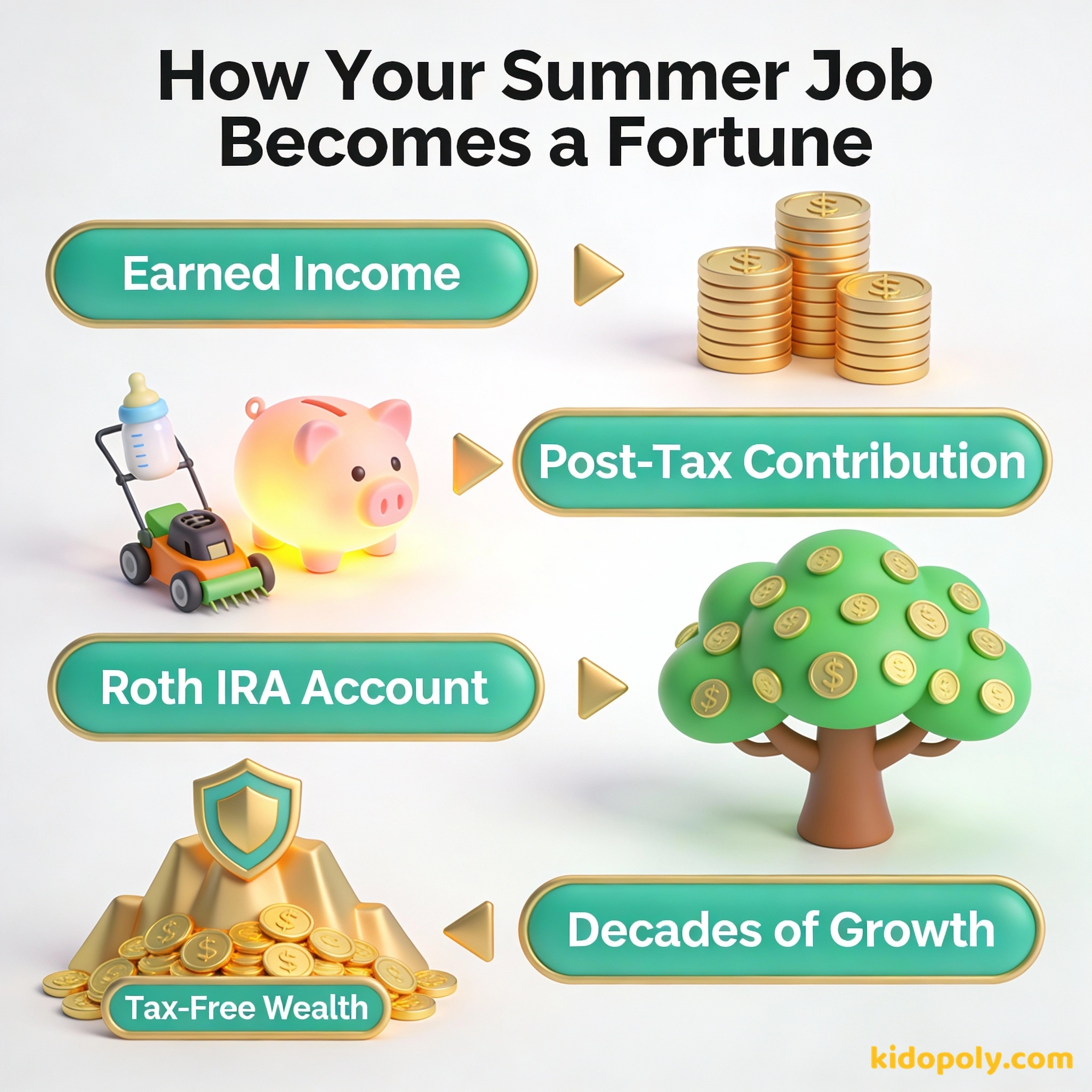
A Roth IRA is a special type of retirement account that allows you to contribute money after you have already paid taxes on it. Because the government has already taken its cut, the money inside the account grows without ever being taxed again.

Unlike a traditional IRA, where you pay taxes when you take money out later, a Roth IRA is 'tax-free forever.' Once the money goes in, you never owe the IRS another penny on the growth or the withdrawals during retirement.
Can a Kid Actually Have a Roth IRA?
Yes, a child can absolutely have a Roth IRA, but there is one major catch. They must have earned income. This means they need to be making money from a job, not just receiving an allowance or birthday gifts from Grandma.

Finn says:
"Wait, so if I get $20 for my birthday, I can't put that in? I actually have to go pull some weeds or wash a car first?"
To set this up, a parent or guardian opens what is called a custodial Roth IRA. You manage the account while they are a minor, but the money belongs to them. Once they reach the age of majority, usually 18 or 21 depending on your state, the account becomes a regular Roth IRA in their name.

Someone's sitting in the shade today because someone planted a tree a long time ago.
What Counts as Earned Income?
The IRS is very specific about what counts as income for a Roth IRA. It generally needs to be money earned from work where a service was provided or a product was sold.
Common examples of earned income for kids include:
- Babysitting for neighbors
- Mowing lawns or shoveling snow
- Working a part-time job at a grocery store or cafe
- Running a small business, like an Etsy shop or a lemonade stand
- Professional modeling or acting work
Let's look at the 'Early Bird' advantage: - Child A: Invests $7,000 at age 15. Total at age 65 (10% return): $821,700. - Person B: Invests $7,000 at age 35. Total at age 65 (10% return): $122,100. Starting 20 years earlier created an extra $699,600 in wealth!
The Mind-Blowing Math of Starting Early
The reason financial experts get so excited about a Roth IRA for kids is the timeline. When you invest at age 15, that money has 50 years to grow before retirement. This allows compound interest to do the heavy lifting.
If you invest $1,000 at age 15 and it earns an average return of 10% per year, it grows to roughly $45,000 by age 55. If you wait until age 25 to start with that same $1,000, it only grows to about $17,000 by age 55. Starting just ten years earlier more than doubles the final result.

Imagine you have two buckets of seeds. The first bucket (a regular account) requires you to give the farmer 25% of all the fruit you grow every year. The second bucket (a Roth IRA) lets you keep every single piece of fruit for yourself. Over 50 years, the second bucket will be overflowing while the first one stays half-empty.
The Contribution Rules You Need to Know
You cannot just dump $50,000 into a child's Roth IRA. There are two very important limits to keep in mind every year. First, the total contribution cannot exceed the annual limit set by the IRS, which is $7,000 in 2024.

Mira says:
"It's like a special treasure chest. You can only put in what you worked for, but once it's inside, the government can't touch it!"
Second, the contribution cannot be more than the child actually earned that year. If your daughter earned $500 babysitting, the maximum that can go into her Roth IRA is $500. You cannot put in more than she made, even if you are using your own money to do it.

The Roth IRA is my favorite investment tool of all time.
The Parent Match: A Secret Strategy
One of the best ways to encourage a child to save is the parent match. Many kids want to spend their hard-earned money on clothes or video games. To help them, you can offer to 'match' their earnings into their Roth IRA.
Try the 'Dollar-for-Dollar' challenge. Tell your child that for every dollar they earn and decide to save for their future, you will put an equal dollar into their Roth IRA. It turns their summer job into a 'buy one, get one free' deal for their future self!
If your son earns $1,000 at a summer camp, he can spend his $1,000 however he likes. You, as the parent, can then contribute $1,000 of your own money into his custodial Roth IRA. As long as he earned at least that much, the IRS is perfectly happy, and his savings get a massive jumpstart.
Finn says:
"So if I earn money and my parents match it, I get to spend my cash AND have a huge retirement fund? That's the best deal ever."
How to Open an Account
Setting up a custodial Roth IRA is surprisingly easy. Most major brokerage firms offer them with no opening fees. You will need your child’s Social Security number and basic information about their income.
Focus on spending now for things they want, missing out on the power of early compounding.
Secure future wealth with tax-free growth, but requires keeping track of earned income and records.
Major providers like Fidelity, Schwab, and Vanguard all offer these accounts. Once the account is open, you can choose how to invest the money. Many parents choose low-cost index funds to keep things simple and diversified for the long haul.

Time is your friend, impulse is your enemy.
When Can They Take the Money Out?
Because a Roth IRA is built with money that was already taxed, you can always withdraw the contributions (the original money put in) at any time for any reason without penalties. However, the earnings (the profit the money made) usually need to stay in the account until age 59 and a half.
If they take earnings out early, they might face taxes and a 10% penalty. There are some exceptions for things like buying a first home or paying for college, but generally, the goal is to leave that money alone. The longer it stays in, the more the tax-free growth works in their favor.
Something to Think About
If you could go back in time and give your 15-year-old self $1,000 to invest, how would your life look different today?
There is no right answer, but thinking about your own financial journey can help you decide if this is a gift you want to provide for your own child.
Questions About Investing
What happens if my child doesn't have a job next year?
Can I use a Roth IRA to pay for my child's college?
Does my child need to file a tax return to have a Roth IRA?
Start the Clock Today
The greatest advantage a child has in the world of investing is not a high-paying job or a secret stock tip, it is time. By opening a Roth IRA now, you are giving them a head start that most adults only dream of. Talk to your child about their next job and how those few hundred dollars today could become a fortune tomorrow.
