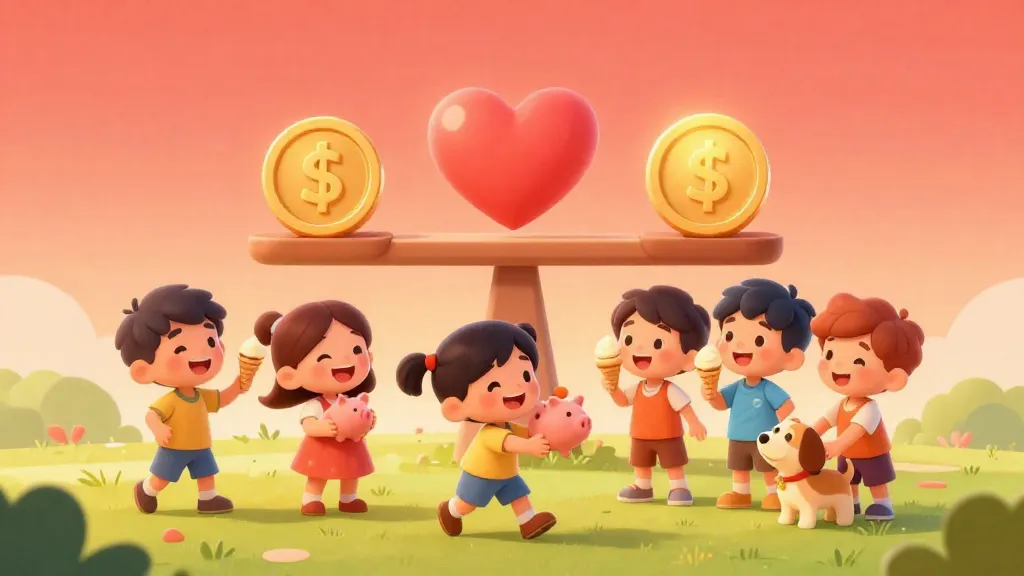
Imagine you won a billion-dollar lottery tomorrow. Would you be the happiest person on Earth forever?
Most people think the answer is a simple 'yes,' but scientists have been studying the relationship between money and happiness for decades. They’ve discovered that while money is a powerful tool for building a good life, its 'happiness-boosting' power has some very strange and surprising limits.
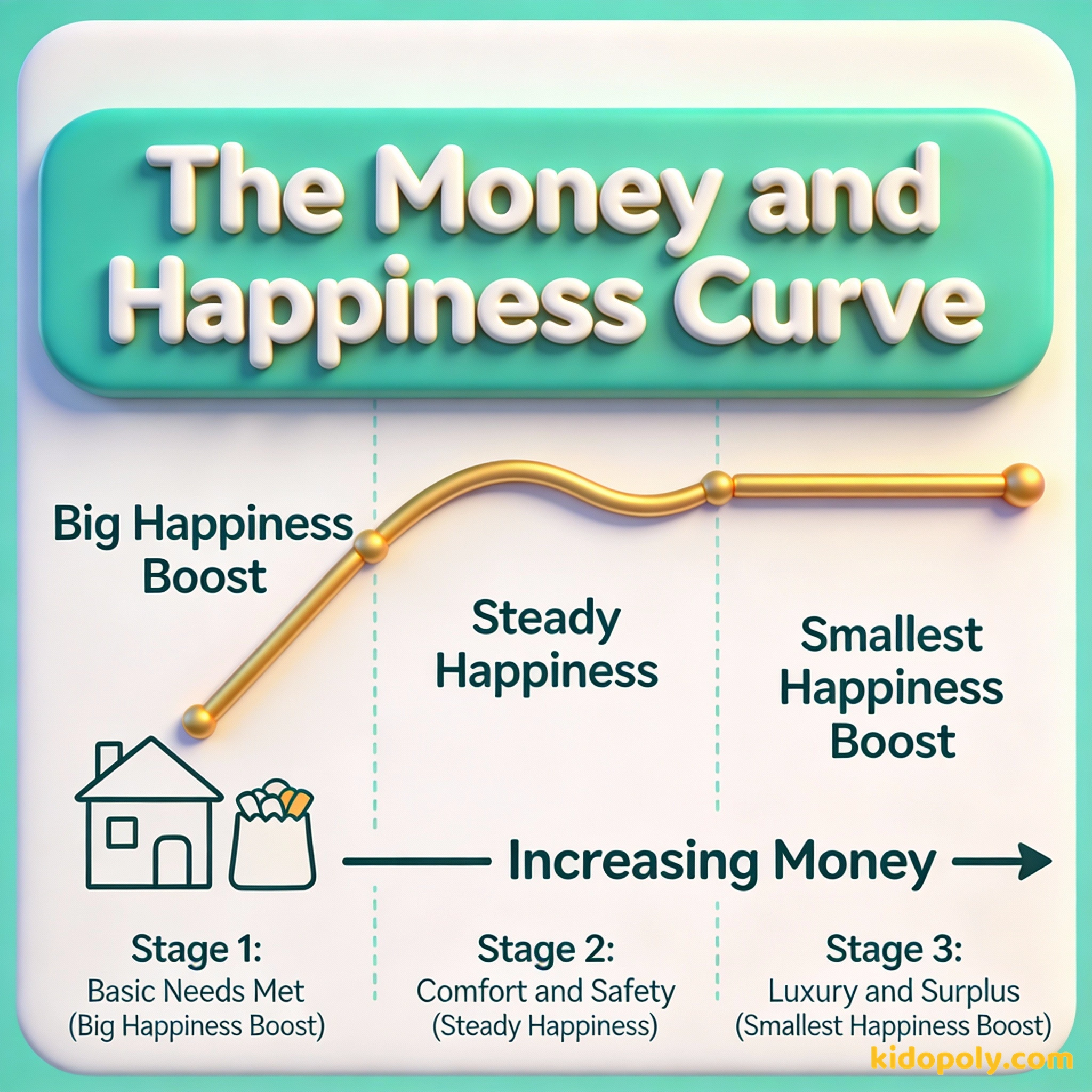
For a long time, researchers have asked thousands of people how much they earn and how happy they feel. They found something fascinating: money actually does buy happiness, but only up to a certain point.
In 1978, scientists studied lottery winners and people who had been in serious accidents. A year later, they found that the lottery winners weren't significantly happier than the other group! We tend to return to our 'baseline' level of happiness no matter what happens.
Think of money like a superpower that solves problems. When people don't have enough money for food, a safe home, or a doctor, they feel a lot of stress. In this stage, getting more money makes a massive difference in how happy they are because it removes that stress.
The Magic Number
A famous study by researchers Daniel Kahneman and Angus Deaton found that in the United States, happiness scores went up as people earned more, until they hit about $75,000 to $100,000 a year. After that, having even more money didn't actually make their daily mood much better.

Finn says:
"So if I got a $1,000 allowance, I wouldn't be ten times happier than if I got $100? That sounds like a glitch in the system!"
Wait, why wouldn't more money make you happier? It’s because once your 'basic needs' are met, you start running into something called diminishing returns. This is a fancy way of saying that the more you have of something, the less exciting each new bit becomes.
Imagine you are at an ice cream shop: - Scoop 1: Delicious! Happiness = 10/10 - Scoop 2: Still great. Happiness = 8/10 - Scoop 3: Getting full. Happiness = 4/10 - Scoop 10: Your stomach hurts. Happiness = -5/10 Money works the same way. The first 'scoops' that cover your needs are the most valuable.
The Updated Science
In 2023, a newer study by researcher Matthew Killingsworth looked at even wealthier people. He found that for some people, happiness can keep rising with more money, but it happens much more slowly.
- For a person with very little, $100 feels like a fortune.
- For a billionaire, $100 is basically invisible.
- To get the same 'happiness boost' as you get richer, you need much, much larger amounts of money.
If you aren't happy with $1 million, you won't be happy with $10 million.
The Hedonic Treadmill
Have you ever wanted a new toy or a video game so badly that you thought you'd never be sad again once you got it? But then, after a week of playing with it, it just became... another toy?

Imagine you move from a normal house into a giant castle with 50 rooms and a cinema. For the first month, you'd be amazed! But after a year, it would just be 'your house.' You’d be used to the cinema, and you might even complain that it takes too long to walk to the kitchen!
This is called the hedonic treadmill. It’s the idea that humans are very good at getting used to new things. When you get something better, your 'happiness bar' moves up, and you start looking for the next thing to give you that same rush.
- You buy a new phone.
- You feel a 'spike' of happiness.
- Your brain starts to view the phone as 'normal.'
- You start wanting the newer, faster phone.

Mira says:
"It's like when you're super hungry and the first slice of pizza is amazing, but by the fourth slice, you're just full and it doesn't taste as special anymore."
Experiences vs. Things
If you have a bit of extra money, science says you should spend it on an experience rather than a 'thing.' Buying a new pair of sneakers feels great for a day, but going to a concert or a theme park with your best friend creates a memory that lasts forever.
Why do experiences win?
- Anticipation: You get excited for weeks before the event happens.
- Social Connection: Most experiences involve other people, which is a huge happiness booster.
- No Comparison: It’s easy to compare your sneakers to someone else's, but your memory of a great summer camp is unique to you.
Buying a new $60 video game. It's fun for a few weeks, but eventually, you beat the game or get bored of it.
Spending $60 to take your two best friends to a trampoline park. You'll laugh about the time you all fell over for years to come.
The Giving Paradox
Here is the most surprising discovery of all: spending money on other people often makes you happier than spending it on yourself. Scientists call this prosocial spending.

The way you spend your money is just as important as how much you have.
In one experiment, researchers gave people $5 or $20. Half were told to spend it on themselves, and half were told to spend it on someone else. By the end of the day, the people who gave the money away or bought a gift for a friend were significantly happier than the people who bought something for themselves.
Finn says:
"Wait, so giving my money away actually makes *me* feel better? Science is definitely weirder than I thought."
Finding Your Balance
So, does money buy happiness? It buys the foundation for happiness by giving you safety and choices. It allows you to focus on the value of money not just as a pile of coins, but as a way to support your life.
Next time you want to spend your pocket money, try the 'Wait and Weigh' test. Wait 48 hours. If you still want the item as much as you did on day one, it might be worth it. If you've already forgotten about it, that's your brain avoiding the 'hedonic treadmill'!
True happiness usually comes from things money can't buy, like:
- Strong friendships
- Learning a new skill
- Helping your community
- Getting enough sleep and exercise

Money has never made man happy yet, nor will it. The more a man has, the more he wants. Instead of filling a vacuum, it makes one.
Once you have enough to be safe and comfortable, the 'secret sauce' to happiness isn't having the most stuff. It's using what you have to create great moments and help the people around you.
Something to Think About
If you had $50 right now, what is one way you could spend it that would still make you smile a year from now?
There's no right or wrong answer! Some people find happiness in helping, while others find it in a shared adventure. Think about what truly lasts for you.
Questions About Money & Society
Can you be happy if you are poor?
Why are some rich people unhappy?
Should I never buy 'things' and only buy 'experiences'?
The Superpower in Your Pocket
Money is a tool, not a destination. Now that you know the science, you can make smarter choices about how you use your 'superpower.' Want to learn more about how to use your money to help others? Check out our guide on giving-and-charity or learn more about the value-of-money and how it’s measured!
