
Your grandma says she's putting money into a '529 plan' for you. You nod politely but have no idea what that means. Is it a bank account? An investment? Why does it have such a weird name?
A 529 plan is a special type of investment account designed to help families save for education. Named after a section of the tax code, it offers unique tax advantages that make it one of the most powerful ways to build a future fund for a beneficiary, usually a child or teenager.
Most people think of a 529 plan as a 'college fund,' but that is only half the story. It is actually a investment tool that lets your money grow without the government taking a cut of the profits, as long as you spend it on learning.

A 529 plan is not just for college. Since 2017, families can use up to $10,000 per year from a 529 to pay for K-12 private or religious school tuition.
At its core, a 529 plan is a deal with the government. They want more people to get an education because it helps the economy, so they promise not to tax the growth of the money you save for it. This is a huge advantage compared to a regular savings account where you might pay taxes on the interest you earn every year.
How Does a 529 Plan Actually Work?
There are two main roles in every 529 plan. The owner is the person who opens the account and makes the decisions, usually a parent or grandparent. The beneficiary is the student who will eventually use the money for school.

Finn says:
"So wait, if my dad owns the account, does that mean he can just take the money back and buy a jet ski if he changes his mind?"
When money is put into the plan, it does not just sit there like cash in a vault. Instead, the owner chooses different investment options, like mutual funds. Over time, that money can grow through the power of the markets.
Imagine you save $200 a month for 18 years. - In a piggy bank: $43,200 - In a 529 plan (averaging 6% growth): $77,500 That is a $34,300 difference just from letting the money grow and not paying taxes on the profit!
The Two Flavors of 529s
Not all 529 plans are the same. Most families use the savings plan version, which works like an investment account. Your balance goes up or down based on how the stock and bond markets perform.
You invest in the market. The balance can grow a lot, but it could also go down if the market drops.
You buy 'units' of tuition today. It doesn't matter how much college prices rise, your units stay valid.
Then there is the prepaid tuition plan. This is less common and only offered by some states and a group of private colleges. It allows you to lock in today’s tuition prices for the future. It is like buying a 'gift card' for a specific university credits 10 years before you actually attend.

The 529 plan is the best way to save for college. Period. It's the only way to get a tax-free return on your money.
Why the Tax Perks Matter
If you put $100 into a regular brokerage account and it grows to $200, the government will eventually want a slice of that $100 profit in the form of capital gains taxes. With a 529 plan, that entire $100 profit stays in your pocket as long as it is spent on qualified expenses.

Imagine you want to be a commercial pilot or a high-end chef. 529 funds can often be used for accredited trade schools and vocational programs, not just four-year universities with ivy on the walls.
Many states also offer a 'state tax deduction' for the person who puts money in. This means if your parents contribute $5,000, they might be able to subtract that amount from the income they report to the state, which lowers their tax bill immediately. It is a double win: a discount today and tax-free growth for tomorrow.

Mira says:
"It is kind of like a team effort. The government gives the tax break, my parents do the saving, and I do the studying. Everyone has a job to do!"
What Can You Buy With a 529?
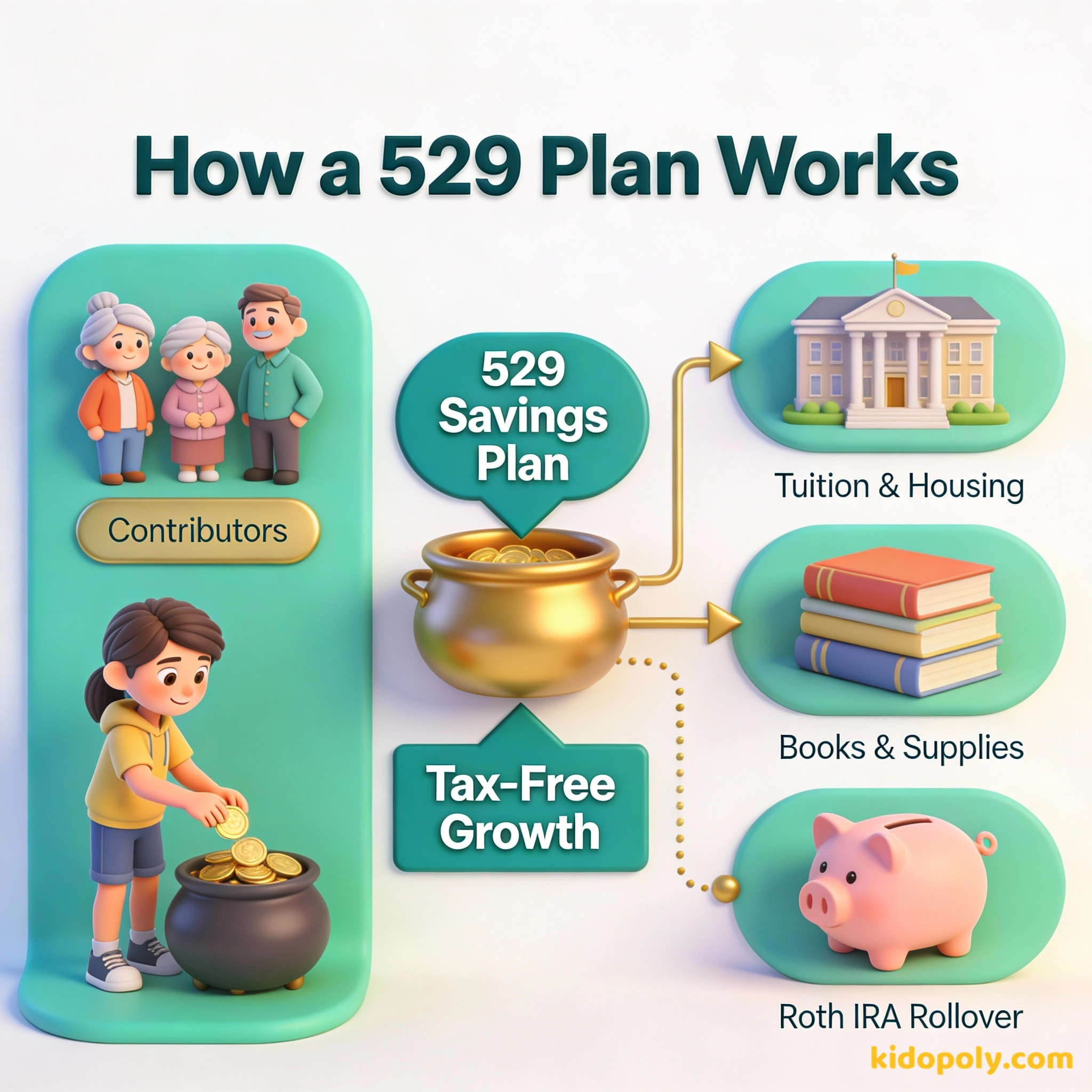
People often call these 'college savings plans,' but the list of what you can pay for is surprisingly long. You can use the funds for qualified higher education expenses at almost any accredited school in the country, including community colleges and trade schools.
- Tuition and fees for classes.
- Room and board, meaning your dorm or off-campus housing (if you are enrolled at least half-time).
- Books and supplies, including that expensive lab equipment or art kits.
- Computers and software needed for your studies.
- K-12 Tuition, up to $10,000 per year for private elementary or high schools.
The 'What If' Question: What If You Don't Go To College?
This is the question that keeps many teens up at night. If your parents have saved thousands of dollars for your education and you decide to start a business or join a band instead, is that money just gone? The answer is no.
If you get a scholarship, you can actually withdraw that same amount of money from your 529 plan without paying the usual 10% penalty. You'll only pay income tax on the earnings portion. It's like a reward for being a great student!
If you do not use the money for school, the owner of the account has a few choices. They can change the beneficiary to another family member, like a sibling or a cousin. They could even use it for their own master's degree or a cooking class at a community college.

Investment in knowledge pays the best interest.
The New 'Super Power' of 529 Plans
Starting in 2024, a new rule called the SECURE 2.0 Act made 529 plans even better. If you have money left over in your account, you can now roll over up to $35,000 of it into a Roth IRA, which is a retirement account. This is a game-changer because it means the money can keep growing for your future even if you do not spend it on a degree.
Finn says:
"A Roth IRA rollover? That sounds like a secret level in a video game. So if I get a scholarship, I can basically jump-start my retirement fund at 22?"
There are some rules: the account must have been open for at least 15 years, and there are yearly limits on how much you can move. But it removes the fear that your education savings will be 'trapped' if your life takes a different path.
Can a Kid Have Their Own 529 Plan?
Technically, a minor cannot be the owner of a 529 plan because they are not old enough to sign the legal contracts. However, you can be the beneficiary of multiple plans. Your parents could have one for you, and your grandparents could have a separate one.

The most important investment you can make is in yourself.
If you have your own money from a summer job, you can actually give that money to the account owner to deposit it into 'your' 529 plan. It is a smart way to watch your own earnings grow much faster than they would in a jar on your dresser. Knowing how these accounts work is the first step toward taking control of your own educational future.
Something to Think About
If you had a 529 plan waiting for you, would knowing the money is there change how you feel about your career choices after high school?
There are no right or wrong answers here. Some people feel more pressure to succeed, while others feel more freedom to explore. Talk with your family about how you view this 'future fund.'
Questions About Saving
What happens if I need to take the money out for a non-school emergency?
Does a 529 plan affect my chances of getting financial aid?
Can I use the money for a school in a different state?
Your Future, Your Choice
A 529 plan is a tool, not a trap. Whether you dream of becoming a surgeon, a welder, or a digital animator, having a tax-advantaged account ready to go gives you more options. If you haven't already, ask your parents if they have explored a 529 plan, and maybe show them the new rules about the Roth IRA rollover!
