
Your child just received $200 for their birthday and you want to put it somewhere it can grow.
You sit down at your laptop to open a child savings account and immediately hit questions: custodial or joint? What about taxes? What documents do you need? This guide walks you through the practical steps to manage your child's first financial institution relationship.
Opening a savings account for your child is more than just a place to store birthday cash. It is a legal and financial step that requires navigating specific rules, tax laws, and ownership structures.
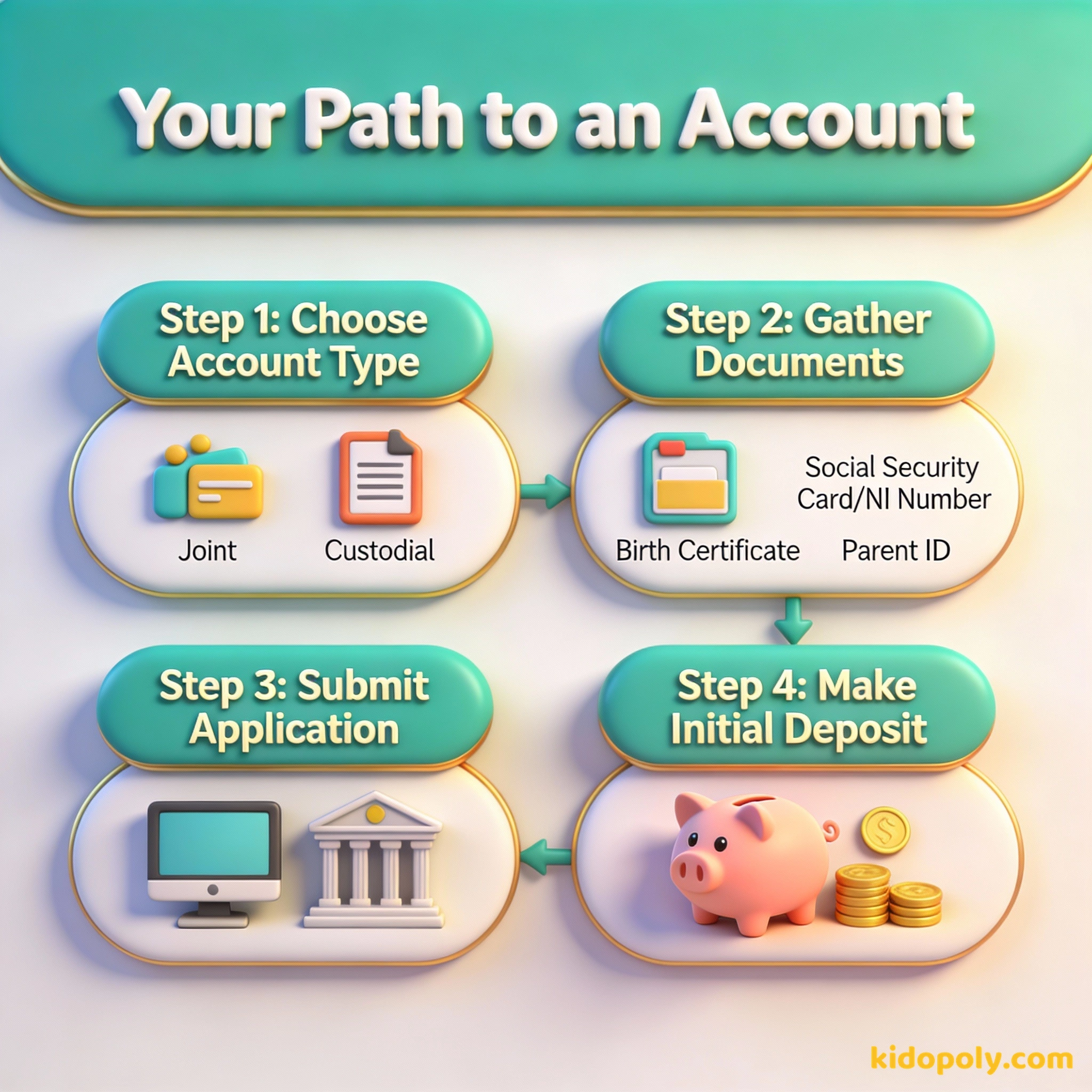
Before you head to the bank or open a browser tab, you need to decide which legal structure fits your family's needs. The two most common options are joint accounts and custodial accounts.

Imagine your child walking into a bank with their own little folder of documents. They hand over their birthday check, and for the first time, they see their name printed on a official statement. This physical connection makes the concept of 'banking' real rather than abstract.

Finn says:
"So if it's a custodial account, I can't touch my own money until I'm 18? That feels like a long time to wait for my birthday cash!"
Choosing the Right Account Structure
A joint account is the simplest setup. Both you and your child have equal access to the funds, and either person can usually withdraw money. This is great for teaching daily money management, but the funds are technically yours as much as theirs.
In contrast, a custodial account (known as UTMA or UGMA in the US) is legally the child's property. You act as the custodian, managing the money until they reach the age of majority, which is usually 18 or 21 depending on your state.

Do not save what is left after spending, but spend what is left after saving.
In the UK, the Junior ISA (Individual Savings Account) is the gold standard. It offers tax-free growth, but the money is strictly locked away until the child turns 18. This is a significant commitment compared to a standard child bank savings account.
Funds are accessible to both parent and child. Great for teaching 'spending' and 'saving' lessons together.
Funds legally belong to the child. Offers better tax protection but limits parental control over how money is spent.
The Necessary Paperwork
Banks are strictly regulated and require specific documents to verify the identity of both the minor and the adult. You cannot simply walk in with cash: you must prove who you both are to satisfy government 'know your customer' laws.
Most financial institutions will require the following items for a successful application:
- The child's Social Security Number (US) or National Insurance Number (UK, if applicable)
- A government issued birth certificate for the child
- Your valid government photo ID, such as a passport or driver's license
- Proof of address, like a recent utility bill or bank statement

Mira says:
"It's like a VIP club. You need your 'membership card' (that's your birth certificate) just to get through the door!"
Understanding the Tax Implications
One of the biggest mistakes parents make is assuming children do not pay taxes. While they often do not earn enough to owe the government, there are thresholds you must watch. In the US, the Kiddie Tax rules apply to unearned income like interest.
For 2024, the first $1,300 of a child's unearned income is usually tax-free. The next $1,300 is taxed at the child's rate. Anything above $2,600 is taxed at the parents' marginal tax rate.
US Tax Example (2024): Interest Earned: $3,000 First $1,300: $0 Tax Next $1,300: Taxed at Child's Rate (approx 10%) Remaining $400: Taxed at Parent's Rate (e.g., 24%) Total Tax: $130 + $96 = $226
In the UK, children have their own Personal Allowance for interest. However, if a parent gives money to a child that earns more than £100 in interest per year, that interest is taxed as the parent's income. This rule is designed to stop parents from using their kids to hide their own savings from the taxman.

Give your children a financial head start, but don't forget to give them the knowledge to handle it.
When Your Child Takes Control
It is vital to remember that money placed in a custodial account (UTMA/UGMA) is an irrevocable gift. You cannot legally take the money back for your own use once it is deposited. It belongs to the child, and you are merely the steward.
When the child reaches the age of majority, the bank is legally required to hand over full control. At 18 or 21, your child can do whatever they want with that money: pay for college, buy a car, or even spend it on something you might disagree with.

In many US states, the default 'Age of Majority' for custodial accounts is 21, not 18. This gives the parent three extra years to help guide the child's financial decisions before they get full keys to the vault.
Finn says:
"Wait, if my parents put money in there, they can't take it back out to pay for a new fridge? It's really mine forever?"
Common Mistakes to Avoid
Many parents forget to update the account as the child grows. A 'toddler' account might have low interest rates that do not keep up with inflation. Regularly reviewing the account terms ensures your child's money is working as hard as possible.
Another pitfall is over-funding a custodial account if you plan to apply for university financial aid. In the US, custodial assets are weighted more heavily than parental assets in the FAFSA calculation. This could potentially reduce the amount of aid your child receives.

Financial peace isn't the acquisition of stuff. It's learning to live on less than you make, so you can give money back and have money to invest.
Finally, ensure you are teaching the practical side of the account. Link the physical act of saving to the digital balance they see on the screen. For more on the educational side of things, see our guide on savings-accounts-for-kids.
Something to Think About
What is the primary goal for this account: long-term wealth building or short-term financial education?
There is no right answer, but your choice will dictate whether you pick a locked-down custodial account or a flexible joint account.
Questions About Saving
Can I open a savings account for my child online?
Is there a minimum age to open a child's savings account?
Will a child's savings account affect their college financial aid?
Ready to take the next step?
Now that you know the 'how' and 'what' of opening an account, you might want to compare specific features. Head over to our best-savings-account-for-kids page to see which modern features might be right for your family.
