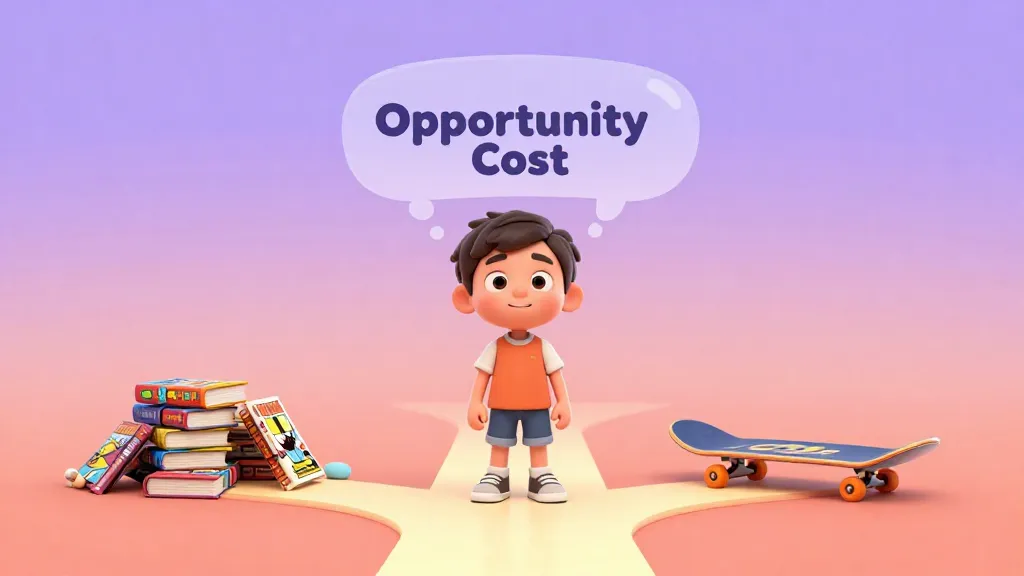
Imagine you have £15 in your pocket. You really want that new hardback book everyone is talking about, but your friends just invited you to the cinema to see the latest superhero movie. If you go to the movie, the ticket costs you £15, right? Well, that is only half the story.
In the world of economics, every choice has a hidden price tag called opportunity cost. This isn't about the money you spend, it is about the value of the thing you didn't choose. Once you learn to see these invisible costs, you gain a superpower for making better decisions.
Most people think the cost of something is just the number on the price tag. If a toy costs £10, they think the cost is £10. But economists, people who study how money and choices work, see things differently. They know that when you spend that £10 on a toy, you are also spending the chance to buy a giant pizza or save up for a bike.
There is no such thing as a free lunch.
What is Opportunity Cost Exactly?
In simple terms, opportunity cost is the value of the next best thing you give up when you make a choice. It is the 'lost opportunity' of the path you didn't take. Since we cannot have everything we want at the exact same time, we have to make trade-offs.

Imagine it is your birthday and you get £20. You see a cool Lego set for £20 and a new football shirt for £20. You can only buy one. If you pick the Lego, the football shirt doesn't just vanish from the shop, it vanishes from your life! That 'missing' shirt is your opportunity cost.
Think of it like a menu at a restaurant where you are only allowed to pick one item. If you choose the burger, the opportunity cost is the pizza you almost ordered instead. You didn't just 'spend' your hunger on the burger: you 'lost' the chance to enjoy that pizza.

Finn says:
"So wait, if I have enough money to buy both the burger and the pizza, is there still an opportunity cost?"
It is Not Just About Money
One of the coolest things about opportunity cost is that it applies to everything, not just your pocket money. Your most valuable resource isn't actually cash: it is time. You only have 24 hours in a day, and how you spend them matters.
If you spend two hours playing video games on a Saturday morning, the money cost is zero. However, the opportunity cost is whatever else you could have done with those two hours. You could have practiced the guitar, gone for a bike ride, or finished your homework so you could play outside later.
Let's look at the 'Time Cost' of a hobby: - 1 hour of practice per day = 7 hours a week. - 7 hours a week = 364 hours a year. - 364 hours = Over 15 full days! If you choose to spend those 364 hours learning coding, the opportunity cost is 364 hours you didn't spend learning French or playing basketball.
The Invisible Price Tag
Whenever you are about to make a big decision, try to look for the invisible price tag. This helps you see the full picture. For example, if you decide to stay up late on a school night to watch a movie, the invisible price tag is how tired and grumpy you will feel during your maths test the next morning.
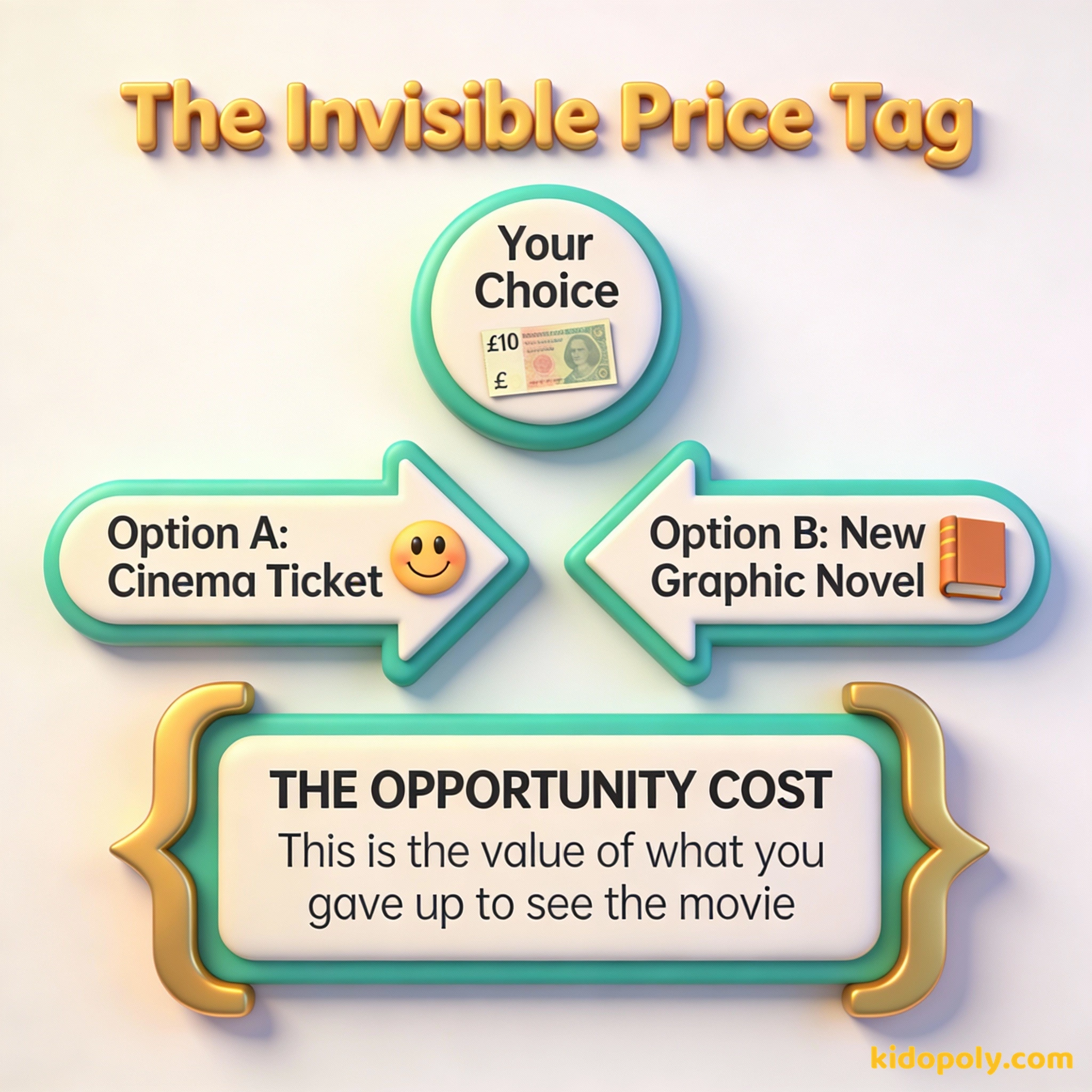
Seeing these costs helps you decide if the choice is actually worth it. Sometimes the 'hidden' cost is much higher than the 'visible' one. This is why understanding this concept is like having X-ray vision for your brain.

Mira says:
"Exactly, Finn! Even if you have the money, you probably don't have enough space in your stomach for both. The opportunity cost then becomes how good you feel versus having a giant tummy ache!"
The 10-Second Choice Filter
How do you actually use this in real life? You can use a simple decision-making framework. Next time you want to buy something or spend your time on a big project, ask yourself one question: 'If I do this, what am I really giving up?'
- Identify your main choice (The thing you want to do).
- Identify your best alternative (The thing you would do instead).
- Compare the two. Is the first choice better than the second?
Focus on the 'visible' price. You only care about the money leaving your wallet right now. It feels simple, but you might regret missing out later.
Focus on the 'invisible' cost. You think about what else you could do with that money or time. It takes more thought, but leads to much happier choices.
A Lesson from History: The King of Decisions
In the late 1950s, a company called Lego had a huge decision to make. They were making all sorts of wooden toys, cars, and even plastic bricks. But their business was messy and they weren't making much money because they were trying to do too many things at once.
The Evolution of a Choice: The Lego Story
The owners realized the opportunity cost of making wooden yo-yos and trucks was the time and energy they weren't spending on their plastic building bricks. They made a brave choice: they stopped making almost all their other toys to focus ONLY on the Lego brick system. The opportunity cost was the money from the wooden toys, but the reward was becoming the most famous toy company in the world!

The difference between successful people and really successful people is that really successful people say no to almost everything.
Why it Gets Harder as You Get Older
When you are five years old, your biggest choice might be picking between a blue crayon or a red one. As you get older, the stakes get higher. The choices involve more money, more time, and more people.
- Choosing which subjects to study in school.
- Deciding which after-school clubs to join.
- Choosing how to spend your first paycheck from a part-time job.
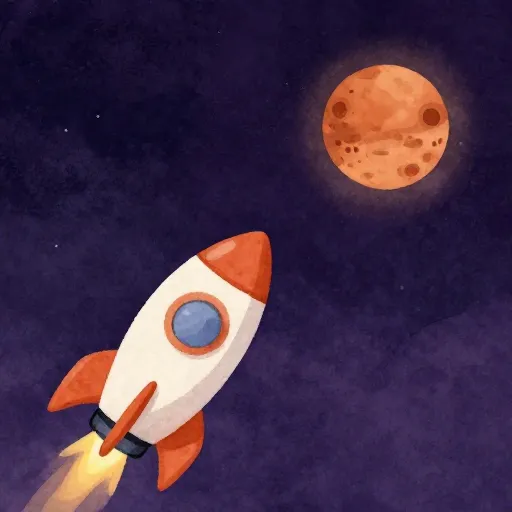
NASA uses opportunity cost to decide which planets to visit! Because space missions cost billions of dollars and take years to build, choosing to go to Mars means the opportunity cost might be NOT going to the moons of Jupiter.
Because you will have more options, the opportunity costs will feel bigger. That is okay! The goal isn't to avoid opportunity cost (that is impossible!) but to make sure that whatever you choose is worth more to you than the thing you are giving up.
Finn says:
"I guess that means I shouldn't feel bad about giving things up. It just means I'm picking something I like even more!"
Master Your Choices
Once you start seeing opportunity cost, you can't un-see it. You will see it at the supermarket, at the park, and even when you are deciding what to watch on YouTube. It turns every decision into an active choice rather than just something that happens to you.
Lost time is never found again.
The next time you are at a shop and want to buy a snack, stop for 5 seconds. Identify the next best thing you could buy with that money instead. If you still want the snack more than that other thing, buy it! You have just officially calculated your first opportunity cost.
Something to Think About
If you were given a completely free Saturday with no chores and no homework, what would you choose to do, and what would be the opportunity cost of that choice?
There is no right or wrong answer here. Your opportunity cost depends entirely on what you value most. One person's 'lost' opportunity might be another person's boring afternoon!
Questions About Spending & Budgeting
Is opportunity cost always about losing something?
Can there be more than one opportunity cost for a single choice?
Does opportunity cost apply to adults too?
You are Now a Choice Architect
By understanding opportunity cost, you have moved beyond just looking at price tags. You now see the world as a series of exciting trade-offs. To keep building your money superpowers, why not check out our guide on smart-spending to see how to get the most value for every pound you choose to spend?