
Have you ever reached into your pocket for that £10 note you were sure was there, only to find a crumpled receipt and a single 20p coin?
Most of us think we know where our money goes, but it has a funny habit of disappearing like a magic trick. A spending diary is your secret detective tool to track every transaction and see the truth about your spending habits.
Imagine you are an explorer trekking through a jungle. You have a map, but you keep getting lost because you are not looking at the path behind you. Tracking your money is exactly like looking at that path.

Imagine your money is like water in a bucket. Every time you spend, it is like a tiny hole in the bottom. Some holes are big, like buying a new game. Others are so small you barely see them, like a pack of sweets. A spending diary is how you find the leaks!
When you keep a spending diary, you are not just writing down numbers. You are gathering clues. You might think you are saving for a new gaming headset, but your diary might show you that you actually spent £12 on vending machine snacks this week instead.
The 5 Golden Columns
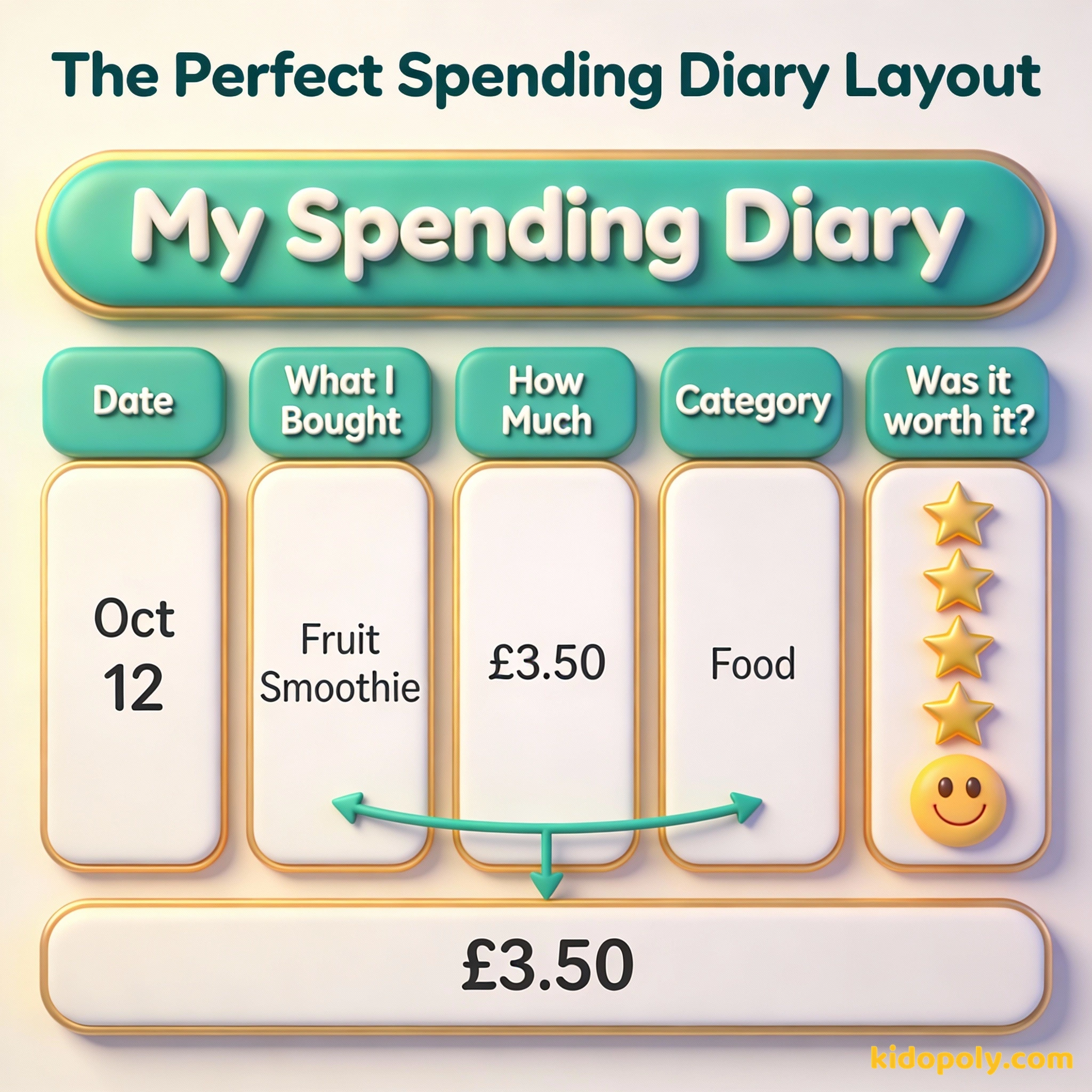
To start your diary, you do not need anything fancy. You just need a place to write and five specific columns. These columns turn a boring list into a powerful data machine.
- Date: When did the money leave your hand?
- Item: What exactly did you buy?
- Amount: How much did it cost in pounds and pence?
- Category: Was it Food, Entertainment, Stuff, or a Gift?
- The Happiness Score: This is the secret weapon. Was it worth it?

Finn says:
"Wait, do I really have to write down the 50p I spent on a single gummy bear? That seems like a lot of work!"

Beware of little expenses; a small leak will sink a great ship.
The 7-Day Challenge
Most people find tracking money for a whole year feels like a chore. That is why we recommend the 7-Day Challenge. For just one week, you promise to write down every single thing you buy, no matter how small.

Studies show that people who don't track their spending often forget about 30% of what they actually bought! That means if you spent £10, you might only remember where £7 of it went.
If you buy a pack of gum for 60p, write it down. If you spend £2 on a mobile app skin, write it down. Even if you give 50p to a friend, it goes in the diary. At the end of the week, you will have a complete picture of your life in coins.
Choose Your Method
There is no 'right' way to keep a diary. The best method is the one you will actually use. Most kids find success with one of these three ways:
- The Pocket Notebook: A small book you carry everywhere. It is fast and never runs out of battery.
- The Phone Notes App: Great if you always have your device. Just start a new note called 'My Money Tracker' and list everything there.
- The Pro Spreadsheet: If you love computers, use a tool like Google Sheets. It can even do the maths for you and create colorful pie charts.
For your 'Was It Worth It?' column, use emojis instead of numbers. 🤩 = Amazing, 🙂 = Okay, 😐 = Meh, ☹️ = Total waste. At the end of the week, count how many ☹️ emojis you have. That is your 'hidden' savings!
Spotting the Sneaky Patterns
After your seven days are up, it is time to become a data scientist. Look at your categories. You might find that 50% of your money goes to 'Stuff' you forget about two days later.

Mira says:
"It is like a fitness tracker for your wallet! Once you see the patterns, you realize that your money is basically a reflection of what you find fun."
Look closely at your 'Was it Worth It?' column. If you see a lot of sad faces or low scores next to snacks, but five stars next to a book or a cinema ticket, you have just discovered a secret. Your diary is telling you how to be happier with your money.

Price is what you pay. Value is what you get.
Turning Data Into Power
Once you know where your money is going, you can decide if you want to change the path. This is the first step toward building your first-budget. You are not guessing anymore: you have real facts.
Let's do the math: If you spend £1.50 on a fizzy drink every school day, that is £7.50 a week. In a month, that is £30. In a year, you have spent £390 on bubbles! Is that drink worth a new PlayStation or a trip to a theme park? Only your diary can help you decide.
For example, if you see that you spend £8 a week on school treats, you can choose to keep doing that, or you can decide to save £4 of it for that big saving-goal you have been dreaming about. The diary does not tell you what to do: it just gives you the power to choose.
Finn says:
"So the diary isn't there to tell me I'm bad at spending, it's just showing me what I'm actually doing? I can deal with that."
Making It a Habit
To make sure your diary does not feel like homework, try to make it a 'trigger' habit. Every time you get a receipt or put your change away, take 10 seconds to log it. If you wait until the end of the day, you will likely forget at least one thing.

A budget is telling your money where to go instead of wondering where it went.
I track every single penny the second I spend it so I never forget anything.
I keep all my receipts in a jar and write them down once a week on Sunday morning.
Something to Think About
If you looked at your spending from last week, what is one thing you bought that you've already forgotten about?
There are no right or wrong answers here. Thinking about which purchases 'disappear' from your memory can help you decide what is actually important to you.
Questions About Spending & Budgeting
What if I lose my spending diary?
Do I have to show my diary to my parents?
Is a spending diary the same as a budget?
Ready for the Detective Mission?
Now that you know how to build your tracker, why not start your 7-Day Challenge today? Grab a notebook or open your phone and record your very first entry. Once you've mastered tracking, you'll be ready to move on to building your first-budget!