
Have you ever wondered if you can prove something is real even if you cannot see it?
In the 13th century, a quiet man named Thomas Aquinas spent his life building a bridge between two worlds: the world of faith and the world of reason. He believed that our ability to think was a gift that could help us understand the deepest mysteries of the universe.
Imagine you are living in Italy 800 years ago. The world is full of massive stone castles, narrow muddy streets, and the constant ringing of church bells. In this world, most people believed that the only way to find truth was through holy books and ancient traditions.
But a young man named Thomas was asking a different kind of question. He did not just want to be told what was true: he wanted to use his own mind to figure out how the world worked. This was a time when the famous Greek thinker Aristotle was being rediscovered in Europe, thanks to the work of scholars like Ibn Sina.
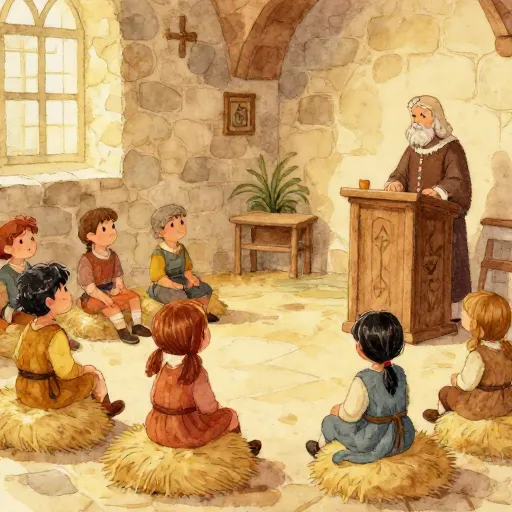
Imagine a university in the year 1250. There are no computers or printed books. Every book is written by hand on animal skin. Students travel for months on horseback just to hear a famous teacher speak. The classrooms are freezing cold, and students sit on straw on the floor while they take notes with quills and ink.
Thomas was born into a wealthy family that had big plans for him. They wanted him to become a powerful leader in the church, someone who lived in a rich monastery and advised kings. When Thomas told them he wanted to join the Dominicans, a group of monks who lived simply and spent their time teaching and traveling, his family was so upset they actually kidnapped him.
They locked him in a castle tower for over a year to try to change his mind. But Thomas did not give up. He spent his time in the tower reading and thinking, eventually escaping out of a window to follow his path.

Finn says:
"Wait, his own family kidnapped him just for wanting to be a teacher? That sounds like a movie! I wonder if he was scared or if he just kept reading his books anyway."
The Silent Ox and the Loud Truth
When Thomas finally made it to school in Paris and Cologne, he was much larger and quieter than the other students. He sat in the back of the classroom, listening intently but rarely speaking a word. His classmates thought he was a bit slow and gave him a mean nickname: the Dumb Ox.
But his teacher, a wise man named Albert the Great, saw something different in the quiet student. After reading some of Thomas's writing, Albert told the class that while they called him a dumb ox, one day his 'bellowing' would be heard across the entire world.
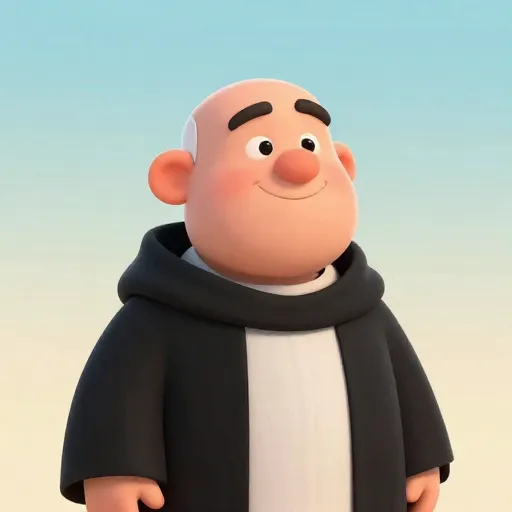
The things that we love tell us what we are.
Thomas was a practitioner of Scholasticism, which was a way of learning that used logic and debate to solve difficult problems. Instead of just accepting an answer, Scholastics would look at every possible argument against their idea before deciding if it was true. They believed that if an idea was really solid, it could survive any question you threw at it.
Thomas's favorite way to learn was through debate. Try this with a friend: Pick a simple topic, like 'Should we have dessert before dinner?' One person has to argue 'Yes' and the other 'No.' Then, switch sides! Thomas believed you couldn't really understand your own opinion until you understood the other person's reasons too.
This method of questioning is why Thomas's books are so long and detailed. He would write down a question, like 'Does God exist?', and then list every reason why someone might say 'no.' Only after he had looked at the 'no' side fairly would he explain why he thought the answer was 'yes.'
Building the Bridge
One of the biggest puzzles Thomas tried to solve was the relationship between science and religion. At the time, many people thought you had to pick one or the other. If you relied on your senses and logic, they thought you were ignoring your heart and your beliefs.
Thomas disagreed. He argued that there are two 'books' through which we can learn about the world. One is the book of scripture, which contains stories and spiritual truths. The other is the book of nature, which we read using our eyes, ears, and brains.

Mira says:
"It's like he's saying our brains are a tool kit. We have 'Logic' in one drawer and 'Wonder' in another, and we need both of them to build something great."
He believed that because both 'books' came from the same source, they could never truly contradict each other. If science tells us one thing and our belief tells us another, Thomas thought we just needed to look closer. To him, reason was like a ladder that could help us climb toward higher truths.
The world is a mystery that we can only understand through prayer and ancient stories. Logic might lead us away from the truth.
The world is a logical place. God gave us brains so we could use them to study nature, math, and science to find the truth.
This idea was revolutionary. It meant that people could study biology, astronomy, and physics without feeling like they were doing something wrong. It encouraged people to look at the stars and the soil and see them as worth understanding.
The Inner Compass: Natural Law
Thomas also thought a lot about how we decide what is 'good' or 'bad.' He came up with an idea called Natural Law. He believed that every human being is born with a kind of internal 'light of reason' that helps us understand basic right and wrong.
Think about how you feel when you see someone being treated unfairly. You might feel a tug in your chest or a sense that 'this isn't how things should be.' Thomas argued that this feeling is not just an accident: it is part of how humans are designed to function.
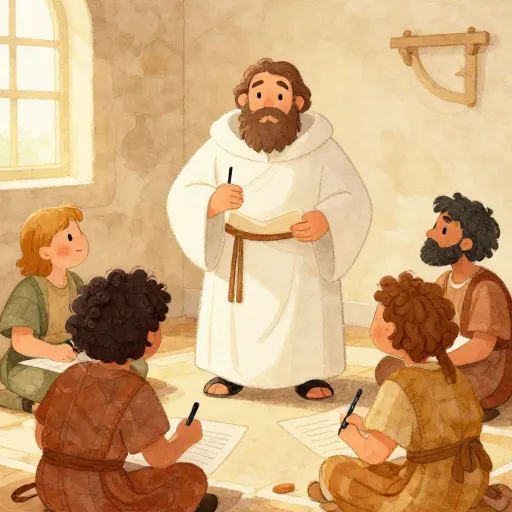
Thomas Aquinas was so prolific that he sometimes dictated his books to four different secretaries at the same time! He could keep four different complicated arguments in his head all at once, moving from one to the next without getting confused.
He believed that we don't always need a written rulebook to know that we should preserve life, learn new things, and live peacefully with others. Our own nature points us in that direction. This idea eventually helped lead to the concept of Human Rights, the belief that every person has value just because they are human.
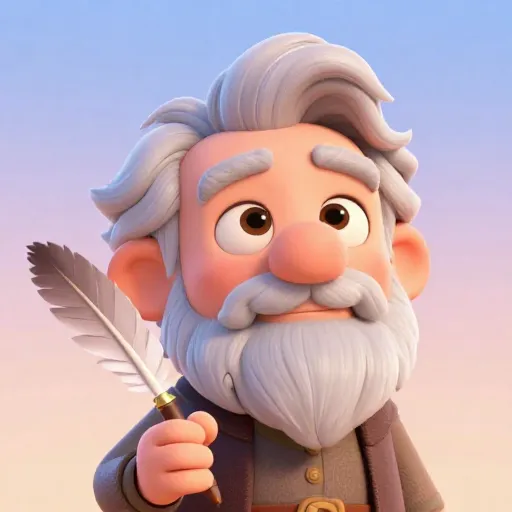
To one who has faith, no explanation is necessary. To one without faith, no explanation is possible.
The Five Ways
Thomas is very famous for his 'Five Ways,' which are five logical arguments he wrote to prove that there must be a 'First Cause' or a Creator. He didn't want people to just believe because they were told to: he wanted to show that it made logical sense.
One of his arguments is about motion. He noticed that everything in the world is moving or changing. But nothing moves itself: a ball doesn't roll unless someone kicks it, and a plant doesn't grow unless the sun and water trigger it. He argued that if you trace all the movement back to the very beginning, there must be something that started the very first movement.
Finn says:
"The 'First Cause' idea is like a giant line of dominoes. If the first one falls, it hits the next, but who tipped over the very first domino?"
Another argument was about design. He looked at how perfectly things in nature work together, like the way a bee pollinates a flower or how the seasons change. To Thomas, the world looked like a giant, complex clock, and if there is a clock, there must be a clockmaker.
Even though he was one of the smartest people in history, Thomas was known for being incredibly humble. He once said that everything he learned from books was nothing compared to what he learned by simply being kind to others.
Through the Ages
The End of the Journey
Toward the end of his life, Thomas had a very strange experience. While he was praying in Naples, he suddenly stopped writing. He was in the middle of his biggest book, the Summa Theologica, which had thousands of pages of arguments.
When his friends asked why he stopped, he told them that he had seen something so wonderful and vast that all his writing seemed like 'straw' in comparison. He realized that as much as our minds can understand, there is always a mystery that is even bigger than our words.

Sorrow can be alleviated by good sleep, a bath, and a glass of wine.
Thomas Aquinas showed us that curiosity is not the enemy of belief. He taught that the more we learn about the world, the more we can appreciate how amazing it is. He left us with the idea that we should never be afraid to ask 'why,' because the truth is big enough to handle any question.
Something to Think About
If you had to build a bridge between two things that seem opposite (like 'fun' and 'work' or 'science' and 'magic'), what would that bridge look like?
There are no right or wrong answers here. Thomas spent his whole life building a bridge between thinking and believing: what worlds would you like to connect?
Questions About Philosophy
Was Thomas Aquinas a scientist?
Why did people call him a 'Dumb Ox'?
Did he finish his most famous book?
The Adventure of Thinking
Thomas Aquinas reminds us that being smart isn't just about having the right answers: it is about having the courage to ask the hardest questions. Whether you are looking at the stars or reading an old book, you are using the same 'light of reason' that Thomas used 800 years ago. Keep building your own bridges!