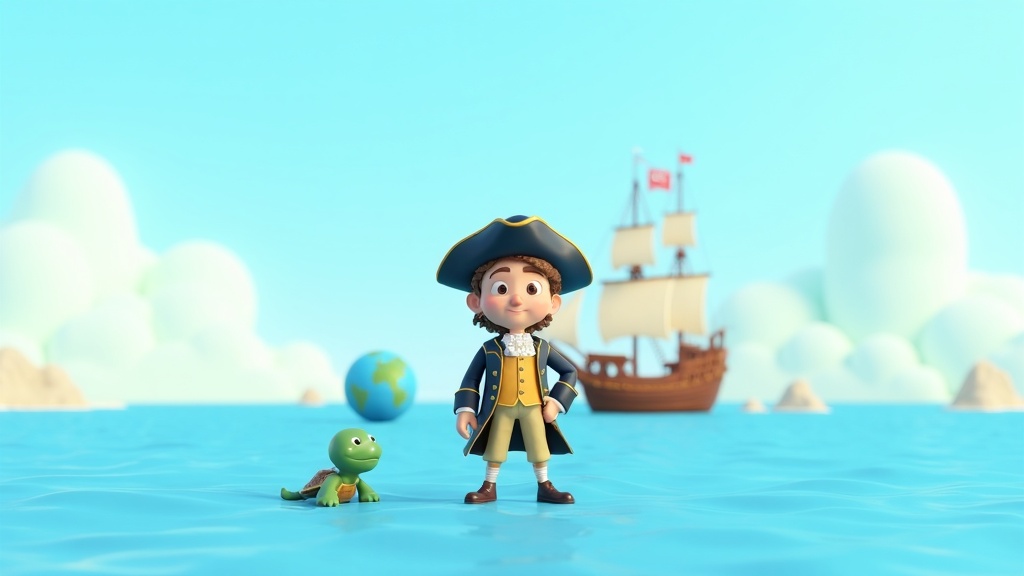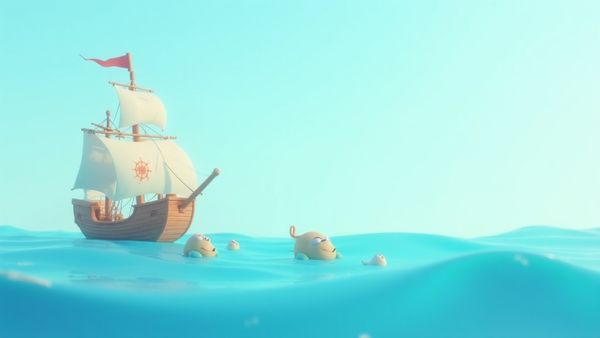
The Age of Exploration (1400s-1600s) was when brave European sailors used new ships to discover the world by sea. Vasco da Gama successfully sailed directly to India in 1498, cutting out long land routes. This era launched incredible adventures that changed maps forever!
Have you ever looked at a map and wondered what the world looked like hundreds of years ago? It was mostly blank spaces and guesses!
The Age of Exploration, which happened roughly from the early 1400s to the early 1600s, was an incredible time when brave sailors set out from Europe to explore the world by sea. Before this time, Europeans didn't know much about places like the Americas or the Pacific Ocean. They mainly traded for super-valuable goods like spices—think pepper and cinnamon—by traveling on land routes that were often controlled by others. But then, new ships and better tools made it possible to sail farther than ever! Countries like Portugal and Spain wanted to find faster, cheaper sea routes to Asia. This quest for new routes and new lands kicked off one of history's biggest adventures for kids to learn about!

Mira says:
"Wow, imagining sailing into a giant, unknown ocean with only the stars to guide you! That takes so much courage. I wonder what kinds of amazing animals they saw on those long trips!"
What Was the Big Deal About Spices and Sea Routes?
Spices were like the gold of the Middle Ages! They made food taste amazing and helped keep it fresh. Pepper, cloves, and nutmeg were worth so much money that people called them 'black gold.'
For a long time, getting spices from Asia to Europe was a long, difficult journey over land, controlled by many different groups who charged tolls. Portugal wanted to cut out the middleman by finding a sea route that went all the way around Africa, straight to India. This discovery would change who had the power and wealth in the world!
Mind-Blowing Fact!
The main reason for the big voyages was to find a western route to the East Indies (modern-day Indonesia, rich in spices) because the eastern route around Africa was getting crowded and controlled by other traders!
The Amazing Accomplishments of Key Explorers
This era brought us some of history's most famous adventurers. Each one pushed the boundaries of what people thought was possible!
One major pioneer was Vasco da Gama of Portugal. In 1497, he bravely sailed around the southern tip of Africa—the Cape of Good Hope—and successfully reached Calicut, India, in 1498. This was the first direct sea route from Europe to Asia, a massive win for Portugal!
Columbus reached the Americas
Magellan started his voyage
Magellan's crew completed the first circumnavigation
The main Age of Exploration period
How Did Ferdinand Magellan’s Crew Sail Around the World?
While Ferdinand Magellan led the expedition, he sadly didn't finish the trip himself. But his journey proved that the world really is round and you can sail all the way around it!
Magellan started in 1519 with five ships and over 270 men, sailing for Spain to find that western route to the Spice Islands.
The Grueling Pacific Crossing
After sailing down the coast of South America and finding the strait that now bears his name (The Strait of Magellan), they entered a massive ocean. Magellan called it the 'Peaceful Sea,' but it was anything but peaceful for the sailors!
Magellan thought the Pacific Ocean would be quick to cross, but it took them almost four months of sailing without seeing much land. The crew ran out of food and had to eat terrible things like leather bindings from the ship and even rats just to survive.
💡 Did You Know?
The ship that finally made it back to Spain in 1522, the Victoria, had only 36 men left out of the original 270+, and it had sailed over 42,000 miles!
🎯 Quick Quiz!
What valuable goods were explorers hoping to find easier and cheaper routes to get in Asia?
Why Were New Tools So Important for Explorers?
These epic voyages couldn't have happened without new technology. Imagine trying to cross an ocean with no idea where you were going!
Explorers relied on amazing instruments to figure out their position and stay on course. These tools helped them navigate even when they couldn't see the coast.
- The Astrolabe: This cool tool helped sailors figure out their latitude (how far north or south they were) by measuring the height of the sun or a star above the horizon.
- The Compass: This classic tool, using a magnetic needle, always pointed North, which helped them keep a steady direction for weeks on end.
- Better Maps (Cartography): As explorers returned with new knowledge, mapmakers redrew the world, making each new trip a little less blind!
The Age of Exploration didn't just change maps; it changed the world forever! While it brought new goods and knowledge to Europe, it also led to challenging times for the people whose lands were suddenly 'discovered.' Understanding this history for kids means learning about the bravery and the big consequences of these world-changing journeys.
Questions Kids Ask About Explorers
Keep Charting Your Own Course!
From the tiny ships battling huge waves to the discovery of entire continents, the Age of Exploration is a whirlwind of history! These explorers changed how we see our planet. Now you know the story of how the world got connected. What new lands will YOU explore in your own adventures?