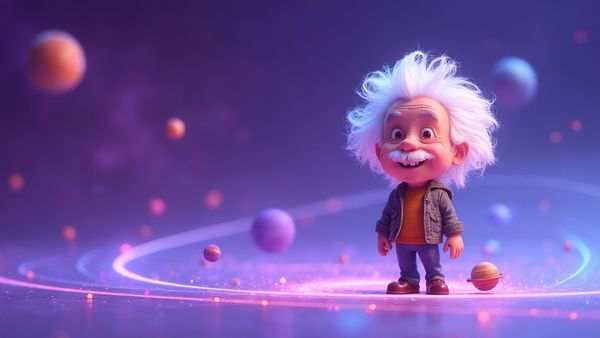
Einstein's Theory of Special Relativity (1905) explains that the laws of physics are the same for everyone moving at a constant speed, and that mass and energy are interchangeable (E=mc²). This concept, involving the speed of light (186,000 miles per second), helps us understand the universe and modern tech like GPS!
Did you know that time can speed up or slow down, and that space isn't actually flat?
Whoa! That sounds like science fiction, but it’s all thanks to one super-smart scientist: Albert Einstein! Einstein, with his famous fuzzy hair, completely changed how we understand the universe in the early 1900s. He came up with two massive ideas called the Theory of Special Relativity (in 1905) and the Theory of General Relativity (in 1916). These theories tell us that space and time are connected in a strange and stretchy way we call spacetime! This was a huge change from what scientists believed before, changing ideas that had been around for 200 years from Isaac Newton. These ideas are super important for everything from GPS on your parents' phones to understanding giant black holes in space! Let’s dive into this amazing history lesson for kids and discover what makes Einstein's theories so awesome!

Mira says:
"I always thought time was like a steady drumbeat, the same everywhere. But Einstein showed us that if you zoom really fast, your clock ticks slower than someone standing still! It’s like a real-life superpower that only works near the speed of light!"
What is Special Relativity? Motion, Speed, and Light!
Einstein’s first big idea, Special Relativity (1905), is all about things moving at a steady, straight speed. It has two main rules that blew people's minds.
Rule number one is the Principle of Relativity: No matter how you are moving at a constant speed, the laws of physics—like gravity or how a ball bounces—are exactly the same for everyone. If you are on a super-smooth train with the windows blacked out, you couldn't tell if you were moving or standing still!
Rule number two is the wildest: The speed of light is always the same for everyone! Light travels at about 186,000 miles per second (or 299,000 kilometers per second) whether you are standing still, running toward it, or running away from it. This speed is the universe's absolute speed limit—nothing with mass can ever go faster than light!
Mind-Blowing Fact!
Einstein first started thinking about these big ideas when he was just 16 years old! He imagined what it would be like to ride right alongside a beam of light—a famous thought experiment that helped kickstart his special relativity theory!
The Famous Equation: E=mc²
You’ve probably seen this secret code: E=mc²! This comes from Special Relativity and it's a huge idea: Energy (E) and Mass (m, which is just how much 'stuff' something has) are the same thing, just in different forms! They can change into each other.
The 'c' in the equation stands for the speed of light, which is a super big number. Since it’s squared (multiplied by itself), it means a tiny bit of mass can turn into a HUGE amount of energy!
This is why the sun shines! It turns a tiny bit of its mass into the light and heat that warms our Earth. It’s also the science behind things like nuclear energy.
(per second!)
was published
Special and General
How General Relativity Explains Gravity
Special Relativity was great for steady motion, but what about when things speed up or slow down—like planets orbiting a star? That's where General Relativity (1916) comes in, and it's all about gravity!
Isaac Newton said gravity was an invisible force pulling things together. Einstein said, 'Not quite!' He explained that gravity is actually the result of mass bending the fabric of the universe.
Spacetime: The Cosmic Trampoline
Imagine the whole universe is a giant, stretchy rubber sheet. This sheet is spacetime (space plus time all rolled into one concept).
When you place something heavy, like a bowling ball, onto the sheet, it sinks down and curves the fabric, right? In the universe, the Sun is like that bowling ball, and its mass bends the spacetime around it.
If you roll a little marble (that's Earth!) nearby, it doesn't get 'pulled' by a magic force; it simply follows the curve or the dip made by the bowling ball (the Sun). That path it follows is what we call an orbit, and that dipping is what we call gravity!
💡 Did You Know?
Einstein's General Relativity predicted that super heavy things—like stars—can actually bend light rays coming from things far behind them! Scientists have seen this happen many times, proving that gravity really does warp the path of light, just as he described!
🎯 Quick Quiz!
What is the 'speed limit' of the universe that Einstein said nothing with mass can pass?
Wild Results: Time Dilation and Length Contraction
Because time and space are linked, when you move super-fast (near the speed of light), weird things happen! Scientists call this Time Dilation—time actually slows down for the fast-moving object compared to someone standing still.
If you zoomed around space for a year at near light speed and came back, your twin who stayed on Earth might be much, much older than you! This isn't just a guess; we actually have to correct clocks on GPS satellites because they move so fast relative to us!
- Time Dilation: Clocks moving very fast tick slower.
- Length Contraction: Objects moving very fast look squished or shorter in the direction they are traveling.
- Relativity of Simultaneity: Two events happening 'at the same time' for one person might happen at different times for someone moving differently.
- Mass-Energy Equivalence: Mass (stuff) and Energy (power) are two sides of the same coin (E=mc²).
Even though Einstein’s ideas sound like something out of a sci-fi movie, they are constantly proven true today! From helping us navigate with GPS to helping us understand the birth and death of stars, Einstein’s revolutionary thinking about space, time, and gravity truly made history not boring for kids and adults alike!
Questions Kids Ask About Famous People
Keep Thinking Like Einstein!
Wow, we just explored some of the biggest ideas in science! Remember, Einstein didn't just read about these things; he used his imagination to picture crazy scenarios, like chasing light beams. That’s the power of asking 'What if?'. Keep asking questions, and you might just change history too!