The history of computers began with early counting tools like the abacus, leading to mechanical designs by Charles Babbage in the 1830s. The first electronic computers, like the ENIAC in 1946, used 18,000 vacuum tubes! This story shows how brilliant thinkers made huge machines shrink to fit in your pocket.
Did you know that the powerful computer in your pocket started out as a machine that filled an ENTIRE ROOM?!
Get ready to power up your brain for an awesome journey through the history of computers! Today, we use computers for everything—schoolwork, games, talking to family—but these amazing devices didn't just pop up overnight. The story of computers is filled with brilliant thinkers, huge machines, and tiny parts that made all the difference. Long before smartphones, people invented early tools to help them count, like the abacus thousands of years ago. But the machines we think of as 'computers' started taking shape in the 1800s with mechanical ideas!

Finn says:
"Whoa! A machine that fills a whole room? I bet it needed a HUGE plug! I love that we can now hold that much power in our hands. This is going to be epic!"
What Was the Very First 'Computer' Idea?
Before electricity, brilliant people dreamed up ways to calculate faster than counting on your fingers. One of the biggest dreamers was an English inventor named Charles Babbage in the 1830s.
Babbage designed something he called the 'Difference Engine,' which was a mechanical machine meant to calculate math problems automatically. It was not electronic—it used gears and moving parts, like a super fancy clock!
Even cooler, Babbage designed an even more advanced idea called the 'Analytical Engine.' He imagined it could store information and follow a set of instructions, which is exactly what a modern computer does! The machine was so complex that he never actually finished building it, but his ideas were the blueprint for the future.
Mind-Blowing Fact!
The very first person to write instructions (or 'programs') for Babbage's Analytical Engine was a woman named Ada Lovelace! She is often called the world's first computer programmer!
The Electronic Age: Computers Get Super Size!
When scientists finally figured out how to use electricity to make computers work in the 1940s (during World War II), things got HUGE! These early electronic computers used parts called vacuum tubes instead of gears.
These machines were so massive that one of the first, the ENIAC (Electronic Numerical Integrator and Computer), was formally dedicated in 1946 at the University of Pennsylvania.
The ENIAC was designed to calculate things for the army very quickly. To give you an idea of how big it was, it weighed over 30 tons—that’s like having 15 regular cars stacked on top of each other!
Used in the ENIAC!
The size of several classrooms!
What took 12 hours by hand!
How Did Computers Get Smaller and Faster?
Having a computer the size of a building is amazing, but not very practical for taking to school! The next big leaps happened because scientists swapped out those giant vacuum tubes for smaller, better parts.
First came the transistor in 1947. Transistors were like tiny electronic switches that replaced the big, hot vacuum tubes. Computers got smaller, used less electricity, and stopped needing to cool down so much!
The Microchip Magic
The next huge invention was the integrated circuit, or computer chip, in the late 1950s. Imagine taking hundreds, then thousands, of those tiny transistors and squishing them all onto one tiny piece of material called a silicon wafer. This chip is what we call the microprocessor today—the 'brain' of the computer!
💡 Did You Know?
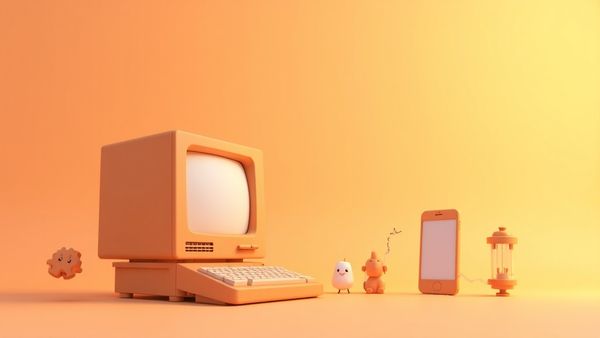
Because of the computer chip, computers shrunk from filling rooms to fitting on your desk! This led to the personal computers (PCs) of the 1970s and 1980s, making them available for regular families for the first time!
🎯 Quick Quiz!
What was the name of the first *mechanical* computer designed by Charles Babbage?
Who Made the Internet Possible?
Once computers were small enough to be on desks, people wanted to connect them! This led to the invention of networking.
The start of the massive network we call the internet began with something called ARPANET in 1969. It was a way for a few big research computers to talk to each other.
But the internet as we know it—the World Wide Web that lets you click on links and see websites—was invented much later, in 1991, by a scientist named Tim Berners-Lee!
- Early Counting: The Abacus (thousands of years ago).
- Mechanical Dream: Charles Babbage’s Difference Engine (1820s/30s).
- Electronic Giant: The room-sized ENIAC using vacuum tubes (1940s).
- Shrinking Power: The Transistor replacing vacuum tubes (1947).
- The Brain: The Microprocessor (computer chip) revolution (late 1950s/early 1960s).
- Connecting the World: The invention of the World Wide Web (1991).
From those massive, whirring machines that needed their own buildings to the super-smart computers in your phone and tablet today, the history of computing is a story of constant, exciting improvement! Every time you use a computer for learning or fun, you’re using technology built on the dreams of Babbage and the hard work of thousands of scientists and programmers!
Questions Kids Ask About Inventions
Keep Computing Your Curiosity!
Isn't that incredible? Every time you play a game or watch a video, you are using an invention that is still being upgraded! What do you think computers will look like when you grow up? Keep exploring, because history is definitely not boring!