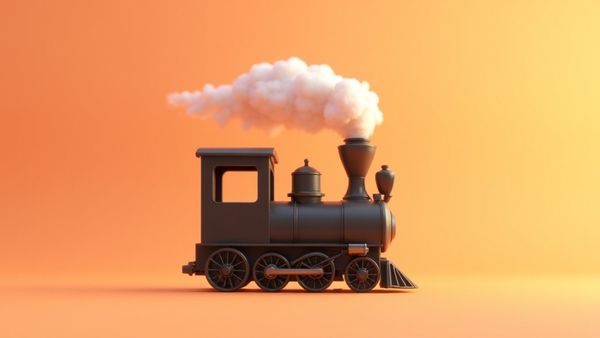
The history of trains begins with the steam locomotive, the first self-powered railway engine that used boiling water to create steam power. Richard Trevithick’s 1804 engine first pulled 10 tons along a track. These inventions started the Industrial Revolution and connected the world!
Have you ever watched a big, powerful train rumble by and wondered, 'How did people ever invent something so amazing?!'
Get ready to travel back in time because today we are learning about one of the biggest game-changers in transportation history: the train! Before trains, people moved heavy things with horses or boats, and traveling long distances took forever. Trains totally changed that, speeding up life and helping build whole new worlds! The very first trains were steam-powered, which means they used hot steam from boiling water to push giant wheels around and around. These smoky, noisy machines kicked off the Industrial Revolution and started connecting cities like never before!

Mira says:
"I think the most incredible part is how the early inventors kept trying even when their first engines were too heavy! It shows that making history means never giving up on a cool idea, even if the first try only goes a few miles!"
What is a Locomotive and How Did It Start?
A train is made of a powerful engine section—called the locomotive—attached to cars that carry people or cargo. A long time ago, carts on tracks were pulled by horses! But inventors wanted more power. They looked at the steam engine, which used boiling water to make powerful puffs of steam.
The amazing first person to build a full-size, working railway steam locomotive was a British engineer named Richard Trevithick! In 1804, his machine made history by pulling a heavy load—10 tons of iron, five wagons, and 70 men—along a track in South Wales.
While Trevithick’s first try was a huge success, the engine was unfortunately too heavy for the cast-iron tracks of the time and kept breaking them!
Mind-Blowing Fact!
The very first railway journey using a steam locomotive happened on February 21, 1804! Imagine seeing that giant machine puffing down the track for the first time—it must have been a huge shock to everyone watching!
The Rocket: A Super Speedy Leap Forward!
After Trevithick’s start, engineers kept tinkering to make the engines lighter and stronger. The next big superstar was the team of George Stephenson and his son, Robert Stephenson.
In 1829, they created the Rocket to compete in a famous contest called the Rainhill Trials. This engine was lighter and used clever design ideas, like a special multi-tube boiler, to make steam super fast!
(58 km/h) of the Rocket
Stockton & Darlington Railway
Distance of the first locomotive journey
Liverpool & Manchester Railway opened
How Did Trains Change the World So Much?
The success of the Rocket proved that steam trains were the future! When the Liverpool and Manchester Railway opened in 1830, it was the first public railway to use only steam locomotives for both people and cargo.
Key Changes Trains Brought
Trains made it possible to move huge amounts of goods, like coal and steel, much faster than before. This was super important for the Industrial Revolution, which was all about making things in factories!
Traveling across a country that used to take weeks could now take just a few days. This helped people move to new cities for jobs and explore new lands, especially in places like America when railroads stretched across the continent in the 1830s!
💡 Did You Know?
The amazing Rocket locomotive won the competition with an average speed of about 12 mph while pulling a load, but when it ran without any carriages, it could zoom up to 30 mph! That’s faster than many cars on a local road today!
🎯 Quick Quiz!
Who invented the world's FIRST full-scale working railway steam locomotive?
From Steam to Super Speed: The Train Evolution!
Steam ruled the tracks for a long time, but technology kept marching forward! After steam, engineers learned how to use electricity and fuel like diesel to power trains. These new engines were often quieter, faster, and cleaner.
Today, we have super sleek, super fast Bullet Trains (like Japan’s Shinkansen) that zip along at speeds up to 300 mph!
It’s wild to think that the first steam engine could only manage about 2.4 mph on its big test run!
- Steam Locomotives (Early 1800s): Used coal to boil water and create steam pressure to move pistons. Smoky but powerful!
- Electric Trains (Late 1800s): Got power from overhead wires, making them cleaner and faster than steam.
- Diesel Trains (Early 1900s): Used diesel fuel, which made them very strong for pulling heavy freight cars.
- High-Speed / Maglev Trains (Modern Era): Use electricity or magnetic levitation (Maglev) to float above the track and travel incredibly fast!
The history of the train is a perfect story about innovation for kids: an initial big idea, a few failures (like those heavy first engines!), and then smart people building on those ideas until they create something that completely changes how the world works. Next time you see a train, remember the amazing inventors who got the wheels turning!
Questions Kids Ask About Inventions
Keep Exploring the Tracks of Time!
From a sputtering engine pulling iron in Wales to sleek trains that fly across continents, the story of the train is a story of human smarts! We hope you enjoyed this ride through history. What other amazing inventions should we discover next?