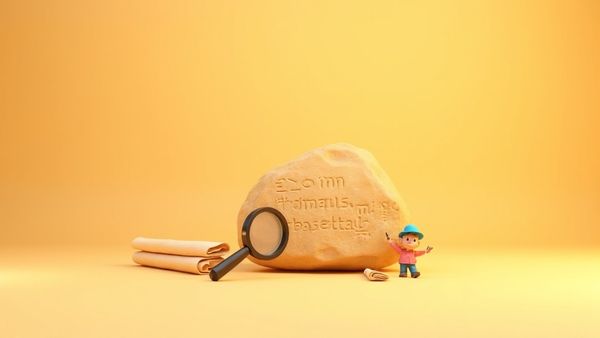
Egyptian hieroglyphics are a formal writing system using pictures called 'sacred carvings.' This complex script used over 1,000 distinct characters, combining sound-signs (phonograms) and word-signs (ideograms). Learning this code, thanks to the Rosetta Stone, unlocked Ancient Egypt's secrets for us.
Imagine finding a secret message written in pictures that no one on Earth has understood for over a thousand years. Would you want to crack the code?
That’s exactly what happened with Egyptian hieroglyphics! For a super long time—about 1,400 years—the beautiful pictures carved on temples and tombs in Ancient Egypt were a total mystery. Hieroglyphs, which means 'sacred carvings' in Greek, were the formal writing system used by the Egyptians, and they were super complex. They used more than 1,000 distinct characters! Learning to read them became a secret held by only a few scribes before the knowledge faded away.

Mira says:
"It’s like they used a picture for a whole word, a picture for a sound, AND a picture just to help you guess what kind of word it was! Ancient Egyptian scribes were the ultimate code-makers!"
What Are Hieroglyphics, Anyway?
Hieroglyphs aren't just pretty drawings; they are a super creative writing system! Think of it like this: some pictures stood for an entire word (that’s called an ideogram), like a drawing of the sun meaning 'sun'. Other pictures stood for a single sound, much like our letters (these are phonograms).
Here’s a twist: Ancient Egyptian hieroglyphs focused mostly on consonants—the letters like B, C, D, not the vowels like A, E, I. This is super different from our alphabet! Imagine writing 'cat' as just 'c-t'. It makes deciphering them much trickier for kids learning history today!
Mind-Blowing Fact!
Ancient Egyptian writing had no spaces between words and no punctuation, like commas or periods! You have to know what the message is about to figure out where one word ends and the next one begins!
The Writing System That Used Over 700 Symbols!
It can feel like forever trying to learn the 26 letters in our alphabet, right? Well, the Egyptians had to learn way more! During the height of the Middle Kingdom, scribes used about 900 distinct signs regularly. By the later Greco-Roman period, this number jumped to over 5,000 signs being used in total!
Even when they tried to simplify their writing for everyday notes—using a faster script called Hieratic—it was still much more complex than our modern writing. Only the highly educated priests and scribes could read and write these complex symbols.
How Did They Finally Crack the Code? Enter the Rosetta Stone!
The biggest 'aha!' moment in history happened by total accident! In 1799, French soldiers under Napoleon were building a fort near the town of Rashid (called Rosetta by the French) when they stumbled upon a giant, dark stone slab. This stone became the key to everything: the Rosetta Stone!
The Trilingual Treasure Map
The Rosetta Stone was amazing because it had the *exact same message* written in three different scripts! The top part was in hieroglyphics (the sacred writing), the middle was in Demotic (a common, cursive Egyptian script), and the bottom was in Ancient Greek.
Since scholars *could* read Ancient Greek, they finally had a translation guide! It was like finding the secret decoder ring for all of Egyptian history. Even so, it wasn't an easy task; it took many smart people working for over two decades to fully solve it.
💡 Did You Know?
To figure out which way to read the hieroglyphs, scholars looked at the animals or people in the writing! Whichever way the birds or figures were facing told you which direction to start reading—left to right, or right to left!
🎯 Quick Quiz!
What was the key to finally understanding hieroglyphics?
Meet the Code Breaker: Jean-François Champollion
While many people helped, the person who made the final, giant breakthrough was a brilliant Frenchman named Jean-François Champollion in 1822.
He realized that hieroglyphs weren't *just* pictures representing ideas, but that they also used sounds, just like our letters do! He cleverly focused on the names of rulers like 'Ptolemy' and 'Cleopatra,' which were circled in an oval shape called a cartouche.
- Thomas Young: An English scholar who first figured out that the hieroglyphs inside the royal cartouches must represent sounds, like for the name Ptolemy.
- Champollion's Secret Weapon: Champollion was also one of the few people who knew Coptic, which is a language descended from ancient Egyptian but written with the Greek alphabet. This gave him a massive clue about the *sounds* used in the old writing!
- The Breakthrough: By matching the sounds he knew from Coptic and Greek to the hieroglyphic symbols, Champollion could finally read the ancient Egyptian words!
Thanks to the Rosetta Stone and the hard work of Champollion and others, we can now read stories, see math, and understand the incredible history of the ancient Egyptians! It proves that if you have a big enough puzzle, sometimes all you need is the right key, or in this case, the right rock!
Questions Kids Ask About Ancient Egypt
Keep Decoding History!
That’s the incredible adventure of learning to read hieroglyphics! From a secret picture language to a decoded history book, the story of the Rosetta Stone is a true adventure for history detectives like you. Keep exploring the amazing secrets of Ancient Egypt!