The Ice Age was a long period when Earth's climate was much colder than today, causing massive glaciers to spread across continents—like a super-long winter! This era started about 2.6 million years ago and was home to megafauna like the woolly mammoth. Kids will learn how giant animals adapted to the deep freeze.
Imagine waking up to find snow and ice piled as high as a skyscraper outside your window! Sound like a super chilly dream?
Welcome to the Ice Age! This wasn't just one cold day; it was an epic time in Earth's history when huge sheets of ice, called glaciers, covered massive parts of the world. The most recent major ice age, the Pleistocene Epoch, lasted for a loooong time, starting about 2.6 million years ago and ending around 11,700 years ago! This long stretch of time had ups and downs—periods when the glaciers grew bigger (glacials) and periods when they melted back (interglacials). Even though it was called the Ice Age, it didn't mean it was always freezing everywhere! It was a time of amazing, gigantic animals that had cool ways to stay warm.

Mira says:
"Wow, Finn, did you know that during the coldest part of the last Ice Age, global temperatures were only about 11 degrees Fahrenheit (6 degrees Celsius) lower than today? That might not sound like much, but when you have ice sheets miles thick, that tiny change makes a HUGE difference for the whole planet!"
What is an Ice Age, Really?
An ice age is a long time when the Earth's climate is much colder than normal, causing huge glaciers to grow and spread across continents. Think of it like a super-long winter!
The ice sheets grew so big they could bury entire countries! In North America, the ice covered all of Canada and a large chunk of what is now the United States.
These massive rivers of ice, sometimes hundreds or even thousands of feet thick, didn't just sit there—they moved slowly, carving up the land like giant, slow-motion bulldozers.
Mind-Blowing Fact!
The biggest difference between life during the Ice Age and today wasn't always the winter cold, but the summers! Summers were often too cool to melt all the ice from the previous winter, so the ice piled up year after year.
Meet the Icy Giants: Ice Age Animals
The Ice Age was the time of the megafauna—that means super-sized animals! These creatures were built tough for the cold. They needed special superpowers to survive the chill and find food.
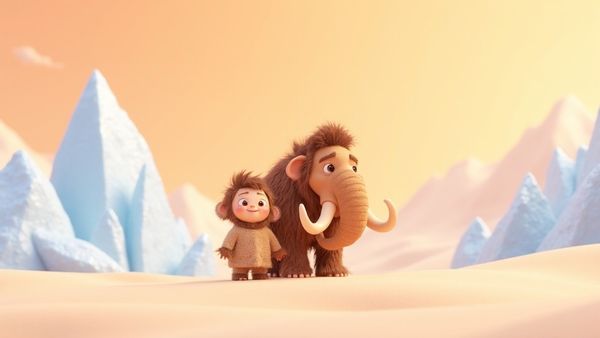
The most famous star is the woolly mammoth, a fuzzy cousin of today's elephants. They weren't just big; they were covered in thick, shaggy fur and had a layer of fat under their skin for extra insulation!
Another cool creature was the saber-toothed cat, which had enormous, dagger-like teeth perfect for hunting. Imagine seeing one of those roaming near your Ice Age neighborhood!
(Woolly Mammoth Height)
(Mammoth Tusks)
(Last Glacial Period)
(Pleistocene Epoch)
How Did People Survive the Deep Freeze?
Humans—our ancestors, Homo sapiens—were definitely around during the last Ice Age! They were smart survivors, using tools made of stone and bone to hunt and build shelters.
They didn't live in the middle of the thickest ice. Instead, they stayed in warmer pockets where trees and food were still available, often near the edges of the glaciers.
Land Bridges: Walkways Across the Ocean
When so much of the Earth’s water was trapped in those giant ice sheets, the sea levels dropped way down—about 125 meters (410 feet) lower than today!
This drop in water exposed massive underwater plains, creating land bridges connecting continents! The most famous was the Bering Land Bridge, which let early humans walk all the way from Asia into North America (Alaska).
💡 Did You Know?
We can learn about the Ice Age by drilling deep into ancient ice to pull out ice cores! These cores have tiny bubbles of air trapped inside, acting like a time machine that lets scientists breathe the ancient atmosphere!
🎯 Quick Quiz!
What animal is the most famous for living through the Ice Age, surviving thanks to its thick fur and small ears?
Why Did the Ice Age Finally Melt?
The end of the Ice Age wasn't a switch that flipped overnight; it took thousands of years for the planet to warm up after about 11,700 years ago!
Scientists believe the warming was caused by tiny, long-term changes in Earth's orbit around the sun, which changed how much solar energy hit different parts of the planet.
- The Great Lakes in North America were carved out by massive ice sheets scooping out the land!
- When the glaciers melted, they left behind huge piles of rocks and dirt called moraines, which are still evidence of where the ice once was.
- The melting ice caused sea levels to rise, covering up those land bridges and separating the continents again!
Fun fact for you: we are technically still in a larger 'Ice Age' (the Quaternary glaciation), but we are currently in a warm spell called an interglacial period, which is why most of the giant ice sheets have melted away!
Questions Kids Ask About Prehistory
Keep Exploring Beyond the Ice!
From giant hairy beasts to land bridges connecting continents, the Ice Age for kids is full of incredible history! It shows us how tough and clever life—including early humans—can be when facing a changing planet. Keep listening to History's Not Boring to find out what amazing stories the past holds next!